Showing posts with label fantasy poems. Show all posts

April 16, 2026

O is for Owl

        
(My A to Z Blog Challenge theme this year is Beyond Pomegranate & Thorns, my immanent collection of short stories, poems, and art inspired by fairy tales, myths, and folklore.  All through the month I’m sharing excerpts of art, stories, and poetry, as well as some reflections on the power of the traditional stories that inspired me.)
        Today’s poem is inspired by one of the slightly less famous fairy tales collected by the Brothers Grimm.  “Jorinde and Joringel” is another of those tales with a dreamlike, evocative setting and atmosphere which has always enchanted me.  If you don’t know this one (or need a reminder), you can read it here.  (I also mentioned the story here in my 2024 A to Z on the Botany of the Realms of Imagination.)  The owl is the story’s wicked witch and I think there’s something interesting about an owl-shifting witch transforming her female victims into birds.  Perhaps her avian misery loves company?  Or perhaps she actually thinks she’s helping them by making them into a superior form?  There are definitely some seeds for retellings and re-imaginings in this…  But for my poem I didn’t twist or change anything about the story itself.  Instead I sank deeper into it, imagining what it would really feel like to have experienced that transformation and imprisonment.  My poem begins

We have children grown now, with children of their own.

We have had joy together many years now, he and I.

I remember now that day’s late sunlight, slanting between leaves,

The strange beauty that pierced us, our joy in a minor key,

Until suddenly the castle walls loomed from the weird shadows

And the owl came circling three times with its nightfall wings.


As my soft voice became song, and my body wings,

My mind, too, shifted, slipped away, no longer my own.

My self was lost in the song, feathered in shadows,

And all I knew became the nightingale.  I

Beat against the cage, as she carried me from my key -

His heart - left locked behind us among the darkening leaves.


Then I remembered neither speech nor hands, neither sky nor leaves,

Only wings in a wicker cage, which are no wings.

And in my nightingale mind only one fragile key

With which to keep locked the center of my own 

Identity: the certainty that I could sing, that I

With song could claim space against shackles and shadows. 


        The poem is a sestina, a form that has seven stanzas, each with 6 lines (except the final stanza, with 3), ending with the same 6 words arranged in a different order each time.  I really enjoy this form, and its length gives it enough room to put roots down into a story.  If you want to read my whole poem, it was first published in Strange Horizons and you can find it here.  (Also mentioned in this prior post Okapis and Nightingales, but there isn’t really much additional info there.)
        
As for the owl, the moral she gives in this story is not to be out in the forest past sunset.  But also, owls are an interesting case study in folklore and mythology because almost everyone seems to think there’s something very significant about them, but that significance can span the full range of good and evil.  Perhaps there’s a moral somewhere in there about not projecting your own preoccupations onto the neutral natural world!
        On the other hand, we’re here for the folklore, so feel free to let me know: uncanny or cuddly, sinister or wise?  How do you feel about owls?


[Picture: Illustration for Jorinde Remembers, collage of elements from two rubber block prints by AEGNydam, 2026 (Image from Beyond Pomegranate & Thorns).]


June 9, 2025

They

        Despite a couple of recent posts about my own poetry activities, it’s actually been quite a while since I shared a fantasy poem.  So here’s one called simply Fantasy, by Ruth Mather Skidmore from 1933.


I think if I should wait some night in an enchanted forest
With tall dim hemlocks and moss-covered branches,
And quiet, shadowy aisles between the tall blue-lichened trees;
With low shrubs forming grotesque outlines in the moonlight,
And the ground covered with a thick carpet of pine needles
So that my footsteps made no sound, —
They would not be afraid to glide silently from their hiding places
To the white patch of moonlight on the pine needles,
And dance to the moon and the stars and the wind.


Their arms would gleam white in the moonlight
And a thousand dewdrops sparkle in the dimness of their hair;
But I should not dare to look at their wildly beautiful faces.


        This poem is a bit unusual, for a couple of reasons.  For one thing, the odd number of lines in the final stanza leaves it feeling abrupt, almost unfinished.  To be clear, this doesn’t feel like a mistake, but like pulling the rug out from under the reader to leave us feeling unbalanced.  The structure is also sneaky: starting with that conditional “if” and then walking us into the woods with those long descriptive clauses building up and building up… Until suddenly we’re confronted with the mysterious gleaming figures, beautiful but terrifying.
        There’s also a bit of a mystery about the author, who apparently never published another poem except this one, which came out in an anthology called Off to Arcady when she was a student at Vassar College.  It’s certainly easy enough to believe that a woman might be an extremely accomplished poet without ever having more than one poem published - especially after she got married and had a family to care for.  Still, you’d think that this early taste of success would have encouraged her to continue.  Ruth Mather Skidmore’s complete disappearance as a poet is almost as strange and unsettling as those dancers in the white patch of moonlight on the pine needles.


[Picture: The Fairy Dance (slightly cropped), painting by Karl Wilhelm Diefenbach, 1895 (Image from Wikimedia Commons);

Thanks to Theodora Goss for posting the poem at Poems of the Fantastic and Macabre.] 

September 6, 2024

Sexton's Kind

         Most of the older fantasy poems I share are primarily about telling a story.  The more modern poems on themes of mythology, fantasy, and fairy tale tend to be about using fantasy images and references to explore the self, society, and so on.  Today I want to share a famous poem by Anne Sexton (U.S.A., 1928-1974), who was known for her confessional poetry, which she used in part to explore her own mental illness and troubled personal relationships.  No one would call her a fantasy poet, but in this poem she calls on the mythology of witches.  Because the poem is relatively recent (1960) and not in the public domain, I’m excerpting only the first verse, but I strongly encourage you to read the entire poem (3 verses) at Poetry Foundation.

Her Kind


I have gone out, a possessed witch,   

haunting the black air, braver at night;   

dreaming evil, I have done my hitch   

over the plain houses, light by light:   

lonely thing, twelve-fingered, out of mind.   

A woman like that is not a woman, quite.   

I have been her kind.


        The imagery throughout the poem is powerful, precise, and both shocking and moving.  This makes an excellent illustration of how fantasy can be used for far more than simply telling a story with magic in it.  It can evoke both the darkest and brightest corners of our hearts, it can help us wrestle with the limits of logic and science, and it can open us to new ways of considering issues we had thought we knew.  You can read articles analyzing this poem, but I think it’s most powerful if you just let those fantasy images and emotions move you; if you spend too much time trying to assign specific meanings to specific words and phrases you may be missing the point, and you’re almost certainly missing the magic.


[Picture: Wood engraving from Compendium Maleficarum by Francesco Maria Guazza, 1608 (Image from Wikimedia Commons);

Excerpt from Her Kind by Anne Sexton, from To Bedlam and Part Way Back, 1960 (from Poetry Foundation).]

May 19, 2023

Where My Books Go

         Today’s poem is not exactly fantasy in its own right, but it certainly evokes magic.  It was used as a preface by William Butler Yeats to Irish Fairy Tales, published in 1892.

Where My Books Go

All the words that I gather,
   And all the words that I write,
Must spread out their wings untiring,
   And never rest in their flight,
Till they come where your sad, sad heart is,
  And sing to you in the night,
Beyond where the waters are moving,
   Storm-darken’d or starry bright.


        The first line is often quoted as “All the words that I utter,” and I do actually like that version better.  But I am unable to track down where that version comes from and whether it’s actually Yeats’s edit, or a misquotation.  (If anyone can actually tell me where the “utter” version originated, I’d be happy to hear it.)
        This poem, as I said, is magical, and it describes the magic of books: to cross oceans, to pierce darkness, to fly from heart to heart, and to bring comfort.  At any rate, that’s certainly my wish for my own books!  Unlike most of Yeats’s poetry, this one is very simple: no allusions to mythological figures, no allegories for the politics of the day, no deeply layered meanings…  Just a vision of the power of story.  Though simple, however, it is not simplistic, because the beauty of the images gives this short poem intensity.
        William Butler Yeats (Ireland, 1865-1939) is hardly an obscure poet, and given his love of mythology and Irish folktales, it’s no wonder that he’s appeared in this blog before.  You can revisit The Stolen Child and The Song of Wandering Angus.  But really, if any poem or book has ever come where your heart is, you can attest to the truth of this poem.  Whether your heart was sad before the words flew to it, or simply became more full of joy after, you know where books can go.  And any time I hear from a reader that any of my words (or pictures) have done that for them, it reminds me exactly why I keep doing this.


[Picture: Greenwood Cove, Mendocino Coast, five-color multi-block wood block print by Tom Killion, 2004 (Image from tomkillion.com).]

October 10, 2022

A Poem for Hallowe'en

         James Whitcomb Riley (USA, 1849-1916) was famous for his poetry written in Indiana dialect, much of it for children, often humorous or sentimental, and supposed to represent ordinary folks.  He was especially famous in his lifetime for his live performances of his poems.  This poem is based on a 12 year old orphan girl named Allie, who worked for Riley’s family when he was a young teen.  He had written the poem in 1885 as “Little Orphant Allie,” but it was printed as “Annie” because of a typesetter’s mistake.

Little Orphant Annie’s come to our house to stay,
An’ wash the cups an’ saucers up, an’ brush the crumbs away,
An’ shoo the chickens off the porch, an’ dust the hearth, an’ sweep,
An’ make the fire, an’ bake the bread, an’ earn her board-an’-keep;
An’ all us other children, when the supper-things is done,
We set around the kitchen fire an’ has the mostest fun
A-list’nin’ to the witch-tales ‘at Annie tells about,
An’ the Gobble-uns ‘at gits you
Ef you
Don’t
Watch
Out!


Wunst they wuz a little boy wouldn’t say his prayers, —
An’ when he went to bed at night, away up-stairs,
His Mammy heerd him holler, an’ his Daddy heerd him bawl,
An’ when they turn’t the kivvers down, he wuzn’t there at all!
An’ they seeked him in the rafter-room, an’ cubby-hole, an’ press,
An’ seeked him up the chimbly-flue, an’ ever’-wheres, I guess;
But all they ever found wuz thist his pants an’ roundabout: —
An’ the Gobble-uns ‘ll git you
Ef you
Don’t
Watch
Out!


An’ one time a little girl ‘ud allus laugh an’ grin,
An’ make fun of ever’ one, an’ all her blood-an’-kin;
An’ wunst, when they was “company,” an’ ole folks wuz there,
She mocked ’em an’ shocked ’em, an’ said she didn’t care!
An’ thist as she kicked her heels, an’ turn’t to run an’ hide,
They wuz two great big Black Things a-standin’ by her side,
An’ they snatched her through the ceilin’ ‘fore she knowed what she’s about!
An’ the Gobble-uns ‘ll git you
Ef you
Don’t
Watch
Out!


An’ little Orphant Annie says, when the blaze is blue,
An’ the lamp-wick sputters, an’ the wind goes woo-oo!
An’ you hear the crickets quit, an’ the moon is gray,
An’ the lightnin’-bugs in dew is all squenched away, —
You better mind yer parunts, an’ yer teachurs fond an’ dear,

An’ churish them ‘at loves you, an’ dry the orphant’s tear,
An’ he’p the pore an’ needy ones ‘at clusters all about,
Er the Gobble-uns ‘ll git you
Ef you
Don’t
Watch
Out!


        There are two points I want to mention regarding this poem and where it stands in the world of speculative fiction.  First is the idea of telling scary stories - and having “the mostest fun” listening to them.  From time immemorial people have gathered around campfires and in darkened rooms to amuse each other with the telling of horror tales.  Intellectually I understand the idea of flirting with fear in a safe setting, but at a gut level I’ve never understood this at all; I just don’t find fear in any way enjoyable.  I seem to be one of that small minority who simply doesn’t like being scared - but the rest of you can carry on and live it up this Hallowe’en!
        The second spec fic staple this poem uses is the nursery bogey.  Nursery bogeys are creatures used to scare children into good behavior and to warn members of a community of the dangers of breaking community mores.  I’ve mentioned a number of nursery bogeys in past posts, including the Ninki Nanka and kelpie who will get you if you stray too close to dangerous waterways, and Krampus, who will punish you if you misbehave before Christmas.  Little Orphant Annie tells of monsters that punish children who mock their elders or don’t say their prayers.  Once again, this is not my favorite aspect of fantasy, but once again, humans seem to have been employing it since the dawn of language.
        At any rate, Riley has had fun invoking the “enjoyable” kind of horror in this poem.  You can actually hear him performing it here!  Although since he was recorded on a phonograph record in 1912, it’s not very clear.  (Further trivia that illustrates the popularity of the poem: the red-headed comic strip-cum-Broadway character (debuted in 1924) was named after Riley’s poem, although she doesn’t seem to have much in common beside the name.  Neither does the also-red-headed Raggedy Ann doll, who in 1915 was named after a combination of two poems by Riley: “Little Orphant Annie” and “The Raggedy Man.”)


[Pictures: Little Orphan Annie, illustration by Ethel Franklin Betts, 1892 (Image from Project Gutenberg);

Film still from “Little Orphant Annie” directed by Colin Campbell, 1918 (Image from Wikimedia Commons).]

February 9, 2022

The Brass Horse

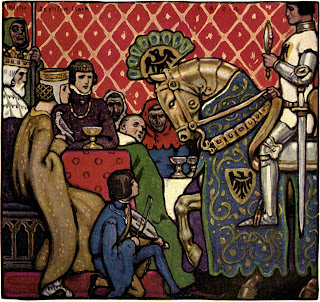
         Today’s poem is an unusual one, as it is just a very small excerpt from The Canterbury Tales by Geoffrey Chaucer (England, c1340-1400).  The Canterbury Tales are a diverse collection of stories, reported as being told by a diverse collection of people.  They range from lewd tales of sex and farting, to sermons on penance, to animal fables, to tales of courtly love.  There are also several stories that we would class as fairy tales, which include elements that are present in many other traditional fairy tales, both from Europe and the 1001 Nights.  The Squire’s Tale is one of these.  Chaucer clearly satirizes the Squire in the portrayal of his verbose, tangential style, which in the end is interrupted by the next character basically saying, “Great, we get the idea,” and proceeding with his own story.  Nevertheless, the Squire gets to tell us about some excellent fantastical elements.  Genghis Khan is holding a party, when in comes a knight bearing gifts from the King of Arabia and India.  These gifts are a brass horse that can carry the rider anywhere in 24 hours or less, a mirror which shows what all the king’s friends and enemies are up to, a ring which allows the wearer to understand the language of birds and the medicinal uses of plants, and a sword that cuts through any armor and can also heal from the wounds it causes.
        Because the tale is unfinished, we never actually find out what happens with any of the gifts (except the ring), but we do get a long exposition about the magical objects and what all the courtiers thought of them.  Today’s excerpt comes from that section.  I offer below two “translations.”  One is sort of halfway between the original Middle English and a modern translation.  It changes as little as possible, but does modernize some of the grammar, spelling, and vocabulary.  The second version is more modern, so pick that if you’re more interested in the sense than the linguistics!  (If you want to read the original, it’s here.  My excerpt begins at line 199.  Or try a twenty-first century colloquial version here.)


But evermore their moste wonder was
How that it coulde go, and was of brass;
It was of Faerie, as the people seem'd.
Diverse folk diversely they deem'd;
As many heads, as many wittes been.
They murmured, as doth a swarm of been,
And made skills after their fantasies,
Rehearsing of the olde poetries,
And said that it was like the Pegasee,
The horse that hadde winges for to flee;
Or else it was the Greeke's horse Sinon,
That broughte Troye to destruction,
As men may in the olde gestes read.
Mine heart," quoth one, "is evermore in dread;
I trow some men of armes be therein,
That shape them this city for to win:
It were right good that all such thing were know."
Another rowned to his fellow low,
And said, "He lies; for it is rather like
An apparence made by some magic,
As jugglers playen at these feastes great."
Of sundry doubts they jangle thus and treat.
As lewed people deeme commonly
Of thinges that be made more subtilly
Than they can in their lewdness comprehend;
They deeme gladly to the badder end. 


But evermore their greatest wonder was,
How it could go, being made all of brass;
It was of Faery, as to people seemed.
And divers folk diversely of it deemed;

So many heads, so many wits, one sees.

They buzzed and murmured like a swarm of bees,

And played about it with their fantasy,

Recalling what they'd learned from poetry;

Like Pegasus it was that mounted high,

That horse which had great wings and so could fly;

Or else it was the horse of Greek Sinon

Who brought Troy to destruction, years agone.

As men in these old histories may read.

"My heart," said one, "is evermore in dread;

I think some men-at-arms are hid therein

Who have in mind this capital to win.

It were right well that of such things we know."

Another whispered to his fellow, low,

And said: "He lies, for it is rather like

Some conjured up appearance of magic,

Which jugglers practise at these banquets great."

Of sundry doubts like these they all did treat,

As vulgar people chatter commonly

Of all things that are made more cunningly

Than they can in their ignorance comprehend;

They gladly judge they're made for some base end.


        The reason I picked this section is that I love seeing what the contemporary audience might have made of the possibility of magic.  They knew it had to have some sort of trick about it for a brass horse to be able to move, but what form of magic was it?  Did it come from fairyland, was it more like the living Pegasus, or more like the Trojan Horse that was all treachery instead of true magic?  Or was it simply a stage illusion?  There is also in other parts of the tale much discussion of alchemy.  This is a fun reminder that just because people in the fourteenth century believed in the possibility of magic doesn’t mean they uncritically believed in all claims of magic.  If this story were set in the present, the people might be speculating that it was made with alien technology, or came from high-tech labs in China and was stuffed full of surveillance programs.  Plus, I’m amused by the Squire’s (or possibly Chaucer’s) satirical comment that people always try to come up with elaborate explanations for the things they’re too stupid to understand.
        (One fun linguistic note about the Fairyland explanation: the original Middle English doesn’t say that the horse comes from Fairyland but that it “was a fairye.”  I think this usage reflects the very earliest meaning of the word “fairy” in English, which was neither the place nor its denizens, but rather “enchantment.”  You can see more history of the word here.)
        What do you think is the best explanation of

This steed of brass, that easily and well
Can in the space of one day naturel
(This is to say, in four-and-twenty hours),
Whereso you list, in drought or else in show'rs,
Beare your body into every place
To which your hearte willeth for to pace,
Withoute harm to you, through foul or fair.
Or if you list to fly as high in air
As doth an eagle, when him list to soar,
This same steed shall bear you evermore
Withoute harm, till ye be where you lest
(Though that ye sleepen on his back, or rest).


[Pictures: There came a knight upon a steed of brass, illustration by Walter Appleton Clark, 1914 (Image from Wikimedia Commons);

The Ebony Horse, linocut and woodcut by Bill Reily, 1960 (Image from theMcNay);

Ebony Horse, frontispiece by John Dickson Batten from More Fairy Tales from the Arabian Nights, 1895 (Image from Wikimedia Commons);

Mounting the Ebony Horse, illustration by Marc Chagall from Four Tales from the Arabian Nights, 1948 (Image from Indianapolis Museum of Art).]

And the rest of the versions I've excerpted above, here and here.

October 8, 2021

Monsters and Aliens - Poetry

         I decided to have a look at modern sci fi and fantasy poetry for children, and although my definition of “modern” is pretty broad (say, the past 60 years or so), it became evident that the subject matter has a narrower focus than I originally planned.  So much of fantasy poetry written for children is about creatures that for this post I focussed in on that.  And even within the poetry about creatures, I discovered that it’s almost entirely about monsters.  From Roald Dahl to Shel Silverstein to Jack Prelutsky, poets seem to be convinced that the way to a child’s heart is jocular horror.  Prelutsky wrote an entire book of poems about imaginary aliens from imaginary planets, and almost every single one of the poems tells how these aliens will slaughter you, or how you will die on that planet.  So much for the wonders of space exploration!
        But while there is no doubt that many children do enjoy such poems, I tend to prefer a wider range of marvels, inspiring delight as well as fear.  So I have a few poems for you today that introduce a variety of creatures.  First is one of Prelutsky’s few aliens that is not directly murderous.  Still horror, perhaps, but not actually violent.  (You can click on the picture to make it large enough to read the poem.)  I do like that the vocabulary and syntax in this poem are quite sophisticated and don’t talk down to children, and that it revels in 
dramatic sound, with rhythm, rhyme and other poetic stylings reminiscent of Edgar Allan Poe.
        Next, another slightly dangerous monster, quickly dealt with in a very different style of poem, by Lilian Moore.  This one is more Ogden-Nash-esque, with its witty one-liner.
        I have to include one creature today that’s actually helpful and friendly, so here’s The Giraft by Jane Yolen.


If you’re out in the ocean, afloat on the deep,

With the sharks making straight for your craft,

Simply close your eyes tightly and whistle a shrill

S.O.S. for the nearest Giraft.


If you plan to be going away on a cruise

And you find your lifeboats understaffed,

Do not give it a thought, simply whistle a tune

That will call on the nearest Giraft.


For they sail very swiftly, can outpace a sub,

And their periscope necks fore and aft

Let them keep a sharp eye on the ocean so no

One can sneak up behind a Giraft.


I have rowed many miles and sailed quite a few,

And on none of those trips have I laughed,

For my travels all filled me with fear and with dread

Till I learned of the friendly Giraft.


        Since I like my creatures marvelous, I also have to include one by Dr. Seuss, although it’s perhaps a stretch to call his poems “modern.”  Nevertheless, he’s got plenty of fun beasties to choose from, and while some are ferocious, most are simply strange and silly rather than frightening.  This is an excerpt from If I Ran the Circus, which includes dozens of fantastical creatures.


And you’ll now meet the Foon!  The Remarkable Foon

Who eats sizzling hot pebbles that fall off the moon!

And the reason he likes them red hot, it appears,

Is he greatly enjoys blowing smoke from his ears.


        I shall conclude with a deadly monster from the swamps of Sleethe, to represent the common sort of screams-for-laughs poem.  After all, we are beginning to get into the season of Hallowe’en.  (For a couple more monsters, follow the links to Dahl and Silverstein above.)  It’s certainly a poem that takes exuberant delight in its own horror, and I like its eloquence.
        That’s plenty of creatures and plenty of poems for one post.  Which is your favorite?


[Pictures and Poems: The Beholder in the Silence, poem by Jack Prelutsky, illustration by Jimmy Pickering from The Swamps of Sleethe: Poems from beyond the solar system, 2009;

Johnny Drew a Monster, poem by Lilian Moore 1972, illustration by Kevin Hawkes 1998, from Imagine That! Poems of Never-Was, selected by Prelutsky;

The Giraft, poem by Jane Yolen, 1994;

The Foon, poem and illustration by Dr. Seuss from If I Ran the Circus, 1956;

The Swamps of Sleethe: Poems from beyond the solar system, by Prelutsky, illustration by Pickering, 2009.]

August 11, 2020

Clanging Upon the Heart

        Here’s an interesting fantasy poem by James Joyce (Ireland, 1882-1941), although probably it would be more accurate to call it a vision or a nightmare than “fantasy.”

I hear an army charging upon the land,
And the thunder of horses plunging, foam about their knees:
Arrogant, in black armour, behind them stand,
Disdaining the reins, with fluttering whips, the charioteers.

They cry unto the night their battle-name:
I moan in sleep when I hear afar their whirling laughter.
They cleave the gloom of dreams, a blinding flame,
Clanging, clanging upon the heart as upon an anvil.

They come shaking in triumph their long, green hair:
They come out of the sea and run shouting by the shore.
My heart, have you no wisdom thus to despair?
My love, my love, my love, why have you left me alone?

        This poem is actually a sort of response to or rewriting of William Butler Yeat’s 1899 poem “He Bids His Beloved Be at Peace.”  In his poem Yeats describes “the Horses of Disaster,” but ends with the idea that lovers can hide "their tossing manes and their tumultuous feet” of those horses while lying together.  The voice in Joyce’s poem, by contrast, has no beloved to lie with him “in deep twilight of rest.”
        Joyce’s poem, published in 1907, has some really wonderful, intense imagery, and magnificently dark phrases.  My favorites are “whirling laughter” and “clanging upon the heart.”  But what exactly is it about?  Again, without having any deep knowledge of Joyce, I’d guess that he meant it as an expression of dread and despair and longing.  These days I can certainly resonate with the oppressive feeling of the second verse.  As usual, though, if I look at it as fantasy, I imagine the host of demons or dark elves, or possibly unquiet ghosts of long-dead warriors.  It’s an intensely vivid evocation of images and emotion.

[Picture: Illustration of an Old Norse Ballad, wood block print by Olaf Willums, 1920s?]

June 10, 2020

La Belle Dame Sans Merci

        Written by John Keats in 1819, this is one of the most famous, most referenced fantasy poems to come out of the Romantic movement.  (There are two versions, by the way.  I give you  here the original.)  It is written in ballad form, and uses a question and response format to set the scene and then allow the knight to tell his tragic tale.

O what can ail thee, knight-at-arms, 
       Alone and palely loitering? 
The sedge has withered from the lake, 
       And no birds sing. 

O what can ail thee, knight-at-arms, 
       So haggard and so woe-begone? 
The squirrel’s granary is full, 
       And the harvest’s done. 

I see a lily on thy brow, 
       With anguish moist and fever-dew, 
And on thy cheeks a fading rose 
       Fast withereth too. 

I met a lady in the meads, 
       Full beautiful—a faery’s child, 
Her hair was long, her foot was light, 
       And her eyes were wild. 

I made a garland for her head, 
       And bracelets too, and fragrant zone; 
She looked at me as she did love, 
       And made sweet moan 

I set her on my pacing steed, 
       And nothing else saw all day long, 
For sidelong would she bend, and sing 
       A faery’s song. 

She found me roots of relish sweet, 
       And honey wild, and manna-dew, 
And sure in language strange she said— 
       ‘I love thee true’. 

She took me to her Elfin grot, 
       And there she wept and sighed full sore, 
And there I shut her wild wild eyes 
       With kisses four. 

And there she lullèd me asleep, 
       And there I dreamed—Ah! woe betide!— 
The latest dream I ever dreamt 
       On the cold hill side. 

I saw pale kings and princes too, 
       Pale warriors, death-pale were they all; 
They cried—‘La Belle Dame sans Merci 
       Thee hath in thrall!’ 

I saw their starved lips in the gloam, 
       With horrid warning gapèd wide, 
And I awoke and found me here, 
       On the cold hill’s side. 

And this is why I sojourn here, 
       Alone and palely loitering, 
Though the sedge is withered from the lake, 
       And no birds sing.

        The plot is pretty straightforward: the noble knight is destroyed by the femme fatale.  (A little more background depth is added by the biographical note that at the time of writing this poem, Keats was himself madly in love.  It was requited by the lady, but he was by then dying of tuberculosis.)  Keats took the phrase “la belle dame sans merci” from a fifteenth century French poem in the courtly love genre, and for those who don’t know the French, it means “the beautiful woman without mercy.”
        As I mentioned, this poem gets quoted and alluded to a lot, and needless to say, artists have loved portraying it.  Mostly it seems to be an excuse to show a beautiful woman, with relatively little emphasis on the subsequent misery of the knight.  Feel free to do a search for all the paintings on the theme, too.
        From a feminist point of view, there’s plenty we could say about the trope of the belle dame sans merci: the demonization of any woman deemed too promiscuous, and the simultaneous demonization of any woman who refuses the advances of the man telling the story.  But I’m here to look at things from the fantasy point of view, and I find this poem interesting as a portrayal of fairy.  This fairy is not cute and sparkly and good.  Keats is describing a being that is very non-human: beautiful, seductive, addictive, strange, other…  One could debate whether she is actively cruel or merely utterly amoral, but certainly she does not care what becomes of all the humans with whom she has dallied.  She belongs to the tradition in which fairies are creatures without souls.  This is the version of fairies that I am working with in my current work in progress, by the way, and this poem is one that I’m quoting in chapter headings.

[Pictures: Illustration by R. Gardner from Lamia, La Belle Dame Sans Merci, & c by John Keats, 1900(?) (Image from MrMorodo);
A Woman Embracing a Man (for La Belle Dame Sans Merci), wood engraving by Michael Renton, 1986 (Image from Roe + Moore);
Illustration by Lancelot Speed from The Blue Poetry Book, 1891 (Image from Project Gutenberg);
Illustration by Robert Anning Bell from Poems by John Keats, 1897 (Image from Internet Archive).]