December 5, 2014

Sales

        This weekend I will be participating in two shows/sales.
        Saturday, 10:00-5:00 - Holiday Open Studio in my own house, as one of the Needham Artists in independent locations.  Here’s a thought about open studio browsing:
        My house, being on a dead-end street in a corner of town, doesn’t get much foot traffic.  Many people who come find themselves the only visitor here at the time, which can feel awkward.  I understand; I’ve been there as the visitor in other studios, and when you’re the only one you might feel like you have to take lots of time, look at everything, maybe even buy something whether you wanted to or not, because it would feel so rude not to.  In fact, you may not even want to go to an artist’s house or studio at all lest you feel put on the spot.  But trust me, it’s okay not to buy anything.  It’s okay not to want to chit-chat.  It’s okay to look around briefly and leave.  Obviously artists love it when someone admires everything and buys lots of stuff, but we do understand that not everyone is going to.  We’d rather have you come and buy nothing than not come at all.  We’d rather have you come just to look without intending to spend any money than to have you not come at all because you’re afraid of feeling awkward.  After all, sales are just one part of art shows.  Meeting people, making connections, getting out the word, education, and having friendly conversations are all important, too.  Being an artist is often a solitary pursuit and we enjoy the opportunity to connect with people, sales or no sales.  So please don’t be shy!  Stop by and say hello to your local artists when you get the chance!
        For more details about the Holiday Sale, my address, and the locations of other participating artists, see this Needham Artists Holiday Sale web site.

        Sunday, 2:00-4:00 - Local Author Book Fair at Wellesley Free Library.
        I don’t have any thoughts to share about this event, because this will be the first time Wellesley Library has run it, and it’ll be the first time I’ve ever done anything like it.  I don’t know entirely what to expect, although I assume it will be similar to art shows in group spaces that I’ve done.  I’m excited about it, though, because at my art shows the books are a minor detour for most people.  I’ve never done a show where the people came because they were looking for books.  I’m hoping it will involve lots of interesting conversations about stories, reading, and what makes books great!  I’m also hoping that it will reach a new group of people who don’t yet know that my books exist, but who might be exactly the kind of people I’ve been writing for - in the words of A.A. Milne, “those, young or old, who like the things which I like.”
        For more details about the Local Author Book Fair, see this flier.

[Pictures: Market, woodcut from Orbis Sensualium Pictus by Jan Amos Comenius, 1658 edition?;
Library, woodcut from Neuer orbis pictus für die Jugend… by Jacob Eberhard Gailer, 1842 (Images from Wikimedia Commons.)]
(Full quotation from Milne here.)

December 2, 2014

Spitzer's Landscapes

        James Spitzer (US b. 1936) has a very distinctive style, all blobby shapes with lots of inked lines left in the carved out areas.  In fact, he never makes any spaces pure white; his carved areas always have fairly heavy texture from the blade.  His landscapes look like fantasies or doodles, but they’re actually based on real places.  I’m not familiar enough with any of these places to know what sort of resemblance Spitzer has captured, but I really get a kick out of them in any case.  His clouds look as solid as his hills, and his skies as thick as his rivers.  His buildings look as round as his trees, and his grass, air, and pavement all 
have the hairy texture of a friendly monster.  His bridges dance, his hills are scoops of ice cream, and his outlines have the happy confidence of a toddler.  These are exuberant block prints.
        I don’t have any first-hand information about his technique, but looking at these images it seems to me that Spitzer is very careful and deliberate with his thick black outlines, and then spontaneous and impromptu with his textures and carving out the inside areas.  Most of the time he seems to use only one blade for everything, although the very top edge and corners of the sky 
in “Hurley Bridge” and “Bridge at Damping Wind” appear to have been done with a wider blade.  Obviously this is no accident - Spitzer has deliberately chosen the blade and carving style that will leave all those little dashes of ink, and he carves in different patterns depending on the design he wants (mostly horizontals, or following the curve of the outlines).
        I would probably have guessed that these pieces were from the 60s, but they’re actually all from the early 90s.  I don’t have any examples of what sort of work Spitzer might have been doing back in the 60s except 2 muddy, angular acrylics posted at the same gallery.  But whatever influences contributed to Spitzer’s wood block aesthetic, this is clearly his own particular style, and I find it delightful.


[Pictures: Hurley Bridge, woodcut by James Spitzer, 1991;
Bridge at Damping Wind, woodcut by Spitzer, 1992;
Bodega Near the Bay, woodcut by Spitzer, 1990;
Rhone River, woodcut by Spitzer, 1990;
The Overpass at Ringaway Ave, woodcut by Spitzer, 1991
(All images from The Annex Galleries).]

November 28, 2014

Words of the Month - & Lady Mondegreen

        Everyone knows an example or two of misinterpreted lyrics or misheard phrases.  You may have heard of Gladly, the cross-eyed bear (“gladly the cross I’d bear”), and Olive, the other reindeer (“all of the other reindeer”) who have become famous.  You may even have wondered about the secret Asian man in the 1960's song “Secret Agent Man.”  I recall an incident years ago where someone thought I declared that I was working on a nudist play - which would indeed be quite a surprise to any who know me.  In fact, I’d said that I was working on “a new display” (of student artwork.)  In another case, teachers were discussing student schedules.  One said that “if he or she has an early lunch period…” and another teacher asked, “Who’s Hiroshi?”  So, who is Lady Mondegreen of my title?  She comes from writer Sylvia Wright’s interpretation of the ballad “The Bonnie Earl o' Moray.”  She heard lines as “They hae slain the Earl o’ Moray, and Lady Mondegreen” when it actually should have been “… and laid him on the green.”  Wright thus coined the term mondegreen (in 1954) to describe new words or phrases that spring from such misinterpretations.
        Most mondegreens, including all my examples above, are funny, mere novelties laughed over by we who know better.  It’s not uncommon, however, for a mondegreen interpretation to change the lyrics of a song over time.  One example is the calling birds of the fourth Day of Christmas.  They originally were colly (black) birds, but as the word colly became archaic and unfamiliar, singers reinterpreted the sound as another word that seemed to make more sense.
        Coolest of all, it’s actually possible for a mondegreen to form a new, respectable, generally accepted word.  In the early nineteenth century, schoolchildren included the & sign at the end when reciting the alphabet.  To make clear that the “and” they were saying was a word in itself, it was called “per se and.”  That made the alphabet end “X, Y, Z, and per se and.”  That final phrase was heard by the children as “ampersand,” which gradually came to be accepted as a real word.  It’s attested in proper English usage from 1837.
        So as we begin to rev up the holiday season, if you’re a carol singer, enjoy all those holiday songs, from Olive the other reindeer and the four calling birds, to “Get dressed, ye married gentlemen,” and “with the jelly toast proclaim, Christ is born in Bethlehem.”  And as you sing, remember to enjoy the company of good Lady Mondegreen.

[Pictures: Donibristle House, where the Earl of Morey was slain in 1592, woodcut by unknown artist  (Actually, this house looks Georgian, and Donibristle House was set afire at the time of the murder in 1592, so it almost certainly wouldn't have been this building, but it’s the best I could do.  Image from When Raine Starts);
Four blackbirds singing, linocut by Ann Lewis, used with the artist's permission (Image from the artist’s web site).]

November 25, 2014

Helpful Cat

        Having done prints of several dogs in the past year, and having sold out of most of my earlier cat pieces, I thought it was time for a new cat.  It took me a while to get around to it, though, because I didn’t want to do it if I couldn’t try something different from the huge amount of Cat Art I’ve done before.  I had a few ideas, but the cat wouldn’t cooperate.  I’ve rhapsodized before about how our cat Nightshade was such a muse, but recently Talia has been a veritable anti-muse.  Every time I saw her in the right pose I’d grab my camera for a reference photo, and every time she’d wait until I was just about to snap the picture and then move.  If I even so much as reached
for a pencil, she’d stretch and shift just before I could sketch anything.  She’s been unhelpful like this for months!  But finally I came up with something to work with, and I carved and printed this rather intense cat.
        To tell the truth, this isn’t quite what I was intending.  I was imagining a mellower look in its eyes, but when I inked the block and saw it glaring up at me so challengingly, I decided this was probably more representative anyway.
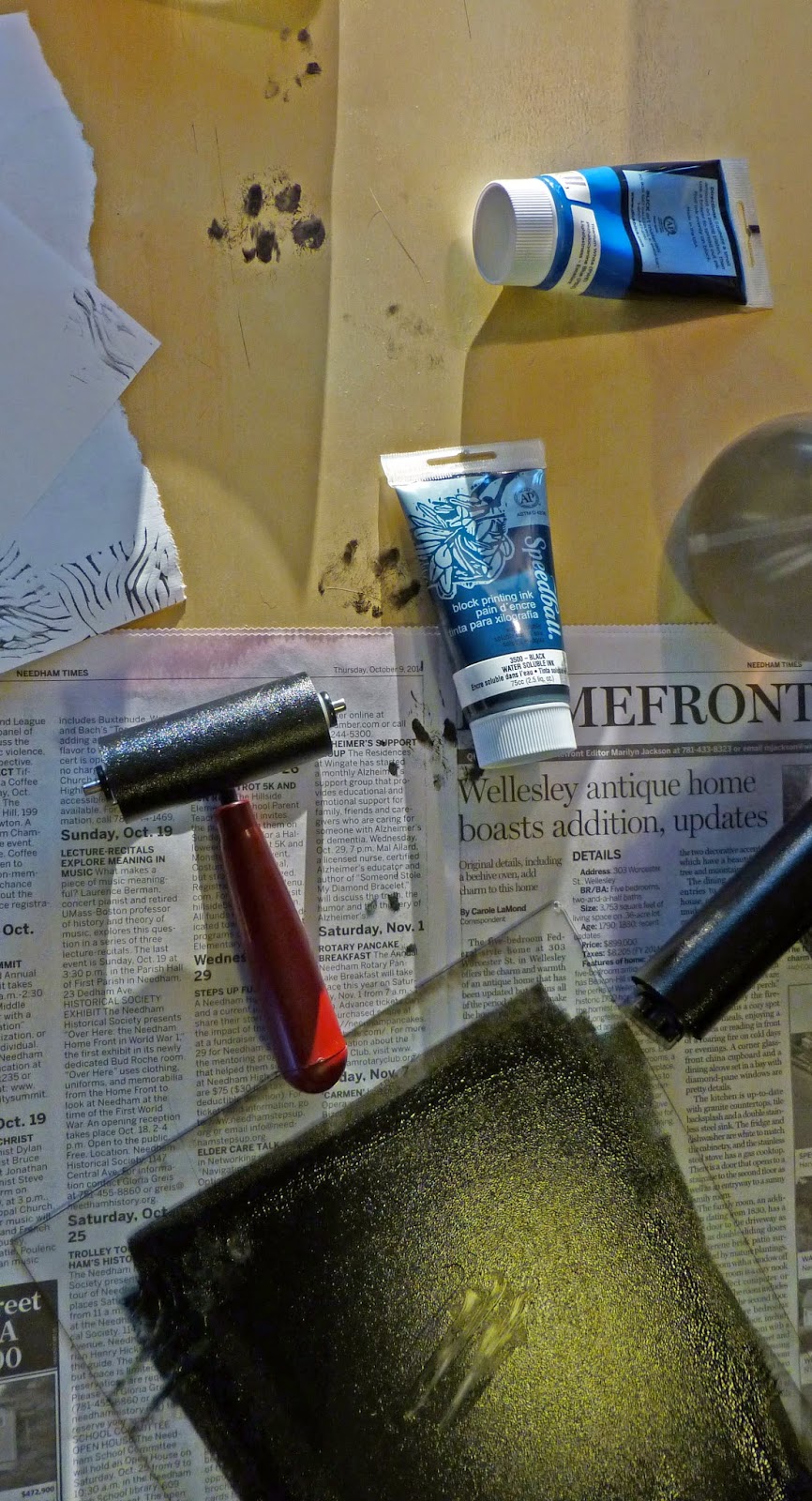
        But despite her apparent reluctance to be a model, Talia has managed to participate in the printmaking in a more hands-on way.  Yes, I really ought to say “paws-on.”  In the midst of a block she jumped onto my table, right into the middle of the ink plate.  Startled, she ran off over the table, along the windowsill, and across the floor, leaving her own trail of relief prints behind her.  I know I always say I encourage everyone to make block prints, but I draw the line at printing all over the floor!  I like having
the company, but I can do without the participation.

        Happy Thanksgiving to those in the US!  May your family and friends be loving and your feast lovely.


[Pictures: White Paw, rubber block print by AEGN, 2014;
Cat tracks, photos by AEGN, 2014.]

November 21, 2014

The Lamp-post in the Wood

        In the next week we have the anniversaries of C.S. Lewis’s birth and his death, so this seems a good time to mention Narnia.  The Narnia books are, of course, extravagantly praised and extravagantly condemned for their Christian theology, and I intend to write about religion in fantasy some other time.  But Lewis himself didn’t set out originally to write Christian apology for children, however much Narnia may have ended up there.  In fact, as he said himself, it “all began with a picture of a Faun carrying an umbrella and parcels in a snowy wood. This picture had been in my mind since I was about sixteen. Then one day, when I was about forty, I said to myself: 'Let's try to make a story about it.’”  It’s funny that this picture stayed with him so long, because it’s the same picture that has stayed with me the most clearly, with the addition of the lamp-post, glowing in the snowy dusk.  It’s not the escape through the woods, or the childrens’ heroism, or even the resurrection of Aslan that stays with me most vividly, but that picture of the lamp-post, Mr Tumnus, the parcels, the umbrella, and the snow.
        So the principle I’m interested in today is how a story doesn’t need to begin with a grand concept - even a story that ends up being about as grand a concept as Christian Salvation.  In fact, often the books with the aim of grand concept-ness only end up being preachy.  A good story begins with something that begs to have a story told about it.  I’ve written about how my story The Extraordinary Book of Doors was inspired quite simply by the images and ideas evoked by the title of Sebastiano Serlio’s Extraordinary Book of Doors.  Sometimes a story is inspired by an imagined character.  Sometimes it starts with an interesting setting, sometimes with a little-known factoid (I think a lot of whodunits begin with factoids.)  So the point is that anything can potentially inspire a story.  The trick is to notice these inspirational snippets - notice them, remember them, cherish them, revisit them, mull about them, and then sit down and actually begin to write.  That’s the stage I’m in now, with a sequel to The Extraordinary Book of Doors.  I’ve collected pages of notes on all manner of little inspirations: historical facts, new characters, lines of conversation, and other cool things.  But now I have to write, because no inspiration, however brilliant, is a story until I can get it out of my head and onto the page.

[Picture: Meeting Mr Tumnus, book sculpture by Justin Rowe, 2013 (Image from Days Fall Like Leaves).]
Quotation from It All Began with a Picture, C.S. Lewis, 1960.

November 18, 2014

Embroidery in Wood?

        Doing a little research for the barely-begun sequel to The Extraordinary Book of Doors, I came across some wood block print designs for embroidery.  This isn’t really a surprising thing, since as long as woodcuts were the technology available for illustrating books, they were made to illustrate and instruct on all manner of activities.  I find it interesting that at least some of these books of textile designs were marketed not to professionals but to gentlewomen at home.  I expect that in the Victorian era, but not in the 16th century.
        Technically, the carving took a lot of skill.  In this middle piece particularly it would have been difficult - and quite tedious - to carve out the interior of every little square in the grid, leaving behind only the thin lines in between.  This design is truly intended to lay out exactly how to make the design, so it requires that level of technical accuracy.  The third piece, by contrast, is carved more traditionally, and is more in the nature of inspiration or general ideas for embroidery than an actual design to follow.  I’m intrigued by the hoops around the dogs’ middles, as well as by the winged sprites or fairies growing out of the flowers.  They’re like mermaids, only botanical.  Somebody was clearly doodling!
        My favorite embroidery design, however, is the first one, also the earliest.  I like the black-on-texture carving style, and I like the variety of patterns, from naturalistic to stylized to geometric.  This would actually be easier to carve than the others, but I like the balance of 
black and white.  I’m guessing that with books of this sort none of the craftspeople involved were considered Artistes.  Nevertheless, they had mastered their skill and used it to create something both useful and pleasing.  I wonder how many women embroidered these very designs, and what color schemes they chose to bring these black and white guidelines to life.

[Pictures: Page 1 from Ein ney Furmbüchlein, woodcut designed by Johann Schönsperger the Elder, c. 1525-30 (Image from The Metropolitan Museum of Art);
Woodcut from Ornamento Delle Belle & virtuose Donne by Matteo Pagano, 1554 (Image from The Metropolitan Museum of Art);
Woodcut from La vera perfettione del disegno, by Giovanni Ostaus, 1567 (Image from mfa).]

November 14, 2014

Altum Incognitum

        You’ve heard of terra incognita on old maps, of course: unknown land, unexplored territory.  But unexplored land is scarce these days, and if you want to find the true unknown on earth you need to look to the depths of the ocean: altum incognitum.  Here’s my new leviathan block print, which does just that.
        For the first stages in the creation of this piece, and the description of the leviathan, you can refer back to my earlier post.  More than anything else, in this piece I was trying to experiment with depicting light.  Sunlight fades as the water gets deeper and deeper, so the first job was to try to make a gradation from top to bottom.  The leviathan itself had to be visible, but I tried to give it a sense of looming out of the darkness.  To this end I put white outlines only along the top edges, and left the bottom undefined.  I also tried to give an appearance of glowing to a few spots of bioluminescence, and finally I wanted to show the stirring up of the water as the monster writhes about, as the description of the leviathan demands.
        The leviathan isn’t the only inhabitant of the ocean, of course, so I added some other fun details.  From the top going down you can see great white sharks (although they’re black), blue whales (although they're white), a couple of disproportionately large sea turtles, and an oarfish, which is one of the creatures given as the scientific explanation for a number of sea serpent sightings.  Also a few schools of unidentified fish.  Continuing down still further, there are sperm whales and a giant squid, but also a plesiosaur of some sort and the kraken itself, huge, of course, but rather small compared with the leviathan.  And finally, down near the ocean floor, a somewhat ill-defined gulper eel and anglerfish, giant tube worms near the deep sea vents, and some truly enormous sea stars.  I had fun deciding what to put into the picture and how to compose it, and I challenged myself on the small details and precision of lines depicting the water and leviathan.  Alas, the biggest challenge of all on a block with this much black is to get the inking relatively dark and smooth.  I never did get it as perfect as I would have liked, but I’m still pretty happy with my image of the mystery of the unknown deep.

[Picture: Altum Incognitum, rubber block print by AEGN, 2014 (sold out).]

(And thanks to local Latin teacher L. Downey for obligingly checking my Latin phrase!  When it comes to Latin, I know only enough to know that I don’t know enough.)

November 11, 2014

The Poppies Blow

        First Armistice Day, celebrating the end of hostilities in the war that was to end all wars, then Remembrance Day, and now, in the US, Veterans Day, I’m sorry that we seem to have turned a celebration of peace into a celebration of militarism.  But whatever the day is called, we can all agree that those who were killed in war must be remembered.
        The red poppy has been a symbol of the dead since the Napoleonic Wars, because it grows in the disturbed earth of battlefields and field graves.  Popularized as a symbol by Canadian John McCrae’s poem In Flanders Fields at the beginning of World War I, and spread still further after the war by US-ian Moira Michael, the poppy is a beautiful reminder of the terrible costs and sacrifices of war.  Here’s a bouquet of poppies in relief block prints.
        Thinking of all this, it seems to me that there’s something poignant about relief block prints of these ephemeral blossoms with their tissue petals.  First there’s the contradiction of carving their image into the block, like carving up the earth, using physical effort, cutting and pressing, to replicate something effortless and fragile.  And then of course, all this work is to make permanent record of something that lasts only a few days - what is a block print of a flower, after all, but a remembrance of something precious and gone?  How fitting.  The difference, of course, between remembering the poppies and remembering the dead of war is that next year’s poppies will bring us all the joy and beauty of this
year’s.  Let us never forget that each individual human, unlike a poppy, is not only precious but unique and irreplaceable.


[Pictures: Poppy Field, linocut by Helen Maxfield (Image from helenmaxfield.com);
Papaver, woodcut by Leonhart Fuchs from De historia stirpium commentarii insignes, 1542 (Image from University of Minnesota Libraries);
Common Poppy, rubber block print by AEGN, 1997;
Summer Song:Poppy, reduction woodcut by Renee Covalucci (Image from Zullo Gallery).]

November 7, 2014

Ambum Stone

        Here’s a funny critter that looks quite fantastical.  This sculpture, called the Ambum Stone (or sometimes Ambun), comes from Papua New Guinea.  It’s tentatively dated to 1500BCE, although it wasn’t excavated properly.  No one knows its original use or what it meant to the people who made it, but modern New Guinea people often consider ancient stone sculptures to be of supernatural origin and use them in their own religious or ceremonial ways.  This one is about 20 inches tall and is one of the earliest and most detailed of prehistoric Pacific sculptures.
        What I’m most interested in, however, is this creature’s identity.  It looks as if it would be right at home amid mythical beasts.  Some scholars think it’s meant to depict the embryo of an echidna, which is certainly an obscure enough thing to make a sculpture of.  You can see that this newborn echidna (called a puggle, because obviously we need a word that’s both cute and silly to describe such a creature) 
shares our Ambum’s curved profile, nose, and tummy.  Cryptozoologist Karl Shuker, however, points out that the Ambum sculpture’s ears, big round eyes, and defined neck (and lack of spines) are inconsistent with an echidna and suggests it could be a palorchestes.  What’s a palorchestes, you ask?  Sheesh, don’t you know anything?  Well, it's a genus of terrestrial herbivorous marsupial with (paleontologists think) a long schnozz.  You can see from the picture that this animal, too, bears a certain resemblance to the Ambum critter.  Unfortunately, as far as any evidence goes, palorchestes lived only in Australia 
and went extinct some 11,000 years ago.  So, while it isn’t inconceivable that something in the genus lived in the wilds of Papua New Guinea until three or four thousand years ago, it’s a long shot.
        Personally, I rather like the idea of the Ambum Stone representing some creature that really does look just like it, round eyes, round tummy, proboscis and all.  I'm tempted to put such a creature in a story some time.  The way it’s sitting makes me think it must be the size and temperament of a panda, mild-mannered but elusive, and out there still, somewhere in the dense, unexplored rainforests of New Guinea.  You never know - surely it’s possible!

[Pictures: Ambum Stone, sculpture by anonymous artist, c 1500BCE (Image from National Gallery Australia);
Beau, short-beaked echidna puggle (Image from Taronga Zoo via ZooBorns);
Palorchestid, drawing by artist whose name I can’t make out (Image from Nova).]