April 22, 2022

T is for Transforming

         (My A to Z Challenge theme this year is How to Make a Fantastical Creature, in which I explore 26 traits that are widely shared among the monsters and marvels of fantasy and folklore.)
        When is that duck not a duck?  When it’s a were-duck, of course.  One feature that marks an animal (or person) out as clearly being magical is if it transforms.  (Fun linguistics fact: the were- part of werewolves and wereducks is from Old English for “man.”)  There are lots of different ways such transformations can work: voluntary or involuntary, superpower or curse, lots of forms or just a couple, in appearance only or in true essence…
        You can revisit a couple of previous posts about some of the most iconic types of transforming creatures: werewolves (and other were-beasts), and selkies, kitsune, swan maidens, and other creatures that use their skins to transform.
        Encantados are Amazon river dolphins that occasionally take human form, usually in order to go to parties and have sex with humans.  When in human form an encantado always wears a hat in order to conceal its blowhole.
        All sorts of animals that can transform into human form are very popular.  Nowadays it’s become popular to give dragons the ability to take human form, which certainly makes it more convenient for them to deal with the human world.  However, I personally am not a big fan of this particular trope.
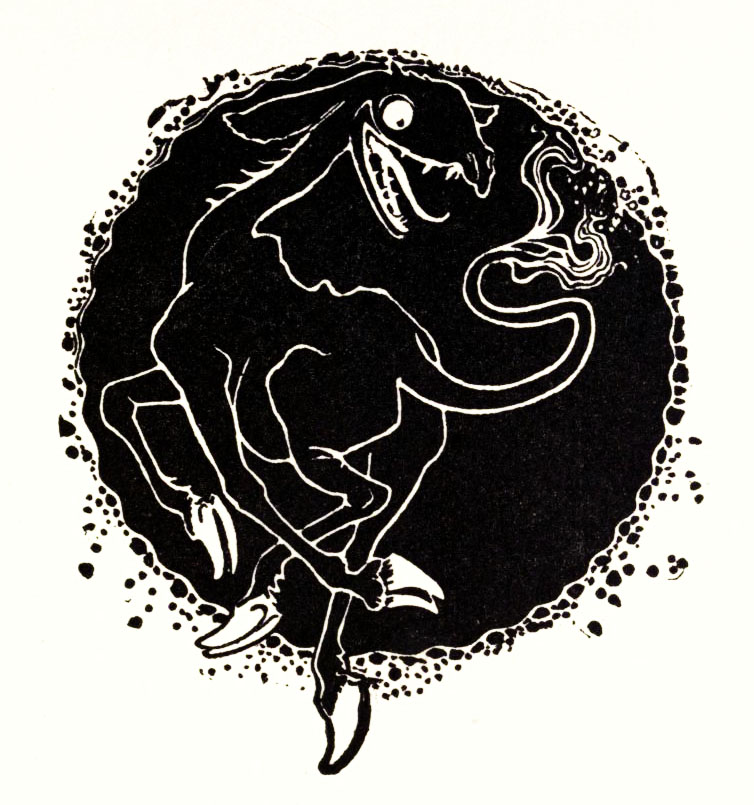
        There are also all manner of spirits that can shape-shift for purposes of pure mischief.  Usually these types of creatures can transform into a wide variety of shapes, from various animals, to humans from infants to hags, to inanimate objects such as baskets, lumps of gold, furniture, and more.  These 
pranksters include the Irish pooka, the Hedley Kow of England, the Mourioche of Brittany, and Osschaert who plagued the people of Flanders with cruel tricks.  Folklorists often describe what these creatures look like, but this seems to me a somewhat pointless endeavor, what with their ability to take whatever appearance they want.  But some certainly do have a preferred form.  The Lange Wapper of Belgium can be tiny as a mouse or taller than a building.  He can even duplicate himself into a whole crowd.  When possible, 
however, he prefers to take forms of things with long, gangly limbs.
  All these tricksters range from playing funny little pranks to getting people killed with their malicious tricks.
        In the folklore of the Toba people of Argentina, the Araganaqlta’a is a sort of lord of snakes and its primary form is a large multicolored serpent with saw-spines down its sides and two hooks on the end of its tail.  However, it can also take the form of a quadruped, a rhea, or even a nattily-attired human.  Whatever form it takes, however, it has a red crest atop its head.  These creatures enjoy human conversation (flashback to L) and are protectors of nature and associated with water (flashback to N).
        In Yupik folklore the Kăk-whăn’-û-ghăt Kǐg-û-lu’-nǐk is an orca that can transform into a wolf in order to hunt on land.  It is especially aggressive.
        A particularly interesting type of transformation is that exemplified by the Eintykára of Paraguay.  These are stingless bees that make much-prized honey.  They can also join together as a swarm to become a single man.  When in human form their hair is golden as honey, and they are exceptionally intelligent and hardworking, but when they want to eat, they transform back into an entire swarm of bees, go out and collect nectar, and then coalesce back into human form when they’ve finished.
        Lots of the creatures I’ve mentioned before can also change forms, including huldra, imp, jinni, kelpie, kobold, lebraude, leshy, and lidérc.
        Shape-shifting is also a popular superpower among more recent mutants (such as Mystique in the X-Men), space aliens (such as glamapods in “Valerian and the City of a Thousand Planets”), and even the Pokémon Ditto.
        The moral of these tales is that Things Are Not Always As They Seem.  A Pro Tip for anyone encountering a hostile shape-shifter is to try tricking them into a shape that can more easily be controlled.  For example, ogres that shape-shift into the form of mice can then be eaten by cats, while jinn that shrink down to fit back into their bottles can be sealed back up.  Usually a bet or a bit of trash-talk questioning the extent of their abilities is enough to get them to take the desired form.
        If you could transform at will into any other form, what would you pick?


[Pictures: Werewolf (Devil), wood block print by Niklaus Manuel I from Cosmographia by Sebastian Münster, 1552 (Image from The British Museum);
Selkie (The Selkie Pool), wood engraving by Kathleen Lindsley (Image from Society of Wood Engravers);
Kitsune, detail from color woodblock print by Ogato Gekko, c 1906 (Image from The British Museum);
Hedley Kow, illustration by John D. Batten from More English Fairy Tales ed. Joseph Jacobs, 1922 (Image from Internet Archive)
Glamapod, concept art by Marc Simonetti for “Valerian and the City of a Thousand Planets,” 2017 (Image from marcsimonetti.com.]

April 21, 2022

S is for Sentience

         (My A to Z Challenge theme this year is How to Make a Fantastical Creature, in which I explore 26 traits that are widely shared among the monsters and marvels of fantasy and folklore.)
        There is a fair bit of overlap between the idea of sentience and L-for-Language.  After all, if the fish you pull up in your net can ask for mercy, it’s safe to say it’s sentient.  All those magical creatures that can speak to you are sentient.  Still, I thought it was worth mentioning this as a specific trait, especially as it relates to objects that would normally be inanimate.
        The darling of science fiction is robots that are not mere machines, but are truly thinking, feeling, self-aware beings.  I’ve listed a number of examples in previous posts here and here, plus some famous robot poetry from Star Trek’s Data here.
        You should read another prior post to learn about Tsukumogami, which are Japanese household objects that come to life after a long enough period of time.  There are all sorts of objects that can gain sentience in this way, from the sad stirrup creature and the murderous futon monster, to the silly straw sandal beast.  You can also revisit the kase-obake, the sentient umbrella.  And today I will introduce a duet of the koto-furunushi, which is an animate zither whose strings turn into a sort of mane, and the biwa-bokuboku, which has the head of a lute, wears a beautiful kimono, and sings and dances, either sadly or raucously, depending on its mood.
        In Brittany can be found the agrippa, a grimoire (book of magic) that is sentient and acts on its own volition.  Its acts are malicious and vengeful, and as it dislikes to be read, any sorcerer wishing to use it must first beat it into resentful submission.  This isn’t easy, either, since an agrippa is as tall as a man.  It also isn’t easy to get rid of one, which you may eventually wish to do, as you will not be able to get into Heaven as long as you have one.  Whether you try to cut it up, burn it, or sink it in the sea, it will come back to you unharmed, determined to torment you.  (Which probably makes it suitable for R.)
        In southern Africa you have to watch out for the Devouring Gourd, which may grow where evil sorcerers were killed.  If you threaten to pick it, it may threaten you right back, and eventually it will become as big as a house, uproot itself, and go around eating everyone it can catch (flashback to A).
        L. Frank Baum’s country of Oz is a great place to find unexpectedly sentient creatures, from the famous Scarecrow and Tin Woodman, to Billina the yellow hen, the Patchwork Girl, Jack Pumpkinhead, the Sawhorse, the Gump, and many more.  In most cases these people become sentient through magic, such as Powder of Life, but a few just seem to come by it naturally in such a magical kingdom.
        A more recent discovery is that the stone-carved gargoyles of Gothic architecture are actually sentient, and can come to life at night or under certain circumstances, and move around.  According to Terry Pratchett, they move very slowly and eat pigeons, but other variants appear in other stories.
        Philosophers and computer scientists alike love to debate the nature of consciousness, and how we can ever be sure whether another being is actually sentient or not.  (For those of you reading this, I think therefore I am.  But then, you have only my word for it, and that’s exactly what a computer would say, isn’t it?)  But in fantasy we don’t have to make such a big puzzle out of it.  The moral of these stories is that if it walks like a duck and talks like a duck, it’s probably a sentient duck.  A Pro Tip for magicians and computer mad-scientists alike is to teach your creatures to appreciate the arts.  After all, what does it even mean to be sentient if you can’t take pleasure in the expression of beauty and emotion?
        If you had a dose of Powder of Life, what would you use it on?


[Pictures: C-3P0 (The Droid), oil painting by Tara Leigh based on 1977 movie “Star Wars,” (Image from Etsy shop TaraLeighArtCo);
Tsukumogami, wood block prints by Toriyama Sekien from Gazu Hyakki, 1784 (Images from Wikimedia Commons);
Jack Pumpkinhead and the Sawhorse, illustration by John R. Neill from The Marvelous Land of Oz by L. Frank Baum, 1904 (Image from Project Gutenberg);
Gargoyles (Gargoyles of Saint-Séverin), rubber block print by AEGN, 2020.]

April 19, 2022

R is for Regeneration

         (My A to Z theme this year is How to Make a Fantastical Creature, in which I explore 26 traits that are widely shared among the monsters and marvels of fantasy and folklore.  You can find the Master List of participating bloggers here.)
        Mythical magical creatures often have the ability to regenerate in ways that have not yet been seen in the mundane world.  This is, of course, a trait that fills us with wonder, and it is also a trait that makes our monsters even more of a challenge to dispatch.  That’s certainly what Hercules found when he had to fight the Lernean hydra.  This serpentine beast had multiple heads (sources vary, but we’ll say seven), and each time one head was cut off, more heads grew in its place (sources vary, but we’ll say two new heads per decapitation).  If you do the math you will see that this is a truly remarkable act of regeneration, and the hydra has therefore given its name to any difficulty with a tendency to multiply and get out of hand.
        In Scotland if you decapitate a snake you must be sure to separate the head sufficiently, lest it rejoin with its body and the whole thing regenerate into a beithir.  This is the largest, most extremely deadly of serpents and thus, as with the hydra, you will be even worse off than before.
        This reminds me of our modern monster, the T-1000 Terminator cyborg from the 1991 movie.  When destroyed, all its separate molten blobs are able to ooze together and regenerate themselves back into the original form.
        In China the fengsheng shou is a little like a smallish blue leopard with a hide that cannot be pierced.  It can only be killed by smashing it in the head, but if any wind enters its mouth, it will be revived again.  (If you eat its brain together with chrysanthemum, you will gain 500 years of life, making the fengsheng shou suitable for J.  It does occur to me, however, that if you’re trying to kill it in order to get its brain for eating, and the only way to kill it is to clonk it repeatedly on the head, you may be in a little bit of a catch-22, even without the risk of inconvenient revivifying breezes.)
        Zlatorog, whom we met at J, also has a method of regeneration.  When injured, its drops of blood grow into Triglav flowers, and if Zlatorog eats these flowers, it is refilled with complete vitality.
        In the Chilean Andes you may find the sapo fuerzo, which looks like a toad with a turtle shell.  It also glows in the dark (flashback to G).  Not only can it regenerate from practically any injury, but it can also attract or repel anything with the power of its magnetic gaze.  The only way to kill it is to burn it completely to ash.  But I honestly don’t understand why you’re so intent on killing it anyway.  What has it ever done to you?
        Then of course there’s the phoenix, introduced at O.  Details of its regeneration method vary widely, but the basic gist is that when it deems itself to have reached its allotted span of life, it builds itself a funeral pyre and burns itself up.  From its ashes a new phoenix will emerge.  Nowadays we generally understand it to be the same phoenix rising from its own ashes, although in some of the older accounts it was a new phoenix being born from the corpse of its parent, and thus not really regeneration.
        A philosophical question is whether or not “rising” as an undead creature counts as a form of regeneration.  What’s your opinion?  But we’ll be seeing more undead creatures later - Foreshadowing!
        The moral of these creatures is never to celebrate victory too soon.  And the Pro Tip for monster slayers is to be sure to destroy the head (or heads).  Generally speaking, if you haven’t destroyed the head, you shouldn’t make any assumptions.  Hercules brought along a friend to cauterize the cuts to keep the hydra from regrowing its heads, and burning things to ash can also be efficacious.  Unless, of course, you’re trying to kill a phoenix.
        Another philosophical question: Eternal Life, good or bad?  Discuss.


[Pictures: Hydra, detail of Greek vase painting, 530-500 BCE (Image from Getty Museum);
Hydra (Hercules fighting the Lernean hydra), engraving by Simon Frisius after Antonio Tempesta, 1610-1664 (Image from Rijksmuseum);
Fengsheng Shou, illustration by Bin Ze, c 2018 (Image from zcool);
Triglav flower (Potentilla nitida), colored engraving from Deutschlands flora by Sturm, 1806 (Image from Plant Illustrations);
Phoenix process, illumination from the “Peterborough” bestiary, 1300-1310 (Image from Stanford Libraries).]

April 18, 2022

Q is for Questions

         (My A to Z Challenge theme this year is How to Make a Fantastical Creature, in which I explore 26 traits that are widely shared among the monsters and marvels of fantasy and folklore.)
        I’ve mentioned Knowledge and I’ve mentioned Language, and another trait that ties in with these is the propensity of mythical beings to ask Questions… especially riddles.  The most famous  of these is the Greek Sphinx, who had the body of a lion, the wings of an eagle, and the head of a woman (flashback to C).  She hung out outside the city of Thebes and famously challenged travellers with her riddle.  All those who failed to guess the answer were savagely devoured (flashback to A).  When Oedipus guessed her riddle (or, in some versions, her three riddles), the Sphinx killed herself, and as she was unique (flashback to O), that was the end of that.
        In The Hobbit by J.R.R. Tolkien, the creature Gollum uses riddles in much the same way.  He threatens to eat Bilbo if the hobbit fails to guess his riddles.  At least Bilbo had the chance to make Gollum guess, too.  Bilbo’s final question (“What have I got in my pockets?”) is kind of a cheating riddle, but is necessary to save his life, and this is actually a common motif in folktales.  Such cheating “riddles” that are posed to save the competitor’s neck and which require knowledge the opponent could not possibly have, are sometimes called “neck riddles.”
        The Blue Men of the Minch are a sort of mermen particular to the strait between Scotland and the Outer Hebrides.  They have the power to cause storms (flashback to N) and enjoy capsizing ships, but sometimes they’ll challenge the sailors with lines of poetry.  If the captain can complete the verses, the ship will be allowed to pass; if the ship’s master isn’t much of a poet, they’re all doomed.  One account from 1917 gives the following exchange:
   
Blue Chief: Man of the black cap what do you say

          As your proud ship cleaves the brine?
   Skipper: My speedy ship takes the shortest way
          And I'll follow you line by line.
   Blue Chief: My men are eager, my men are ready
          To drag you below the waves!
   Skipper: My ship is speedy, my ship is steady;
          If it sank, it would wreck your caves.

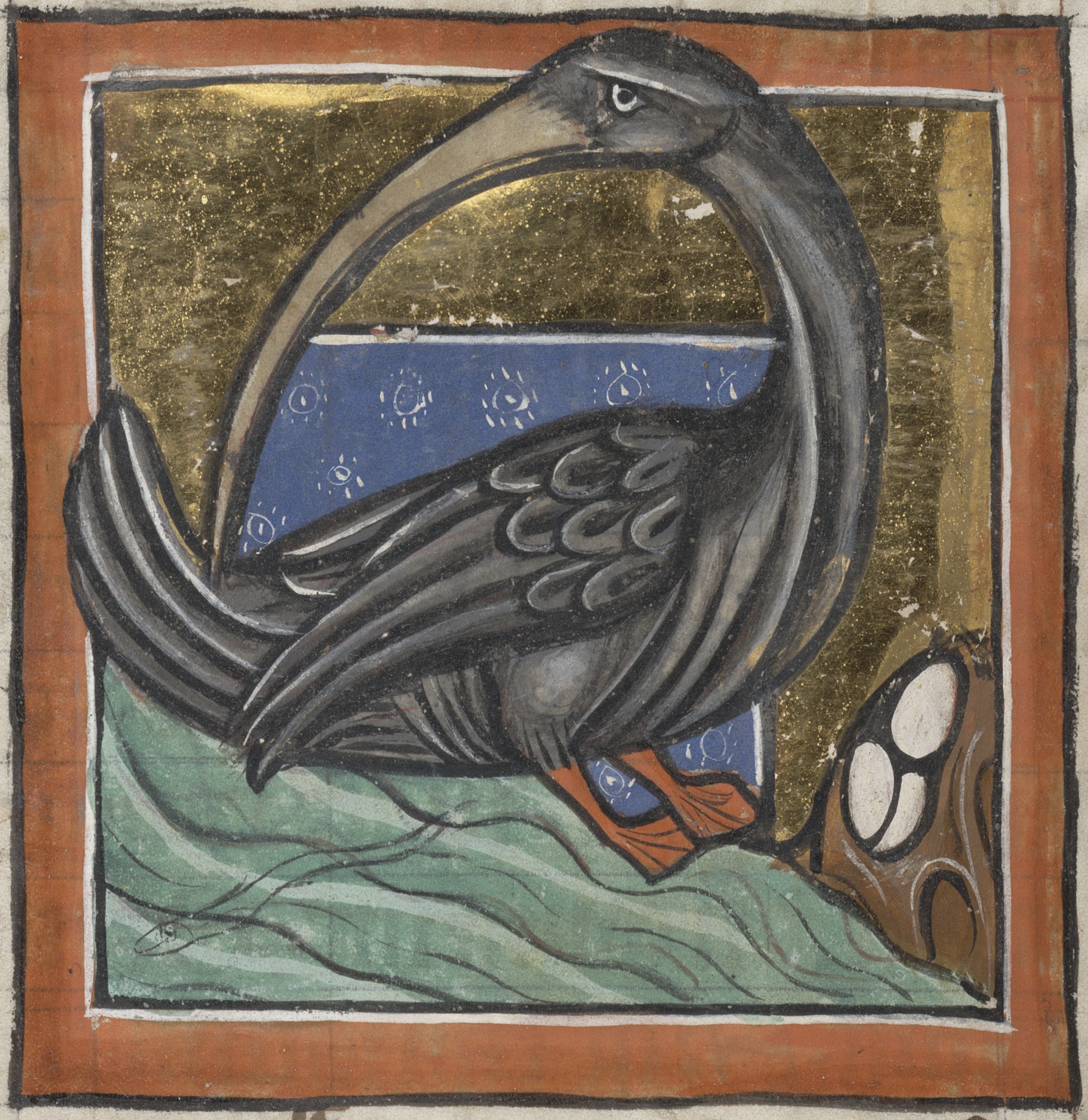
        In the Sanskrit epic the Mahabharata a series of over 100 riddles(!) are posed to our hero by a yaksha, which is a sort of nature spirit (another flashback to N), in this case disguised at first as a crane.
        Wicked witches, ogres, and giants also have a tendency to ask questions - not ones that are intrinsically difficult, but questions which may nevertheless require a certain amount of cunning to answer.  That’s because you’ll be wanting to escape from the lairs of these monsters, but they keep on calling out questions to keep tabs on you: Where are you?  What are you doing?  Is my dinner almost ready?  That sort of thing.  The secret in these situations is to use some sort of enchanted object such as beans, perhaps, or drops of blood, or even one or more of those helpful talking animals mentioned at the letter L.  These can be left with instructions to answer questions on your behalf, while you make your getaway.  When the wicked ogre asks, “Where are you?” the enchanted bean can reply in your voice, “Just sweeping the hearth,” thus gaining you a head start before your captor comes after you.  Three seems to be about the right number to gain you the most amount of time before the monster gets suspicious, discovers your ruse, and comes after you.  (Hopefully you have an extremely swift horse, or some other enchanted items up your sleeve, as well.)
        Prophecies are often given in the form of riddles, which means that wicked witches, fairies, and other sorts of magical beings also use them.  The weird sisters’ “no man born of woman” and “Birnham Wood shall come” prophecies for Macbeth are really riddles.  You can read a prior post about this sort of riddle here.
        The moral of this story is that you need to be quick-witted and creative when dealing with magical beings!  A Pro Tip for riddlers is to ask your questions in areas of knowledge with which your opponent won’t be so familiar.
        And my three questions for today are: Where does an emperor keep his armies?
                 What do you call two crows hanging out together?
                 Where can you always find comfort and sympathy?


[Pictures: Sphinx, marble finial from Greece, c. 530 BCE (Image from The Met);
Gollum, ink illustration by Carlos Magana, 2018 (Image from @carlsmagana);
Blue Man of the Minch (actually a Ganges dolphin!), wood block print (colored by me) from Ortus Sanitatis published by Jacob Meydenbach, 1491 (Image from Internet Archive);
Witches, wood engraving from Macbeth by Shakespeare, 19th century (Image from Wikimedia Commons).]

April 16, 2022

P is for Pygmyism (& Gigantism)

         (My A to Z theme this year is How to Make a Fantastical Creature, in which I explore 26 traits that are widely shared among the monsters and marvels of fantasy and folklore.  Be sure to see what all the other A to Z bloggers are offering in their alphabets!)
        Pygmyism (being an extremely small variant) and gigantism (being an extremely large variant) could be considered a sub-category of Extremes, but extremes of size are such a common characteristic of mythical creatures that I thought it merited its own post.  We’ll start with exceptionally small things, what with this being the post for P and all.  A number of folk tales involve a hero given the supposedly impossible task of finding a tiny creature, such as a dog or horse that can fit in a nut shell.  But these don’t seem to be considered a separate kind or species of creature, so we’ll move on.
        The shamir is a tiny worm, living with (or on?) a wood grouse.  Small as it is, it can cut through anything, so King Solomon used the shamir to cut stones and other materials for the building of his temple, as well as in cutting gemstones.  While the legends aren’t entirely clear how a shamir actually cuts things, one account says it was shown the object to be cut, which leads me to believe it must have laser-beam eyes.  It was kept in a little nest of wool in a lead container.
        The smallest creature of all is the gigelorum, so tiny that it lives in the ears of mites.  It was discovered in Scotland.
        But by far the most populous category of magical pygmy creatures is Little People.  All around the world there are legends of tiny humanoids, from the myriad fairies, brownies, pixies, gnomes, etc. of Europe, to the Chaneques of Mexico, the Pukwudgies of the Wampanoag, the Mannegishi of the Cree in Canada, the Menehune of Hawai’i, the kijimuna of Japan, the Jingren of China, and many more.  Although there are of course all sorts of differences in detail, it is very common for tiny people to be particularly mischievous.  Despite that, they may quite often be helpful, as long as their privacy is respected, but they generally do not like to be spied upon.  That may be why so many of them can also turn invisible (flashback to I).  They are often disproportionately strong, and may be skilled builders and crafters, although they are also quite frequently associated with nature (flashback to N).  And they are often understood to be the earliest inhabitants of their lands, living there before normal-sized humans arrived.  So many similarities in stories from all around the world have made many a cryptozoologist go “Hmmm.”  (Although I think another possible explanation of these similar tales is that they’re all told by humans!)
        You can read a prior post here about some of the confusions among different types of European Little People, or revisit brownies, dwarfs, fairies, gnomes, goblins, leprechauns, and pixies.
        You can read a facetious poem about the microscopic microbe, or cast your mind back to the tiny jetin at E, the wokulu at I, the chang nam at M, and the pyrallis at N.  Or perhaps you’ll enjoy my pussy willows.

        Gigantism is far more prevalent even than pygmyism, probably for the simple reason that bigger monsters make bigger challenges for our heroes.  We can start, however, with humanoids.  The naming convention is simpler: in English most giant humanoids are simply called giants, regardless of any specific details.  Once again, cultures all around the world have tales of giants, and the common threads here are that giants are, more often than not, vicious, uncivilized, and anthropophagus (flashback to A).
        Another popular class of giant creature is birds of prey.  The most famous is the roc, but similar monstrous birds include the ziz of Jewish folkore, the ngani-vatu of Fiji, and the p’eng of China, among others, as well as the thunderbird introduced at N.  All these birds are large enough that their wings darken the sky.  The nok hussadee of the Himmapan Forest is an enormous bird with the added interest of having the head of an elephant (flashback to C)!
        Then there are the sea monsters.  The timingila is the “whale eater” in Sanskrit texts, and although we don’t know much about what it looks like, we know it’s big.  The Tumi-Ra’I-Fuena of Tahitian mythology is like a spotted octopus whose tentacles can reach every corner of Earth and even heaven.  Previously-mentioned mega-giant sea creatures include Jörmungandr, the serpent large enough to circle the world, and leviathan, the largest sea creature of all in Jewish-Christian-Islamic traditions.
        In the northern seas of China there is a race of giant crabs called daxie, that are over 300 miles (1000 li, 500km) in size.  The kraken, these days generally considered an enormous cephalopod, is not quite as big, but is certainly large enough to strike terror into the hearts of sailors.  Sea serpents are, of course, giant-sized, as are the aspidochelone and all the other island-impersonating beasts you can revisit here.
        On land, the largest creature you could possibly encounter is the behemoth, which we know is a force of chaos and enormous strength, but that he eats grass like an ox.
        But really, any creature blown up to excessive size becomes a monster.  This is especially noticeable with creatures that we don’t really like much even when they’re small.  Giant spiders are the stuff of nightmares, including Shelob and her brood (introduced at D), and the Japanese tsuchigumo.  Don’t forget the giant skeleton gashadokuro, and Japan also has some dreadful giant rats.
        A giant mouse called Ugjuknarpak terrorized the people in its neighborhood in Alaska.  It caught people in its prehensile tale and ate them (flashback to A), but was eventually dispatched  and seems to have been the only one of its kind (flashback to O).
        Don’t think humans have lost our taste for extremely large creatures in modern times, either.  Babe is a giant (and blue) ox, appearing in lumberjack tales around 150 years ago, King Kong is a giant gorilla appearing in a movie in 1933,  the ROUS’s (Rodents of Unusual Size) appeared in a novel by William Goldman in 1973 adapted to a movie in 1987, and Clifford is a giant (and red) dog first appearing in books by Norman Bridwell in 1963, but popular in television up to the present.
        And then there’s the gallinipper, an American mosquito big enough to suck all the blood out of a person in a single gulp.
        The moral of these creatures is that we’ve just about figured out how to deal with animals at the sizes in which we normally encounter them, and we get completely thrown off when they come at us in an unexpected size.  A Pro Tip for photographers is to bring both macro and fisheye lenses in your kit, just to be sure you’ll be able to capture the perfect shot of any creature you may happen to spot.
        If you could have a pet of unusual size, would you rather it be extra big or extra small?


[Pictures: Smallest Dog, illustration by G.P. Jacomb Hood from The Blue Fairy Book, 1930 (Image from Internet Archive);
Little People (Garden Apartments) rubber block print by AEGN, 2017;
Giant (The Giant and the Boy), wood engraving by Dale DeArmond, c 1994 (Image from daledearmond.com);
Nok Hussadee, sculpture from funeral of Princess Petcharat, 2012 (Image from Wikimedia Commons)
Daxie, illustration by Siyu Chen from Fantastic Creatures of the Mountains and Seas, 2015;
Sea serpent, wood block print from Historiae animalium by Conrad Gesner, 1551 (Image from Hathi Trust);
Tsuchigumo, brush painting from Bakemonozukushie scroll, before 1868 (Image from Internet Archive);
Gallinipper (Panic Caused by a Mosquito in Piccadilly Circus), illustration from The Strand Magazine, 1909 (Image from Hathi Trust);
Behemoth and Leviathan, engraving by William Blake from the Book of Job, 1825 (Image from The Met).]

April 15, 2022

O is for One-and-Only

         (My A to Z Challenge theme this year is How to Make a Fantastical Creature, in which I explore 26 traits that are widely shared among the monsters and marvels of fantasy and folklore.)
        Among ordinary earthly animals it generally takes two to tango, if you know what I mean - and a lot more than that to maintain a viable population.  In the world of legend, on the other hand, there are quite a few creatures that are unique: only one of them in the world.  Some, like the phoenix, regenerate asexually, so that although there’s only one at a time, the species can continue.  Some, like the minotaur and several of the mutant creatures we saw at M, come about by some hideous one-time-only aberration.  Still other creatures, however, just don’t seem to concern themselves with carrying on the family name.  They are unique and proud of it.
        Yamata no Orochi was a dragon with eight heads, eight tails, and the usual diet of maidens.  The hero Susanoo gave each head a vat of liquor, and when they had all fallen asleep drunk, he cut them all off.  Just to be complete, he cut off all the tails, as well, and in one of them discovered an epic magical sword.  Bonus!
        The Nargun is a beast made of stone, except for its arms and breast.  It lives in a cave behind a waterfall in Victoria, Australia, and has a tendency to drag unwary passers-by into its cave.  Weapons are useless against its stoniness, and invariably bounce back upon the attacker.
        In Ontario, Canada a thirty-foot-long lake monster called Oyaleroweck was causing trouble, and a priest was sent to solve the problem.  Instead of killing it, he sent it to the next lake over, and while I applaud his mercy, I can’t help but wonder whether the residents around Lake Saint Joseph were happy with their new neighbor.  It’s precisely because of people like this priest that it is illegal in my state to capture and relocate wildlife.
        Long ago the Ellén Trechend devastated Ireland from its base in County Roscommon, but we are not entirely sure what this monster even looked like.  It definitely had three heads, but was it perhaps a giant vulture?  Alas, it’s been slain, so we’ll never know.
         The Peteu was a monstrous bird strong and voracious enough to carry off entire horse-and-carts, and it tormented the town of Vergisson, France.  Its beak was surrounded by long, whip-like feathers, but its most remarkable feature was that after a brave hero had finally defeated it, he discovered that it weighed only four ounces without all its feathers.
        The carcolh lives in a cave beneath the town of Hastingues, France.  It is sort of like a monstrous, slimy snail with hairy tentacles.  It doesn’t matter that it’s big and slow and doesn’t move around much, because if anyone comes within range it can seize them with its tentacles and drag them into its lair to be consumed.
        In Persia the hero Kirsasp encountered a monster called the Azi Sruvara.  It was so enormous that at first he mistook it for a hill and stopped for a picnic on its back, although it was yellow, had horns as tall as a mountain, huge eyes, and ears as big as fourteen blankets!  It took Kirsasp all day to run all the way up to its head to knock it dead.
        I’ll mention the more recent sci fi and fantasy trope of the creature that is the last of its kind.  But I’m not counting those today, because what makes today’s creatures actually fantastical is somehow being a species of which there is never more than one.
        Admittedly with all the monsters killed by all the heroes sometimes it can be hard to decide what’s a separate and unique species, and what’s just another variant of dragon.  So perhaps someday I’ll do a post on those hapless beasts that I deemed insufficiently one-and-only for purposes of this post.  But you can revisit more truly unique beasties in previous posts about the six-legged, turtle-shelled Tarasque, the green-quilled Velue, the banished Oillepheist, the arm-twisting Grendel and his Mother, and the Questing Beast of ill omen.  Several more unique monsters have already been mentioned in this very alphabet, including the three-headed Chimaera at C, many of the demons at D, the hideous Bugul Noz at E, Zlatorog at J… and a few more still to come - Foreshadowing!
        The moral of these one-off creatures is that while we’re all special and unique, some of us are definitely more special and unique than others.  A Pro Tip for scientists and explorers is to remove all identifiable geographical data when you publish your discovery of the next singular creature.  Otherwise a swarm of heroes armed with everything from holy water to magic swords will be there within days, all intent on slaying your monster — and we don’t need any more animals to be made extinct right now.
        If you could bring any species back from extinction (either a single individual or a viable breeding population) what would you pick?


[Pictures: Phoenix, wood block print by Jost Amman from Thierbuch, 1592 (Image from Library of Congress);
Yamata no Orochi, illustration by Kobayashi Eitaku from Yamata No Orochi, 1886 (Image from Waseda University Library);
Azi Sruvara, illumination by Master of the Jainesque Shahnama, 1425-1450 (Image from Museum Reitberg);
Tarasque, illustration by André des Gachons from La Livre des Légendes by Clovis Hugues, 1895 (Image from L'aube naissante);
Questing Beast, illustration by Arthur Rackham from The Romance of King Arthur and His Knights of the Round Table, 1917 (Image from University of Rochester).]

April 14, 2022

N is for Nature

         (My A to Z Challenge theme this year is How to Make a Fantastical Creature, in which I explore 26 traits that are widely shared among the monsters and marvels of fantasy and folklore.)
        Today I’m considering mythical creatures associated with the forces of nature, and there are so many I couldn’t possible list them all.  I’ll start by just brushing over some of the most common types…
        A wide variety of cultures have myths about magical creatures that pull or chase the sun across the sky, as well as monsters that occasionally chomp at the sun, causing eclipses.  Snow, ice, and winter seem to be embodied by giants all around the northern latitudes in cultures of both Europe and North America.  Many different cultures have celestial serpents associated with the rainbow.
        Another common type is a bird that brings storms.  The most famous is the thunderbird of a number of North American peoples.  Although there are variations, generally it looks like a huge eagle, which creates thunder by flapping its wings, and sparks lightning from its eyes.  It is associated with the sky, naturally, and often battles the pernicious creatures of the water or underworld.
        In China many sorts of extreme weather are presaged by magical creatures.  The feiwei is a six-legged, four-winged snake that can bring up to seven years of drought, while the shangyang bird predicts rain by dancing on its single leg.
        The Ccoa of Quechua folklore is sort of like a grey-striped cat, except that he has huge fiery eyes that shoot out hail!
        In Zambia storms may be caused by lightning monsters, who are front half goat and back half crocodile (flashback to C) and who create lightning by snapping back and forth between earth and sky on long stretchy threads.  In Australia a similar job, complete with threads, is done by lightning serpents.
        The ahuizotl of Mexico looks rather like a dog-headed monkey, but its most interesting trait is the hand at the end of its tail, with which it seizes its victims and drags them to their death in the water.  It is a servant of the rain 
gods, and sometimes considered a water protector, as well.
        In Japan can be found the thunder beast Raiju, which looks like a dog, badger, or weasel composed of white and blue lightning.  During storms it gets agitated, cries out with the sound of thunder, and races all over the place scratching trees with its claws.  In a twist you might not have seen coming, it also likes to sleep in people’s belly-buttons!  The remedy is: don’t sleep on your back outdoors during bad weather… But then you probably didn’t need the threat of Raiju to tell you that.
        My favorite storm creature is the kasagonaga of Argentina and the Gran Chaco region, which looks like a small, hairy anteater with a long snout, tiny feet, and rainbow-colored fur.  Its roar is thunder, lightning shoots from its mouth, and it chooses when the rain comes.  However, powerful as it is, sometimes it falls down to earth and is too small to get back up by itself.  Humans have to help by sending it up to the sky on the smoke of a bonfire.  If you do help one, it will be enduringly grateful.
        Tired of all these storms?  Then it’s time for the halcyon.  This bird lays its eggs on the seashore, or even on the sea, in the midst of the gales of winter - yet for the fourteen days that it hatches its young, the ocean remains completely calm and untroubled by storms.  (This is where we get the phrase “halcyon days.”)
        The bujanga is a sort of dragonoid winged monster of Java and West Malaysia, who has knowledge of all creatures and forest lore (flashback to K), and is a protector of the jungles.

        In modern Mayan folklore there are four balam, which are jaguar spirits that are protectors of nature.

        The Green Man who occurs all across Europe and beyond, is entirely covered by, if not actually composed of leaves and other plants, and is associated with fertility, forests, and all sorts of nature and plant growth.
        Among the many, many nature-creatures I’ve discussed before, you can revisit the renaissance alchemists’ elementals: earth gnome, air sylph, fire salamander, and water undine.  There’s the pyrallis that can’t live outside its fire, nymphs for every conceivable body of water, and dryads for every species of tree, plus all manner of water spirits including nixie, knucker, and vodyanoy.  The leshy is a forest protector.  There’s the cherufe of volcanos, Namazu of earthquakes, and my own “fairies” of the seasons.
        Earlier in this year’s alphabet at D we had the impundulu associated with lightning and the batibat who is a tree spirit, and at M we met the kelpie, a water spirit.  There will be more to come, as well - Foreshadowing!
        The moral of all these beings is Don’t Mess with Mother Nature - or any of her myriad spirits and monsters!  A Pro Tip for environmentalists is to get on the right side of these creatures in order to enlist their help in mitigating the worst effects of climate change.
        Where’s your favorite place to enjoy nature, or your favorite way to engage with the natural world?


[Pictures: Thunderbird (The Last Thunderbird), wood engraving by Dale DeArmond, 1988 (Image from daledearmond.com);
Feiwei, illustration by Siyu Chen from Fantastic Creatures of the Mountains and Seas, 2015;
Ahuizotl, illustration from Codex Telleriano-Remensis, c. 1562 (Image from Bibliotheque nationale de France);
Raiju, wood block print from Kanda-Jihitsu by Ban Koke, 1806 (Image from National Diet Library);
Kasagonaga, illustration by Ellen Surrey for “Monstrum”, 2020 (Image from PBS);
Halcyon, illumination from bestiary, 1226-1250 (Image from Bodleian Libraries);
Green Man, pen and ink by Rheannon Ormond (Image from Etsy shop RheannonOrmond1);
Season Fairies, reduction block prints by AEGN, 2021.]