April 16, 2022

P is for Pygmyism (& Gigantism)

         (My A to Z theme this year is How to Make a Fantastical Creature, in which I explore 26 traits that are widely shared among the monsters and marvels of fantasy and folklore.  Be sure to see what all the other A to Z bloggers are offering in their alphabets!)
        Pygmyism (being an extremely small variant) and gigantism (being an extremely large variant) could be considered a sub-category of Extremes, but extremes of size are such a common characteristic of mythical creatures that I thought it merited its own post.  We’ll start with exceptionally small things, what with this being the post for P and all.  A number of folk tales involve a hero given the supposedly impossible task of finding a tiny creature, such as a dog or horse that can fit in a nut shell.  But these don’t seem to be considered a separate kind or species of creature, so we’ll move on.
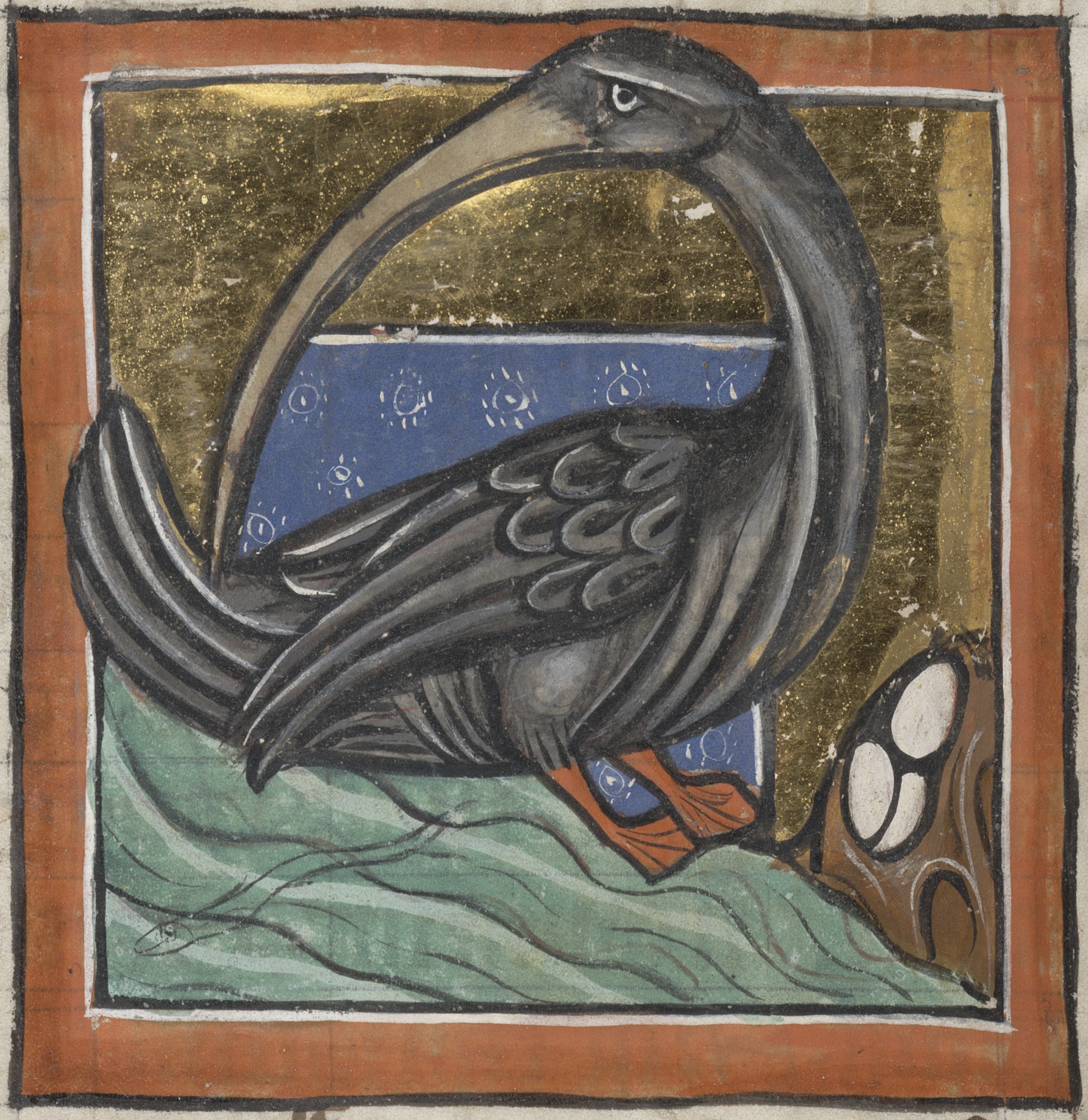
        The shamir is a tiny worm, living with (or on?) a wood grouse.  Small as it is, it can cut through anything, so King Solomon used the shamir to cut stones and other materials for the building of his temple, as well as in cutting gemstones.  While the legends aren’t entirely clear how a shamir actually cuts things, one account says it was shown the object to be cut, which leads me to believe it must have laser-beam eyes.  It was kept in a little nest of wool in a lead container.
        The smallest creature of all is the gigelorum, so tiny that it lives in the ears of mites.  It was discovered in Scotland.
        But by far the most populous category of magical pygmy creatures is Little People.  All around the world there are legends of tiny humanoids, from the myriad fairies, brownies, pixies, gnomes, etc. of Europe, to the Chaneques of Mexico, the Pukwudgies of the Wampanoag, the Mannegishi of the Cree in Canada, the Menehune of Hawai’i, the kijimuna of Japan, the Jingren of China, and many more.  Although there are of course all sorts of differences in detail, it is very common for tiny people to be particularly mischievous.  Despite that, they may quite often be helpful, as long as their privacy is respected, but they generally do not like to be spied upon.  That may be why so many of them can also turn invisible (flashback to I).  They are often disproportionately strong, and may be skilled builders and crafters, although they are also quite frequently associated with nature (flashback to N).  And they are often understood to be the earliest inhabitants of their lands, living there before normal-sized humans arrived.  So many similarities in stories from all around the world have made many a cryptozoologist go “Hmmm.”  (Although I think another possible explanation of these similar tales is that they’re all told by humans!)
        You can read a prior post here about some of the confusions among different types of European Little People, or revisit brownies, dwarfs, fairies, gnomes, goblins, leprechauns, and pixies.
        You can read a facetious poem about the microscopic microbe, or cast your mind back to the tiny jetin at E, the wokulu at I, the chang nam at M, and the pyrallis at N.  Or perhaps you’ll enjoy my pussy willows.

        Gigantism is far more prevalent even than pygmyism, probably for the simple reason that bigger monsters make bigger challenges for our heroes.  We can start, however, with humanoids.  The naming convention is simpler: in English most giant humanoids are simply called giants, regardless of any specific details.  Once again, cultures all around the world have tales of giants, and the common threads here are that giants are, more often than not, vicious, uncivilized, and anthropophagus (flashback to A).
        Another popular class of giant creature is birds of prey.  The most famous is the roc, but similar monstrous birds include the ziz of Jewish folkore, the ngani-vatu of Fiji, and the p’eng of China, among others, as well as the thunderbird introduced at N.  All these birds are large enough that their wings darken the sky.  The nok hussadee of the Himmapan Forest is an enormous bird with the added interest of having the head of an elephant (flashback to C)!
        Then there are the sea monsters.  The timingila is the “whale eater” in Sanskrit texts, and although we don’t know much about what it looks like, we know it’s big.  The Tumi-Ra’I-Fuena of Tahitian mythology is like a spotted octopus whose tentacles can reach every corner of Earth and even heaven.  Previously-mentioned mega-giant sea creatures include Jörmungandr, the serpent large enough to circle the world, and leviathan, the largest sea creature of all in Jewish-Christian-Islamic traditions.
        In the northern seas of China there is a race of giant crabs called daxie, that are over 300 miles (1000 li, 500km) in size.  The kraken, these days generally considered an enormous cephalopod, is not quite as big, but is certainly large enough to strike terror into the hearts of sailors.  Sea serpents are, of course, giant-sized, as are the aspidochelone and all the other island-impersonating beasts you can revisit here.
        On land, the largest creature you could possibly encounter is the behemoth, which we know is a force of chaos and enormous strength, but that he eats grass like an ox.
        But really, any creature blown up to excessive size becomes a monster.  This is especially noticeable with creatures that we don’t really like much even when they’re small.  Giant spiders are the stuff of nightmares, including Shelob and her brood (introduced at D), and the Japanese tsuchigumo.  Don’t forget the giant skeleton gashadokuro, and Japan also has some dreadful giant rats.
        A giant mouse called Ugjuknarpak terrorized the people in its neighborhood in Alaska.  It caught people in its prehensile tale and ate them (flashback to A), but was eventually dispatched  and seems to have been the only one of its kind (flashback to O).
        Don’t think humans have lost our taste for extremely large creatures in modern times, either.  Babe is a giant (and blue) ox, appearing in lumberjack tales around 150 years ago, King Kong is a giant gorilla appearing in a movie in 1933,  the ROUS’s (Rodents of Unusual Size) appeared in a novel by William Goldman in 1973 adapted to a movie in 1987, and Clifford is a giant (and red) dog first appearing in books by Norman Bridwell in 1963, but popular in television up to the present.
        And then there’s the gallinipper, an American mosquito big enough to suck all the blood out of a person in a single gulp.
        The moral of these creatures is that we’ve just about figured out how to deal with animals at the sizes in which we normally encounter them, and we get completely thrown off when they come at us in an unexpected size.  A Pro Tip for photographers is to bring both macro and fisheye lenses in your kit, just to be sure you’ll be able to capture the perfect shot of any creature you may happen to spot.
        If you could have a pet of unusual size, would you rather it be extra big or extra small?


[Pictures: Smallest Dog, illustration by G.P. Jacomb Hood from The Blue Fairy Book, 1930 (Image from Internet Archive);
Little People (Garden Apartments) rubber block print by AEGN, 2017;
Giant (The Giant and the Boy), wood engraving by Dale DeArmond, c 1994 (Image from daledearmond.com);
Nok Hussadee, sculpture from funeral of Princess Petcharat, 2012 (Image from Wikimedia Commons)
Daxie, illustration by Siyu Chen from Fantastic Creatures of the Mountains and Seas, 2015;
Sea serpent, wood block print from Historiae animalium by Conrad Gesner, 1551 (Image from Hathi Trust);
Tsuchigumo, brush painting from Bakemonozukushie scroll, before 1868 (Image from Internet Archive);
Gallinipper (Panic Caused by a Mosquito in Piccadilly Circus), illustration from The Strand Magazine, 1909 (Image from Hathi Trust);
Behemoth and Leviathan, engraving by William Blake from the Book of Job, 1825 (Image from The Met).]

April 15, 2022

O is for One-and-Only

         (My A to Z Challenge theme this year is How to Make a Fantastical Creature, in which I explore 26 traits that are widely shared among the monsters and marvels of fantasy and folklore.)
        Among ordinary earthly animals it generally takes two to tango, if you know what I mean - and a lot more than that to maintain a viable population.  In the world of legend, on the other hand, there are quite a few creatures that are unique: only one of them in the world.  Some, like the phoenix, regenerate asexually, so that although there’s only one at a time, the species can continue.  Some, like the minotaur and several of the mutant creatures we saw at M, come about by some hideous one-time-only aberration.  Still other creatures, however, just don’t seem to concern themselves with carrying on the family name.  They are unique and proud of it.
        Yamata no Orochi was a dragon with eight heads, eight tails, and the usual diet of maidens.  The hero Susanoo gave each head a vat of liquor, and when they had all fallen asleep drunk, he cut them all off.  Just to be complete, he cut off all the tails, as well, and in one of them discovered an epic magical sword.  Bonus!
        The Nargun is a beast made of stone, except for its arms and breast.  It lives in a cave behind a waterfall in Victoria, Australia, and has a tendency to drag unwary passers-by into its cave.  Weapons are useless against its stoniness, and invariably bounce back upon the attacker.
        In Ontario, Canada a thirty-foot-long lake monster called Oyaleroweck was causing trouble, and a priest was sent to solve the problem.  Instead of killing it, he sent it to the next lake over, and while I applaud his mercy, I can’t help but wonder whether the residents around Lake Saint Joseph were happy with their new neighbor.  It’s precisely because of people like this priest that it is illegal in my state to capture and relocate wildlife.
        Long ago the Ellén Trechend devastated Ireland from its base in County Roscommon, but we are not entirely sure what this monster even looked like.  It definitely had three heads, but was it perhaps a giant vulture?  Alas, it’s been slain, so we’ll never know.
         The Peteu was a monstrous bird strong and voracious enough to carry off entire horse-and-carts, and it tormented the town of Vergisson, France.  Its beak was surrounded by long, whip-like feathers, but its most remarkable feature was that after a brave hero had finally defeated it, he discovered that it weighed only four ounces without all its feathers.
        The carcolh lives in a cave beneath the town of Hastingues, France.  It is sort of like a monstrous, slimy snail with hairy tentacles.  It doesn’t matter that it’s big and slow and doesn’t move around much, because if anyone comes within range it can seize them with its tentacles and drag them into its lair to be consumed.
        In Persia the hero Kirsasp encountered a monster called the Azi Sruvara.  It was so enormous that at first he mistook it for a hill and stopped for a picnic on its back, although it was yellow, had horns as tall as a mountain, huge eyes, and ears as big as fourteen blankets!  It took Kirsasp all day to run all the way up to its head to knock it dead.
        I’ll mention the more recent sci fi and fantasy trope of the creature that is the last of its kind.  But I’m not counting those today, because what makes today’s creatures actually fantastical is somehow being a species of which there is never more than one.
        Admittedly with all the monsters killed by all the heroes sometimes it can be hard to decide what’s a separate and unique species, and what’s just another variant of dragon.  So perhaps someday I’ll do a post on those hapless beasts that I deemed insufficiently one-and-only for purposes of this post.  But you can revisit more truly unique beasties in previous posts about the six-legged, turtle-shelled Tarasque, the green-quilled Velue, the banished Oillepheist, the arm-twisting Grendel and his Mother, and the Questing Beast of ill omen.  Several more unique monsters have already been mentioned in this very alphabet, including the three-headed Chimaera at C, many of the demons at D, the hideous Bugul Noz at E, Zlatorog at J… and a few more still to come - Foreshadowing!
        The moral of these one-off creatures is that while we’re all special and unique, some of us are definitely more special and unique than others.  A Pro Tip for scientists and explorers is to remove all identifiable geographical data when you publish your discovery of the next singular creature.  Otherwise a swarm of heroes armed with everything from holy water to magic swords will be there within days, all intent on slaying your monster — and we don’t need any more animals to be made extinct right now.
        If you could bring any species back from extinction (either a single individual or a viable breeding population) what would you pick?


[Pictures: Phoenix, wood block print by Jost Amman from Thierbuch, 1592 (Image from Library of Congress);
Yamata no Orochi, illustration by Kobayashi Eitaku from Yamata No Orochi, 1886 (Image from Waseda University Library);
Azi Sruvara, illumination by Master of the Jainesque Shahnama, 1425-1450 (Image from Museum Reitberg);
Tarasque, illustration by André des Gachons from La Livre des Légendes by Clovis Hugues, 1895 (Image from L'aube naissante);
Questing Beast, illustration by Arthur Rackham from The Romance of King Arthur and His Knights of the Round Table, 1917 (Image from University of Rochester).]

April 14, 2022

N is for Nature

         (My A to Z Challenge theme this year is How to Make a Fantastical Creature, in which I explore 26 traits that are widely shared among the monsters and marvels of fantasy and folklore.)
        Today I’m considering mythical creatures associated with the forces of nature, and there are so many I couldn’t possible list them all.  I’ll start by just brushing over some of the most common types…
        A wide variety of cultures have myths about magical creatures that pull or chase the sun across the sky, as well as monsters that occasionally chomp at the sun, causing eclipses.  Snow, ice, and winter seem to be embodied by giants all around the northern latitudes in cultures of both Europe and North America.  Many different cultures have celestial serpents associated with the rainbow.
        Another common type is a bird that brings storms.  The most famous is the thunderbird of a number of North American peoples.  Although there are variations, generally it looks like a huge eagle, which creates thunder by flapping its wings, and sparks lightning from its eyes.  It is associated with the sky, naturally, and often battles the pernicious creatures of the water or underworld.
        In China many sorts of extreme weather are presaged by magical creatures.  The feiwei is a six-legged, four-winged snake that can bring up to seven years of drought, while the shangyang bird predicts rain by dancing on its single leg.
        The Ccoa of Quechua folklore is sort of like a grey-striped cat, except that he has huge fiery eyes that shoot out hail!
        In Zambia storms may be caused by lightning monsters, who are front half goat and back half crocodile (flashback to C) and who create lightning by snapping back and forth between earth and sky on long stretchy threads.  In Australia a similar job, complete with threads, is done by lightning serpents.
        The ahuizotl of Mexico looks rather like a dog-headed monkey, but its most interesting trait is the hand at the end of its tail, with which it seizes its victims and drags them to their death in the water.  It is a servant of the rain 
gods, and sometimes considered a water protector, as well.
        In Japan can be found the thunder beast Raiju, which looks like a dog, badger, or weasel composed of white and blue lightning.  During storms it gets agitated, cries out with the sound of thunder, and races all over the place scratching trees with its claws.  In a twist you might not have seen coming, it also likes to sleep in people’s belly-buttons!  The remedy is: don’t sleep on your back outdoors during bad weather… But then you probably didn’t need the threat of Raiju to tell you that.
        My favorite storm creature is the kasagonaga of Argentina and the Gran Chaco region, which looks like a small, hairy anteater with a long snout, tiny feet, and rainbow-colored fur.  Its roar is thunder, lightning shoots from its mouth, and it chooses when the rain comes.  However, powerful as it is, sometimes it falls down to earth and is too small to get back up by itself.  Humans have to help by sending it up to the sky on the smoke of a bonfire.  If you do help one, it will be enduringly grateful.
        Tired of all these storms?  Then it’s time for the halcyon.  This bird lays its eggs on the seashore, or even on the sea, in the midst of the gales of winter - yet for the fourteen days that it hatches its young, the ocean remains completely calm and untroubled by storms.  (This is where we get the phrase “halcyon days.”)
        The bujanga is a sort of dragonoid winged monster of Java and West Malaysia, who has knowledge of all creatures and forest lore (flashback to K), and is a protector of the jungles.

        In modern Mayan folklore there are four balam, which are jaguar spirits that are protectors of nature.

        The Green Man who occurs all across Europe and beyond, is entirely covered by, if not actually composed of leaves and other plants, and is associated with fertility, forests, and all sorts of nature and plant growth.
        Among the many, many nature-creatures I’ve discussed before, you can revisit the renaissance alchemists’ elementals: earth gnome, air sylph, fire salamander, and water undine.  There’s the pyrallis that can’t live outside its fire, nymphs for every conceivable body of water, and dryads for every species of tree, plus all manner of water spirits including nixie, knucker, and vodyanoy.  The leshy is a forest protector.  There’s the cherufe of volcanos, Namazu of earthquakes, and my own “fairies” of the seasons.
        Earlier in this year’s alphabet at D we had the impundulu associated with lightning and the batibat who is a tree spirit, and at M we met the kelpie, a water spirit.  There will be more to come, as well - Foreshadowing!
        The moral of all these beings is Don’t Mess with Mother Nature - or any of her myriad spirits and monsters!  A Pro Tip for environmentalists is to get on the right side of these creatures in order to enlist their help in mitigating the worst effects of climate change.
        Where’s your favorite place to enjoy nature, or your favorite way to engage with the natural world?


[Pictures: Thunderbird (The Last Thunderbird), wood engraving by Dale DeArmond, 1988 (Image from daledearmond.com);
Feiwei, illustration by Siyu Chen from Fantastic Creatures of the Mountains and Seas, 2015;
Ahuizotl, illustration from Codex Telleriano-Remensis, c. 1562 (Image from Bibliotheque nationale de France);
Raiju, wood block print from Kanda-Jihitsu by Ban Koke, 1806 (Image from National Diet Library);
Kasagonaga, illustration by Ellen Surrey for “Monstrum”, 2020 (Image from PBS);
Halcyon, illumination from bestiary, 1226-1250 (Image from Bodleian Libraries);
Green Man, pen and ink by Rheannon Ormond (Image from Etsy shop RheannonOrmond1);
Season Fairies, reduction block prints by AEGN, 2021.]

April 12, 2022

M is for Magic and Mutant

         (My A to Z Challenge theme this year is How to Make a Fantastical Creature, in which I explore 26 traits that are widely shared among the monsters and marvels of fantasy and folklore.)
        Today I have two traits that both seemed important to include, so today’s post is a twofer.
        First is simply Magic.  “Well of course magical creatures are magic,” you may be muttering, and you’re not wrong.  But what I want to mention today is the idea that the creatures of mythology and folklore often have specific magical abilities.  There are lots of magical abilities that get their own entries in this alphabet, but I did want the opportunity for a catch-all of some of the magic that didn’t fit in elsewhere.
        The caladrius, for example, is a white bird that can look at a sick person and tell whether or not they will die.  If a caladrius turns away from the patient, they’re doomed, but if it faces them, it will draw the illness out of them and they’ll recover.
        The kelpie is a malevolent water creature that usually takes the form of a horse… But it has the magical trait that its back can stretch longer and longer to accommodate as many people as it can tempt to sit upon it, whereupon the victims become magically stuck to to the kelpie’s back and can’t dismount while the kelpie dives into the loch and drowns them all.
        The Mi-ni-wa-tu is a sea monster in the Missouri River.  It is like an amphibious buffalo with a serrated back, red hair, a single horn, and a single eye.  It also glows at night as it swims through the water (flashback to G).  But as if all its relatively straightforward physical characteristics weren’t enough, if anyone sets eyes on it during the daytime, they will first go blind, then go mad, and then, after a day of convulsions, die.  There are actually a number of North American monsters that cause madness to any who so much as see them, including Unhcegila and the qiqirn.
        Gorgons are monster women with snakes instead of hair, and they have the magical power that anyone who looks upon their face turns to stone.  The basilisk and cockatrice also both have petrifying stares (according to some sources).
        The chang nam of Thailand looks like a tiny mouse-sized elephant, but judge it by its size do not!  If you see a chang nam’s shadow you will die instantly, or it can kill you by stabbing your reflection in the water with its tusks.
        Then there’s the shen or shinkiro found in the oceans off China.  This giant clam-monster rises to the surface of the ocean and breathes out mirages and illusions.


        The second trait for the day is Mutant.  These creatures tend to be drawn from our modern mythology of sci fi and comics, and the poster child is Godzilla.  Godzilla is a prehistoric sea monster (who looks more like a land dinosaur) supercharged by nuclear power.  He’s in a class of Japanese monsters called kaiju, which include Rodan, Mothra, and Anguirus (among many others).
        The Teenage Mutant Ninja Turtles have everything right there in the name.  Their mutation is caused by exposure to an alien ooze.
        DC Comics’ Captain Comet and Marvel Comics’ X-Men are mutants deriving their superpowers from their mutations.
        Various mutant creatures feature in The Hunger Games by Suzanne Collins, including mockingjays, birds which can copy human songs (making them suitable to join the jackalopes at L).
        So, today’s moral comes from mutants: stay away from radioactivity!  You may think it would be fun to develop mutant powers, but you are more likely to become a monster than a hero.  And a Pro Tip for anyone doing business with magical creatures is to invest in a high-quality pair of protective sunglasses with mirrored lenses.  I’m not sure how much protection these will actually provide from all those lethal glances, but at least if you do still go mad or turn to stone, you’ll look cool doing it.
        Do you think fantastical things are more believable if they’re attributed to radioactivity or alien ooze as opposed to plain old unexplained magic?


[Pictures: Caladrius, illumination from bestiary, 1226-1250 (Image from Bodleian Libraries);
Kelpie (Bäckahästen), illustration by Johan Egerkrans (Image from artists’s web site johanegerkrans.com);
Gorgon, detail of black-figure jug by The Amasis Painter, c 550-530 BCE (image from The British Museum);
Shinkiro, wood block print from Hyakki shui by Toriyama Sekien, 1805 (Image from Smithsonian Libraries);
Godzilla, still from “Godzilla” with special effects by Eiji Tsuburaya, 1954 (Image from Bright Wall/Dark Room);
Mutant Ninja Turtles, artwork by Kevin Eastman, 1988 (Image from Kevin Eastman Studios).]

April 11, 2022

L is for Language

        (My A to Z theme this year is How to Make a Fantastical Creature, in which I explore 26 traits that are widely shared among the monsters and marvels of fantasy and folklore.  Don’t forget to check out all the other participating bloggers here.
)
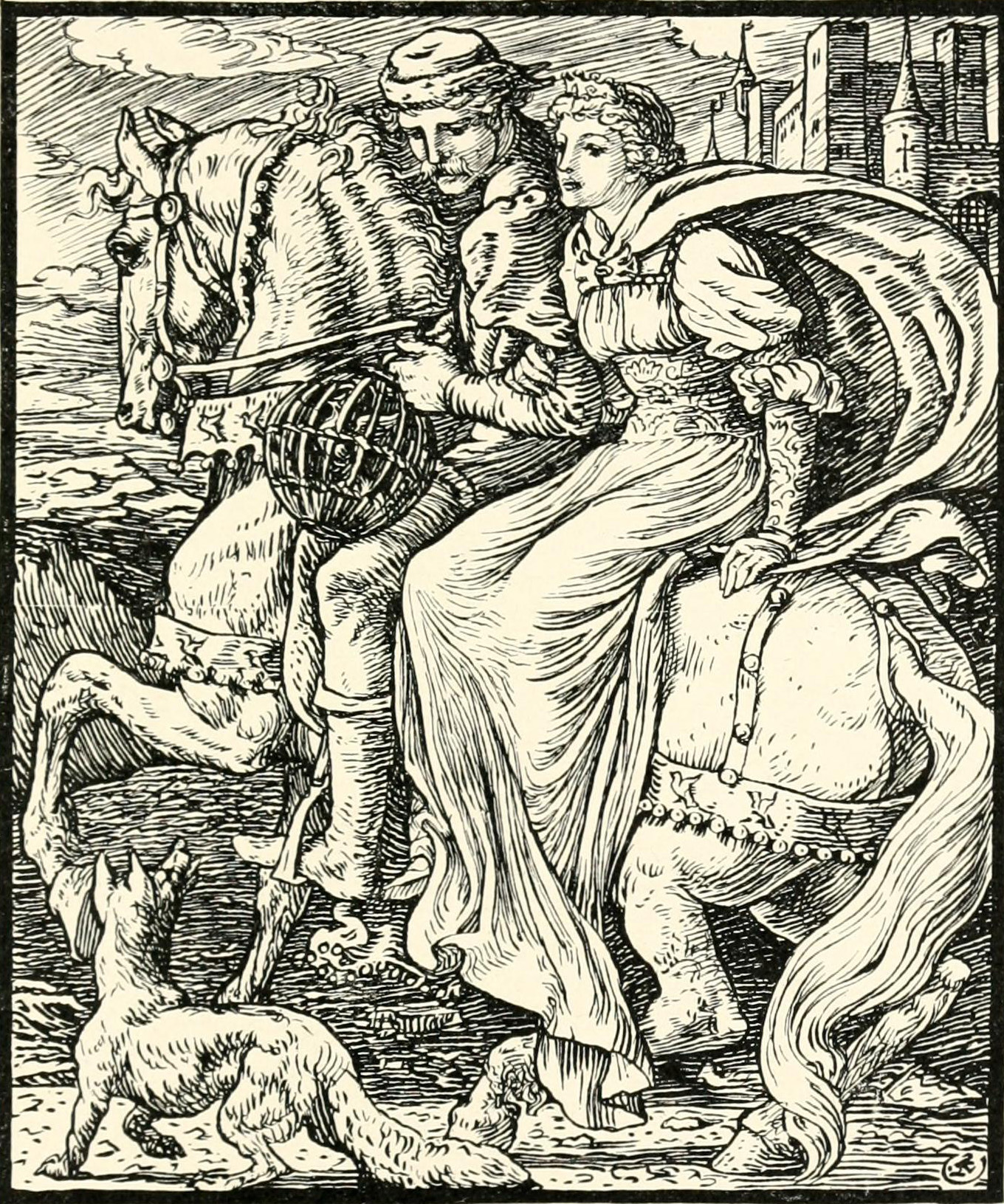
        The sad facts of the mundane world are that the only creatures who can speak human language are humans.  So it comes as no surprise to learn that when other creatures can speak, they must be magical.  No matter how ordinary or everyday a creature may seem, if it can speak your language, it’s fantastical.  Heroes in folktales and legends around the world routinely encounter talking animals including fish, birds, mice, horses, monkeys, and more.  And (with a nod to the letter K) if you would be a hero, you would generally do well to listen to these animals’ advice.  Arrogant older siblings especially ignore these talking creatures to their peril.
        The Zägh is a huge bird in Islamic lore.  It has a human face and, to go along with the face, the ability to speak human languages.  Perhaps it’s not surprising that most of the mythological creatures with humanoid aspects can speak human languages, including the centaurs (see K), fauns and satyrs (see C), ogres (see A),  jinn (see I), merfolk, nymphs (see E), and all sorts of Little People (whom we’ll be seeing more of later - Foreshadowing!)  (All of which actually makes it interesting that there is a class of humanoid creatures that do not seem to speak: the Bigfoot-type beasts including Sasquatch, yeti, yeren, and yowie.  Perhaps this is why science tolerates them as cryptids instead of relegating them to utter mythology.)
        Dragons in modern fantasy can usually speak, although in the medieval era western dragons were seen as mere bestial monsters.  In fact, modern writers have done some really interesting things with dragon speech, such as giving them a sort of primordial language, or making it so they never lie, or conversely making it so that all their words tend to be riddles, deceit, and guile.
        Speculative writers have also used extraterrestrials to explore questions of language, including the heptapods of Arrival (introduced under K), and the Tamarians of the Star Trek: The Next Generation episode “Darmok,” whose language is famously composed of nothing but metaphors.  Usually, however, these stories are explorations of translation, which is a contrast to the more classic trope that starts when we can magically speak perfectly fluently with creatures with whom we wouldn’t normally be able to communicate.
        The xiezhi has the body of an ox, with a head more like a lion, and a single sharp horn.  It is very wise and understands human speech.  Because it always knows right from wrong and guilt from innocence, it can listen to court cases, whereupon it stabs the guilty party with its horn.  However, while it understands speech perfectly, it’s not clear to me that it ever speaks.
        The opposite of that is that there are a number of creatures who can mimic human speech without necessarily understanding what they’re saying.  The real world does have this in some birds, but in fantasy there is the leucrota, which has a mouth that stretches all the way from ear to ear, with only a single sharp bone across each jaw instead of individual teeth.  It mimics human speech in order to lure people 
out into the wilderness to be devoured (flashback to A).  Then there are the
jackalopes (flashback to C), which like to join in with cowboy campfire songs.
        The moral of these stories is that however much we may mistreat other creatures and each other, we nevertheless always long for communication.
        If you could have a conversation with any creature, which would you want to talk with?


[Pictures: Talking Fox, wood block print by Walter Crane from “The Golden Bird,” 1882 (Image from Internet Archive);
Zagh, illumination from The Wonders of Creation by Zakariya al-Qazwini, 16th century (Image from Library of Congress);
Tamarian, film still from “Star Trek: The Next Generation,” 1991 (Image from Memory Alpha);
Xiezhi, cast bronze incense burner, Ming Dynasty 1368-1644 (Image from Vir Muze);
Leucrota, illumination from bestiary, 1200-1210 (Image from British Library);
Talking Wolf, wood engraving by Thomas Bewick from The History of Little Red Riding Hood, 1777 (Image from The British Museum).]

April 9, 2022

K is for Knowledge

         (My A to Z theme this year is How to Make a Fantastical Creature, in which I explore 26 traits that are widely shared among the monsters and marvels of fantasy and folklore.  You can see all the other bloggers here.)
        Another common property of mythical creatures is that they can be useful not just for physical objects as seen at the letter J, but for their extensive and arcane knowledge.  
        Centaurs are a bit bimodal; in most of classical and medieval lore they are barbarous, wild, violent, and uncivilized, but there are a few who are wiser.  Most famous of these is Chiron, who learned knowledge from the god Apollo himself and passed it on to Asclepius, Achilles, Theseus, Perseus, and many other heroes.  But centaurs get an upgrade from C.S. Lewis and J.K. Rowling, both of whom portray them as creatures rich in knowledge, especially astrology and healing.
        Similarly, western dragons have been getting smarter and smarter in modern fantasy.  I myself portray them in my Otherworld Series as being quite proud of their knowledge and wisdom. On the other hand, the lung dragons of Asia have always been keepers of knowledge.
        The simurgh (introduced at C - although you'll note that this particular illustration looks like a bird through and through) has lived through countless ages and possesses her great knowledge because she has lived so long and experienced so much.  With her wisdom she serves as a mediator between earth and sky.
       In his famous travels in 1726, Lemuel Gulliver encountered the Houyhnhnms, creatures that look like (and perhaps are) horses, but are much wiser and more reasonable than humans.
        Extraterrestrial beings are one of the groups I could have mentioned under the letter E.  If they are warlike they are extremely warlike, if their technology is advanced it is extremely advanced…  But I wanted to introduce them today because often they have extremely highly developed knowledge and wisdom.  Examples include the Arisians of the Lensman Series by E.E. Doc Smith, the unnamed extraterrestrials of Carl Sagan’s Contact, and the heptapods of the 2016 movie “Arrival.”
        Advanced AI (Artificial Intelligence) are another group of beings that appear with super-knowledge in modern sci fi, such as the Minds in Iain Banks’s Culture Series.  One interesting twist is that super-intelligent and wise aliens and AI tend to control whole planets and galaxies, often without bothering to explain to any of the little people why they do what they do.  By contrast, the wise creatures of more traditional folklore tend to offer their knowledge and advice on a smaller scale, influencing the behavior of a single protagonist and thus perhaps a single kingdom.
        Then there are creatures such as the banshee and a host of similar spirits, whose knowledge is of a very specific sort: the knowledge of when someone is about to die.  Other ghosts may know who committed a crime, or other such very specific facts.
        For some particularly wise beings in prior posts, check out the qilin, the wizard, and possibly even the Oilliphéist.  The ouroboros snake that makes an eternal circle with its tail in its mouth is a symbol closely linked with the search for knowledge, so I imagine it must have much erudition and arcane mastery.
        The moral of these stories is that one can never be wise unless one is willing to learn from others, no matter how unlikely they may seem.  But a Pro Tip for scholars is to be sure to ask plenty of questions for clarification, lest you get led astray by some unfortunate misunderstanding.
        Who or what is your go-to source for knowledge, wisdom, and advice?


[Pictures: Centaur, wood block printer’s device, 1566 (Image from Penn Libraries);
Simurgh, illumination from The Marvels of Creation by al-Qazwini, 1565 (Image from Bibliotheque municipale de Bordeaux);
Houyhnhnm, illustration by J.J. Grandville for Gulliver’s Travels by Jonathan Swift, 1856 (Image from Tor.com);
Heptapod, film still from “Arrival” directed by Denis Villeneuve, 2016;
Banshee, illustration by R. Prowse from The Halfpenny Miscellany, 1862 (Image from The Wild Geese).]

April 8, 2022

J is for Jewelled

         (My A to Z Blog Challenge theme this year is How to Make a Fantastical Creature, in which I explore 26 traits that are widely shared among the monsters and marvels of fantasy and folklore.)
        As I mentioned under H, we humans have a tendency to look at magical creatures with an eye toward what’s in it for us, and another trait common among magical creatures is that their bodies themselves include precious items that people want to collect.  One such jewelled creature is the Horned Serpent of the Muscogee Creek of the Southeast USA, which has in its forehead a large magical crystal which aids the divination powers of anyone who can get it.  There is also the númhyalikyu of Pacific Northwest Kwakwaka’wakw lore.  It is a giant halibut that contains in its head a jewel called tlúgwi.
        The Tabib al-Bahr is a sort of humanoid fish with a glowing yellow jewel in its forehead.  This jewel is valuable for alchemy, being an excellent ingredient for turning base metals into gold, but I think you’d be much wiser to leave it in the living creature, as the Tabib al-Bahr is entirely benevolent and uses its jewel to heal all the creatures of the sea.
        In the Lan River of the Western Mountains lives the rupi, a bird-headed fish that produces pearls.  It scatters them about from its beak with bountiful largesse, but is not good to eat, what with the pearl-lumps all through its flesh.
        But putting this topic under J was a bit of a fudge, since it’s really much broader than just jewels.  Some creatures have body parts made of pure gold, such as the horns of Zlatorog, a magical mountain goat of the Slovenian Alps, while the Brothers Grimm tell of the Golden Goose, whose feathers are made of gold.  Another “jewelled” goose is the one that laid a golden egg each day, as told by Aesop.
        The carbunclo of southern South America looks a bit like a cat-sized pillbug with a shining spot on its head.  (Indeed the whole creature glows out through its segmented body enough that it gives us a flashback to the letter G.)  The stone in its head brings good fortune to anyone who can get one, and on top of that, inside its shell, its body is chock-full of riches.
        Interpreting the “jewelled” idea more broadly still, there are creatures whose bodies contain treasures that may be more valuable than mere wealth because of their magical properties.  Perhaps the most famous is the unicorn, whose horn, called an alicorn, is capable of both detecting and even neutralizing poison.  (More at the past post on unicorns.)
        The boyi of the Mountains of the South is like a goat with nine fox tails and eyes on its back.  Its fur, made into a garment (eyes and all?) grants courage to the wearer.
        A bit stranger is the yohualtepoztli of Mexico, which looks like a trollish man who, instead of a head, has nothing but the stump of a tree.  Its chest has swinging wooden doors, and if one is brave enough to face the monster, reach in and grab the heart, and threaten to rip it out, the yohualtepoztli will bargain by granting magic agave thorns that assure the recipient glory, wealth, and strength.
        The gulon (introduced under E) could be hunted for its blood, which is a powerful aphrodisiac.
        You can also find out in prior posts why hunters would want the griffin’s claws, the ramidreju’s fur, the firebird’s feathers, the head-jewel of the dragonoid Zmeu, and the entrails of the ophiotaurus.
        The moral of all these is that if you’re a mythical creature you’re really better off being plain and ordinary than having some special element that everyone else wants.  A Pro Tip for hunters is to be mindful of the ecological implications of your harvest.  Poaching too many magical creatures, as Aesop warned in the case of the goose that laid the golden eggs, will destroy the magic entirely.  Don’t be that guy.
        You can read a prior post about the Cabinets of Curiosities in which the learned and wealthy collected these sorts of magical artifacts - and then tell us what item you’d most like to have in your collection of magical wonders!


[Pictures: Horned Serpent (Beckoning of the Plumed Serpent), painting by Margarete Bagshaw (Image from Santa Fe New Mexican);
Zlatorog, sculpture at Jasna Lake, Slovenia by Stojan Batič, 1988 (Image from Sommer Tage);
Zlatorog, detail from engraving based on a painting by E. Herger, from Die Gartenlaube, 1899 (Image from Wikimedia Commons);
Golden Goose (Simpleton finds the Golden Goose), illustration by L. Leslie Brooke from The Golden Goose Book, 1905 (Image from Project Gutenberg);
Boyi, wood block print from Shan Hai Jing (Classic of Mountains and Seas),can’t find a date (Image from CBaiGui);
Unicorn (Young Unicorn), linoleum block print by AEGN, 2015 (sold out).]