April 7, 2022

I is for Invisibility

        (My A to Z Challenge theme this year is How to Make a Fantastical Creature, in which I explore 26 traits that are widely shared among the monsters and marvels of fantasy and folklore.
)
        Today might be a difficult topic to illustrate because after all, there’s nothing to see.  There are a number of magical creatures known to be invisible.  For example, the wokulu are invisible dwarfs of Mali, who can see through walls and trees and like to steal food.
        Luckily for me, however, there are also lots of creatures that are only invisible some of the time.  Jinn, for example, are often invisible, but can also make themselves visible if they wish.
        Kobolds, goblins of Germanic folklore, are usually invisible, but may sometimes appear as little people, animals, or flames (flashback to G).  Many of their characteristics are shared by the Pukwudgies of Wampanoag folklore, who can also appear as little people or as animals, when they’re not invisible.
        The parandrus of medieval bestiaries is a sort of deer or antelope that can become functionally invisible by perfectly matching the colors and patterns of its environment, just like high-tech scientists are trying to do today with camouflage.
        Korean dokkaebi are sort of like goblins and sort of like tsukumogami, and they have magical hats that make themselves invisible.  (They also produce blue will-o-the-wisp-type balls of flame, making them suitable for the letter G.)
        Then there are the 6 foot 3.5 inch tall invisible rabbits, as portrayed in the 1950 American movie “Harvey.”  (Harvey is said to be a pooka, but certainly is not a traditional one.)
        Or consider this famous 1899 poem by William Hughes Mearns:

        Yesterday upon the stair

        I met a man who wasn’t there.

        He wasn’t there again today

        I wish, I wish he’d go away.


        When I came home last night at three

        The man was waiting there for me,
        But when I looked around the hall
        I couldn’t see him there at all!
It reflects the fact that (with the exception of Harvey and the occasional guardian angel) we tend to consider invisible things to be unsettling at best, and at worst quite terrifying.  Things we can’t see have such an unfair advantage, and the trait can so easily be used for nefarious purposes that it’s not surprising that it’s usually attributed to mischievous beings.
        Examples of invisible beings I’ve mentioned before include the Japanese enenra which is invisible except to the pure of heart, and the Zulu tokoloshe, which is invisible except to children.  Plus certain varieties of ghosts may be invisible some or all of the time.
        I’d also like to mention the boojum (described by Lewis Carroll) which uses invisibility in another way.  Rather than being invisible itself, it causes anyone who meets with it to softly and suddenly vanish away.  Which gives us the moral that when it comes to invisible beasts, it is better to see one than be one.  A Pro Tip for those who would track invisible creatures, is to carry at all times a sack of flour or other fine powder which can be strewn about.  If it falls on an invisible shape it may reveal its contours, and if an invisible being steps through the powder sprinkled on the ground, its footsteps may reveal it.  (You can read a prior post about Invisibility here.)
        If you could turn yourself invisible, what would you do with your mythical power?


[Pictures: Jinni, illumination from Kitab al-Buhan, 1330-1450 (Image from Bodleian Libraries);
Jinni (The Slave of the Ring), illustration by John Batten from Fairy Tales from the Arabian Nights, 1915 (Image from Wikimedia Commons);
Kobold, detail from wood block print from Book 3, Chapter 17 of Historia de Gentibus Septentrionalibus by Olaus Magnus, 1555 (Image from Lars Henriksson);

Dokkaebi, earthenware tile from Buyeo, South Korea, 538-660 CE (Image from National Museum of Korea);

Harvey, poster image from movie directed by Henry Koster, 1950 (Image from ReelGood);
Boojum, sketch by Henry Holiday (vetoed by Carroll), 1876 (Image from gwallter).]

April 5, 2022

H is for Hoarding

         (My A to Z theme this year is How to Make a Fantastical Creature, in which I explore 26 traits that are widely shared among the monsters and marvels of fantasy and folklore.  If you want to see what some of this year’s other A to Z bloggers are up to, check here.)
        Lots of mythical creatures have a habit of hoarding treasure.  This one seems sort of strange, because while there are animals in the natural world that like to collect shiny or colorful objects, it seems to me that animals wouldn’t really have much use for gold.  No, the real reason magical creatures like gold is that humans like gold.  If the creatures are evil, we can happily kill them and take their gold for ourselves, and if they’re good, they can happily give us the gold, or guard our own treasures for us.  If there’s one thing we humans like to imagine, it’s collecting treasure, so naturally when we’re imagining mythical creatures, a certain amount of treasure inevitably creeps into the story.
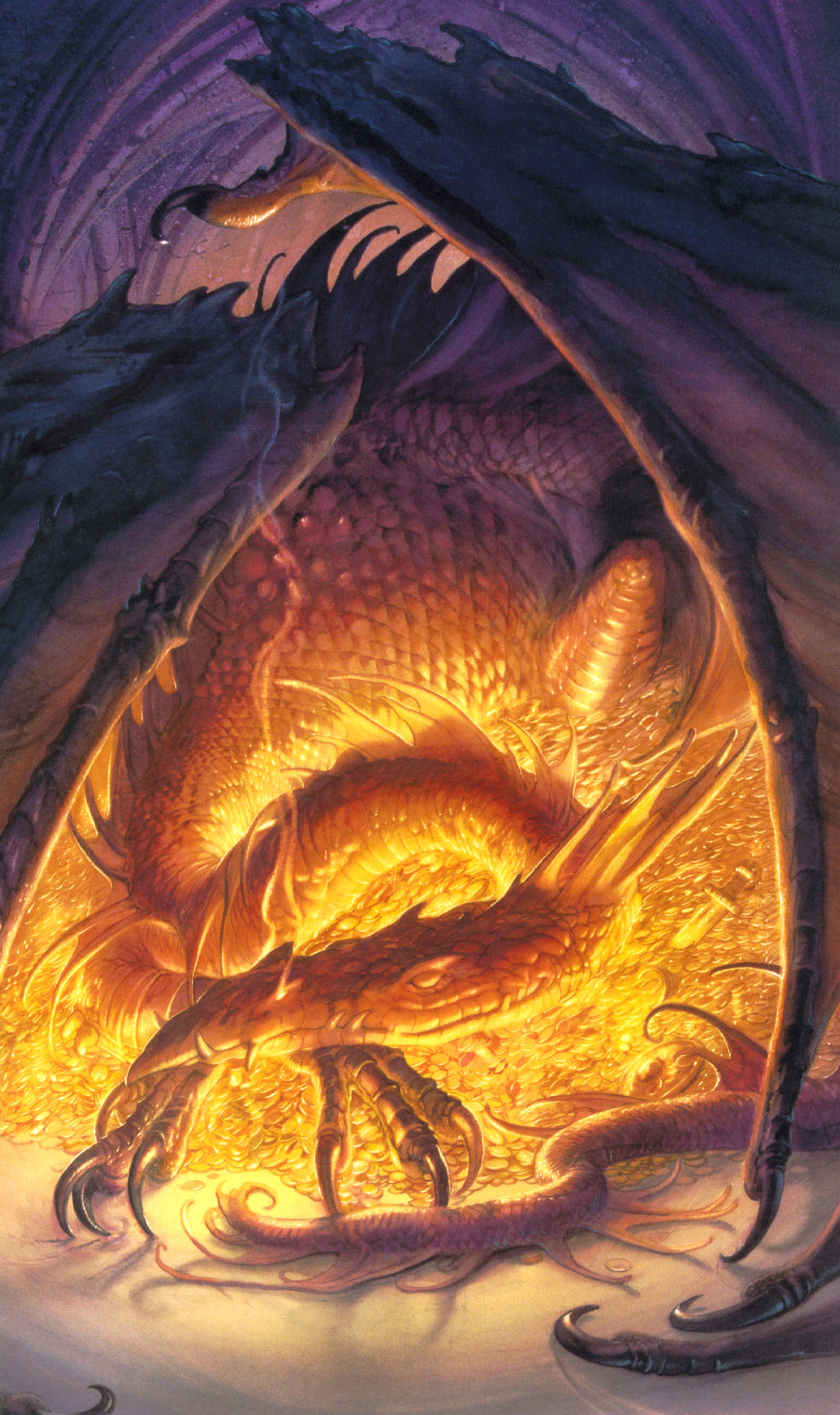
        Once again it’s the dragon that exemplifies this trait, probably dating back to the Norse story of Fafnir, whose unhealthy greed for treasure is what transformed him into a dragon in the first place.  As both Fafnir and Smaug could tell you, dwarfs like hoarding gold and precious objects, too.  In the medieval era it was griffins who were especially known for guarding treasure.
        The alicanto of Chile is a bird that could have been introduced under G, since it glows.  Unlike dragons, it has a real use for gold and other precious metals: they are its food.  If you see an alicanto glowing in the night you can try to follow it to the veins of precious ore from which it feeds.  (It can’t fly because eating all that metal makes it too heavy.)  But be careful, because it will be protective of its food sources and may try to lead you astray.
        Another gold-eater is the Chinese pixiu, a winged lion (which could have been introduced at F), that goes out in search of wealth, which he finds by smell.  He then brings gold and silver back and guards the treasure for his master.
        In Lithuania you may be able to get your hands on some of the gold gathered by the aitvaras or the similar kaukas.  These fiery-tailed dragons collect wealth for the specific purpose of enriching the household they’ve adopted.  However, as they are none too particular about where or how they acquire this wealth, you may have to choose between the aitvaras and an amicable relationship with your neighbors.
        You’re not as likely to get your hands on the gold of the Spanish cuelebre.  This is a flying snake (again, see F) that guards treasure.  Or at least, it’s said to do so, but I cannot confirm it as apparently no one has every actually found the treasure and returned to tell the tale.
        Then there’s the more recently-discovered niffler of the Wizarding world, which has a long snout that might be mistaken for a platypus beak.  Nifflers can be used to hunt for treasure, but such is their glee in shiny objects that they will tear a house or building apart in their search for anything glittery.
        The moral of these stories is that while a sufficiency of wealth is always good, enormous wealth may not be worth the price you’ll have to pay for it.  Nevertheless, if you’re determined, a Pro Tip for treasure hunters is to consider employing the gold-digging ants of India or Ethiopia.  These fox-sized gold-digging beasts are not, in fact, ants, but in any case the gold sand they dig can be gathered up onto camels and hauled away for your own enjoyment.

        Is there anything you particularly enjoy hoarding - I mean, collecting?


[Pictures: Dragon (Smaug), illustration by John Howe for The Hobbit by J.R.R. Tolkien, 1990 (Image from John-Howe.com);
Griffin, illustration by Henry Justice Ford from The Red Book of Animal Stories by Andrew Lang ed., 1899 (Image from Wikimedia Commons);
Pixiu, brass statue, c 1900 (Image from Pamono);
Niffler, poster by anonymous designer from Sykes Cottages ad campaign, 2016 (Image from Sykes Cottages);
Gold-digging Ant, wood block print from Ortus sanitatis by Johann Prüss, 1499 (Image from Boston Public Library);
Hoard of Teacups and Saucers, illustration by Lauren, 2014 (Image from artist’s web site iguanamouth.tumblr).]

April 4, 2022

G is for Glowing

        (My A to Z Blog Challenge theme this year is How to Make a Fantastical Creature, in which I explore 26 traits that are widely shared among the monsters and marvels of fantasy and folklore.
)
        A universal tool in every fantasy-creature-builder’s box is that magical glow.  As with flight, there are certainly plenty of bioluminescent animals in the natural world, mostly insects and lots of different animals in the seas, and yet creatures that glow with their own light are nevertheless clearly magical.  What’s especially interesting to me is that in folklore this trait can be seen as either good or bad.  Some of the most wonderful creatures glow, and so do some of the most terrifying and evil.
        A couple of the most benevolent glowing creatures have been introduced in previous posts: the hercinia that guides lost travellers through the dark, and the auspicious qilin that doesn’t even bend the grass when it walks.  On the other hand, some of the most evil beasts include the demon lidérc (introduced at the letter D), and the Chemosit of Kenya (which could also have gone under A or D).  It stands on its single leg outside a village at night and sings.  Its open mouth glows like a beckoning lamp, and children are lured out by the song and the light, only to be devoured.
        Some creatures are almost nothing except their glow, such as the will o’ the wisp.  Cultures all around the world have variants on the will o’the wisp theme, often with similar descriptions both of the appearance of mysterious balls of flame or light, as well as the behavior, in which these malicious lights lead travellers astray.  You can revisit one example in the previous post about the Japanese kitsunebi.
        The Tompondrano of Madagascar is a giant crocodilian monster with a glow-in-the-dark head.  You can see the head glowing through the water as it swims… and you don’t want to be there to see it when it surfaces.
        In the Alps the Alber is a sort of glowing dragon (also a demon) that shoots through the air like lightning.
        The space goblins of Hopkinsville, Kentucky emitted a silvery-green glow when they were spotted in 1955, and in 1903 the Van Meter Visitor of Iowa had, in addition to its bat wings, a glowing horn that shot out a beam of light.
        The boi-tatá serpent of Brazil has fiery eyes that see almost nothing by day, but everything at night because of their own light.
        The giant water serpent of Algonquin folklore, Meshkenabec, had a red head, iridescent scales, and glowing eyes.
        There are lots of other creatures with glowing eyes, too, especially those sorts of creatures that people tend to encounter in dark woods or lonely highways.  These include the Enfield Horror (Illinois), the Loup-Garou (Louisiana), the Dover Demon (Massachusetts), and the Mothman (West Virginia).
        You can also go back and bask in the glow of the firebird, or the hadhayosh.  We’ll also be seeing lots of fiery creatures in a later post… Foreshadowing!
        The moral of the glow of magical creatures is that one must use the most careful discernment before following anything that glows, and be sure to watch out for marshes and swamps.  (Just like following GPS… Even if it’s giving you directions, you still need to pay attention and not do anything dumb!)  A Pro Tip for children is that if you see mysterious glowing eyes under your bed, keep your extremities from dangling - but try offering a cookie or tuna sandwich.  Under-bed monsters can make excellent friends.
        Do you have any tips for discerning between good glows and evil glows in the dark of the night?


[Pictures: Zhar-Ptitsa aka Firebird, illustration by Ivan Bilibin, 1930 (Image from Wikimedia Commons);
Will o’ the wisp (Peggiwick), illustration by AEGN from Kate and Sam and the Chipmunks of Doom, 2009;
Boi-tatá, illustration in the style of a cordel woodcut from app game “Boitatá: Cobra de Fogo” (Image from Mapingua Nerd);
Under-Bed Monster, illustration by Bill Watterson for Something Under the Bed is Drooling, 1988.]

April 2, 2022

F is for Flight

        (My A to Z theme this year is How to Make a Fantastical Creature, in which I explore 26 traits that are widely shared among the monsters and marvels of fantasy and folklore.  Be sure to check out all the other bloggers participating in the Challenge this year.
)
        Slap a pair of wings on anything that doesn’t normally have them, and Hey Presto, you’ve got a magical creature.  There are plenty of magical mythical birds, and even some insects, but today I’m particularly thinking of the creatures for which the ability to fly is part of their magic.
        A human with wings becomes a fairy or angel, (unless it’s a baby, and then it becomes a cupid, cherub, or putto).  A horse with wings becomes a pterippus, a dog with wings becomes a xog, and don’t forget Ursula K. LeGuin’s Catwings.  This is another of those characteristics that doesn’t require any special analysis: humans have always been fascinated by flight, and any creature with the ability to fly is guaranteed to be pretty darn magical.
        Pegasus is not the only flying horse in the mythological heavens.  To name just a sampling, flying horses (some depicted without wings) are known in China (qianlima, longma, and tianma), central Asia (Tulpar), India (Dadhikra and Uchchaihshravas), Islam (Haizum), Thailand (Tipaka), and probably everywhere horses are known.
        The uwabami of Japan is a giant snake that according to some accounts can fly, and according to all accounts loves to drink sake and eat huge meals (which may include humans, so it could have put in an appearance at A).  Indeed, flying snakes are another type of creature that seems to be popular among storytellers around the world.  If you want more flying snakes, you can revisit the amphiptere.
        The serra is an enormous flying fish that loves to chase after ships and race them.  However, it generally gets bored after about two hundred yards, folds its sail-fins, and dives back down into the water, where hopefully it won’t saw into the ship’s hull.
        Of course everyone looks forward to seeing the proverbially impossible flying pig.
        It’s worth the reminder that many magical creatures can fly magically: without wings.  For example, the Chinese lung dragon seldom has wings, and its ability to fly is sometimes said to be seated in the bump on its head, or in the magical pearl it may carry.
        Some of the fun flying beasties I’ve written about before are the wolpertinger - a winged rabbit-hybrid, the llamhigyn y dwr - a sort of long-tailed winged toad, and my own Winged Peeper and Oaky Nutkin.
        Part of the wonder of your classic dragon and griffin is that they can fly, along with lots of the chimeric creatures introduced under C, including the simurgh, lamassu, and hippogriff.  Whenever I imagine a chimera, I’m certainly inclined to add wings, such as my malacorana.  It’s no coincidence that medieval illuminators loved to put wings on their decorative marginal critters.  After all, the moral of these creatures is that everything’s better with wings!  Which is why a Pro Tip for explorers of the realms of magic is to remember to be aware of what’s above you, as well as all around.

        Have you ever dreamt you could fly?  And if so, how did you do it: did you have wings, or flap your arms, or soar like Superman, or drift like a cloud, or…?  Tell me how you fly!


[Pictures: Pegasus (First Flight), rubber block print by AEGN, (2018);
Fairies, illustration from The Borrowed Bride by Patrick Sarsfield Cassidy, 1892 (Image from Open Library);
Catwings, illustration by S.D. Schindler from Catwings by Ursula K. LeGuin, 1988;
Serra, illumination from Worksop bestiary, 1185 (Image from Morgan Library);
Flying Pig, wood engraving by Steven Noble (Image from artist’s web site StevenNoble.com);
Lung Dragon, Chinese painted porcelain, c 1426-35 (Image from Met Museum);
Marginal monster, illumination from Luttrell Psalter, 1325-40 (Image from British Library).]

April 1, 2022

E is for Extreme

         (It’s April, and that means the A to Z Blog Challenge!  My theme this year is How to Make a Fantastical Creature, in which I explore 26 traits that are widely shared among the monsters and marvels of fantasy and folklore.)
        Sometimes the way you can tell that you’re dealing with a mythical being is not that it has any particularly unusual traits, but simply that it has ordinary traits to extremes.  If a mythical being is beautiful, he or she will be extremely beautiful.  Think of nymphs, mermaids, and vila, which have for millenia offered artists the excuse to portray bevies of beautiful nudes.  But there is also the scitalis, a serpent from medieval bestiaries which captures its prey because its skin is so dazzlingly gorgeous that its victims are literally stunned by the magnificence.
        On the other hand, if a monster is ugly, it will be extremely ugly.  The poor Bugul Noz of Brittany is a rather gentle fae, but doomed to loneliness because he’s so extremely ugly that sometimes just a glimpse of him is enough to cause death, and even the woodland creatures stay away.
        The song of the sirens is so extremely enticing that sailors crash on the rocks under its spell.
        The echeneis is a tiny fish that’s so extremely strong that if it fastens to the hull of a ship, the ship stops dead in the water, even if it had been sailing along at full speed.
        The Fanesii are a tribe of people from the far north of Europe, whose ears are so extremely long that they don’t wear clothes, but simply cloak their bodies with their own ears.
        The seps is a serpent so extremely poisonous that its venom dissolves both flesh and bone.
        The tiny jetins of Brittany are Little People who are so extremely strong that they entertain themselves by tossing around enormous boulders, which is why you find menhirs, standing stones, and other megaliths littered around the countryside.
        The eagle-like humility of Connecticut could fly so extremely swiftly, that it was faster than any bullet.
        The gulon (or jerff) of Scandinavia is so extremely gluttonous that after it’s eaten until it can stuff itself no further, it squeezes itself between two close-growing tree trunks to empty itself back out, so that it can go and eat some more.
        There are also some other extreme traits that I haven’t mentioned today, because they’ll be getting their own posts later.  Foreshadowing!
        If you want to revisit some of the extreme creatures I’ve shared in the past, try the extremely beautiful xana, the extremely smelly isnashi, the extremely ravenous and extremely stupid Ravenous Bugblatter Beast of Traal, the extremely hot hotheaded naked ice borer, and the Foon, who eats extremely hot rocks.
        The moral of these extremes is that if you would avoid a monstrous fate, seek moderation in all things.  But the Pro Tip for creature creators is the opposite: go ahead and dial up those traits to 11… or maybe even 13.
        If you could have one trait to the extreme, what would you want it to be?  (Or what extreme trait do you wish you didn’t have?)


[Pictures: Nymphs (Hylas and the Nymphs), painting by John William Waterhouse, 1896 (Image from Manchester Art Gallery);
Scitalis, illumination from Aberdeen bestiary, c 1200 (Image from University of Aberdeen);
Echeneis, engraving from Symbolorum & emblematum by Joachim Camerarius, c 1593 (Image from Linda Hall Library)
Gulon, hand-colored wood block print from Historiae animalium by Conrad Gesner, 1551 (Image from Hathi Trust).]

March 28, 2022

D is for Demonic

         (My A to Z Blog Challenge theme this year is How to Make a Fantastical Creature, in which I explore 26 traits that are widely shared among the monsters and marvels of fantasy and folklore.)
        In nature, animals are morally neither good nor bad: they all just do what comes naturally to eat, breed, and keep themselves alive.  But in unnatural history, creatures are almost always labelled as good or bad, and the really bad ones are often actually demonic.  Mythology and folklore are full of strange and magical monsters that originate in hell or actively align themselves with pure Evil.
        Mythology of many cultures around the world deals with forces of evil, although there is wide variation in how the whole cosmology of good and evil works.  Are demons subservient to God; does God use demons for heavenly ends?  Can one demon serve as protection against another demon?  Do demons have free will?  Can humans summon and command demons using magic?  Were demons created evil, or are they fallen from a divine creation?  Despite all the various ways these questions can be answered in different cultures, there are some common threads that show up with some frequency: demons are often seen as forces of disease, and also forces of sin (ie negative behaviors and disorders).   They are often believed to be able to possess humans, rather than merely acting on them.  It is also the case that “demons” is frequently considered a general category including many undifferentiated individuals.  Still, there are some particular demonic monsters I can highlight today.
        The incubus is a kind of male demon who seduces/rapes sleeping women, while the succubus is the female equivalent.  Usually they are portrayed as gorgeous humanoids, but often they have unsettling characteristics such as claws or tails.  The Trauco (a dwarf with no feet) is an incubus who lives on an island in Chile, and the lidérc (who can take the form of a will o’ the wisp - or of a naked chicken!) lives in Hungary.  Incubi and succubi are ever-popular in folklore, because sex.
        In South Africa the impundulu or lightning bird is a vampiric demon that summons lightning, serves as a familiar of witches, and can also behave as an incubus.
        The Balrog of The Lord of the Rings is a winged demon of fire and shadow, armed with a flaming sword and a many-thonged whip.  Tolkien gives the etymology of the name as Orcish for “cruel demon.”  The giant spider Shelob also seems to be classed as a demon, rather than a mere monster.
        The batibat of Tagalog folklore is a huge, obese tree-spirit demon, who becomes vengeful when her tree is cut down, and may suffocate people, or torture them through dreams.
        In Bali Rangda is a demon queen who eats babies and brings disease, and is eternally battling the forces of good.
        One of the most famous Judeo-Islamic-Christian demons is Asmodeus, who, depending on who’s telling, ranges from “the worst of demons” who murders anyone he gets his hands on, to one that can be bound by Solomon to build the temple and do other odd jobs.  He’s often said to be a demon of lust, but also gets credited at various times with vengeance and gambling.  Sometimes he’s portrayed as a handsome man who limps due to one rooster foot.  Other times he’s a little more interesting: in addition to the rooster leg, he has a serpent tail and three heads: a sheep, a bull, and a man spitting fire.  He appears as a character in tons of modern stories, but I won’t even get started on all the demons of modern fiction, D&D, and various computer/video games.
        Ammit (introduced under the letter C) is also often classed as demon, although in ancient Egypt the distinction between demons and gods could be fuzzy.  The wendigo (introduced under A) can also be classed as a demon.  Plus, you can check back in previous posts for snippets on Bartimaeus, the tormentors of St Anthony, imps, Tibetan demon Mara, Persian demon Falud-zereh, Japanese oni, and the Alpine Krampus.
        Because this is the last post of the month, let’s spend a little time on etymology.  The word demon appeared in Middle English around 1200 from the Greek
daimōn.  The Greek word referred to a minor deity, a divine spirit lower than a god, or a guiding spirit.  It had no negative connotations.  Its English meaning of a spirit of pure evil arose because Greek translations of the Bible (both Christian and Jewish) used the word daimōn for “heathen gods and idols,” and “unclean spirits.”  So as the word was absorbed into English, it came with that connotation.  But around the mid-sixteenth century English went back to the Greek and re-borrowed the word in its original sense of a guiding spirit.  It’s usually spelled daemon or daimon when it’s used that way.
        This etymology helps illustrate that your views on demons (even taking the modern English definition of “a spirit of evil”) will be influenced by your culture.  Lamashtu is a 
dreadful demon of ancient Mesopotamia.  With a lion head, donkey ears, hairy body, and talons for feet, Lamashtu particularly loves to kill babies and pregnant women.  On the other hand, she can be warded off by invoking other demons, particularly Pazuzu, with a canine head, horns, a scorpion tail, and two sets of wings.  Pazuzu is certainly a scary and dangerous being, but he obviously has his uses.  (Also in Mesopotamia, Gallu demons dragged their victims down to the Underworld, and the demon Asag was so monstrous that his presence made fish boil alive in the rivers, which I think is a marvelously horrible description.)
        The obvious moral of demons is that you must stay strong and vigilant to withstand the temptation to evil.  A Pro Tip for exorcists is that sometimes you can summon one demon to get rid of another.  On the other hand, sometimes that strategy ends up like The Old Woman Who Swallowed a Fly: she died, of course.  It’s probably wise to have bell, book, and candle at the ready just in case things get out of hand.  A shofar and Thibetan Guthuk soup can also be efficacious.
        The nature of Good and Evil - that really is THE question, isn’t it?


[Pictures: Incubus (The Nightmare), oil on canvas by Henri Fuseli, 1781 (Image from Detroit Institute of Arts);
Balrog, film still from “The Fellowship of the Ring” directed by Peter Jackson, 2001 (Image from Wikimedia Commons);
Impundulu, illustration by Ken Wilson-Max, 2013 (Image from the artist’s web site the Illustrationist);
Rangda, wooden mask from Bali (Image from Wikimedia Commons);
Asmodeus, engraving by M.L. Breton from Dictionnaire infernal by Collin de Plancy, 1863 (Image from Library of Congress);
Lamashtu amulet, carved stone, Babylonian, c 7-6th century BCE (Image from Met Museum);
Divs, illumination attributed to ‘Ali Quli, from the Khamsa of Amir Khusraw Dihlavi, c 1598 (Image from The Walters Art Museum).]

March 23, 2022

C is for Chimeric

         (My A to Z theme this year is How to Make a Fantastical Creature, in which I explore 26 traits that are widely shared among the monsters and marvels of fantasy and folklore.  I’ve started early, but I promise that I’ll end with Z on April 30, just like everyone else in the April A to Z Blog Challenge.)
        The chimaera of Greek mythology was described as having parts like three disparate animals: a lion in front, a serpent in the rear, and a goat in the middle.  I would have thought this description implied a snake tail in the same way that a mermaid has a fish tail, but instead the chimera is usually depicted as having a full lion body, with a snake head on the tip of its tail and a goat head poking out of its back.  Quite early in English (late 14th century) this hybrid creature gave its name to any sort of creature composed of various parts of other animals, and later to any sort of wild fancy.  In fact, the most common and universal way to make a magical creature in cultures all around the world is to describe it by the resemblance of various traits to other creatures.  Indeed, the mythical creature that can’t be described chimera-fashion is the exception.  You can read a previous post on chimeras here.
        Loads of famous mythical beasts are chimeric.  The centaur is half man half horse, and the faun half man half goat.
        The Han Dynasty scholar Wang Fu (c. 220 CE) described lung dragons with “the nine resemblances…: his horns resemble those of a stag, his head that of a camel, his eyes those of a demon, his neck that of a snake, his belly that of a clam, his scales those of a carp, his claws those of an eagle, his soles those of a tiger, his ears those of a cow.”
        The Egyptian demon/goddess Ammit has a crocodile head, foreparts of a lion, and hindquarters of a hippo.  She eats the impure hearts of those people who, after death, fail the judgement of Osiris.
        The Mesopotamian lamassu has the body of a bull or lion, a human head, and avian wings.
        The basilisk, although originally a mere serpent, eventually developed into a chimera with the front half of a rooster added to its snake tail.  (It also may have poison breath suitable for the letter B.)
        The hippogriff is a chimera combining the hindquarters of a horse with the front half of another chimera: the griffin.  Of course, the front half of a griffin is just the front half of an eagle.  There’s also a creature called the hippalectryon that looks the reverse: front half horse, back half eagle.
        The magical Himmapan Forest in the Himalayas is populated by many magnificent chimeric creatures, including the Kunchorn Waree, which has the front half of an elephant and the back half of a fish.
        
The Persian simurgh is sometimes depicted as a peacock with the head of a dog and the claws of a lion.  But some chimeras can be a bit variable.
        A creature with lots of options is the yali or vyala of India, which can combine its feline-ish body with lots of different possible heads, including elephant, lion, bird, horse, or dog.  But whatever kind of head it has, it's always strong and fierce.  (This illustration is one of mine.)
        You can find lots more chimeric creatures in previous posts, including malacomorphs, ypotryll, and welwa, as well as the jackalope and a host of similar rabbity-chimeras.  There are even chimeras that are mixes between beasts and objects, such as the umbrellaphant and the capybureau.
        The moral of these conglomerate creatures is that the easiest way to make something new is to mix up a few old things.  A Pro Tip for mad scientists is to get yourself a lab on a secluded island where no one asks awkward questions about why your pet ant-lions need their grain feed supplemented with gazelle meat.
        What creature traits would you most like to combine?  Do you have that mad-science hankering to create your own chimeras?  Try the Hybridizer, and tell us about your favorites!


[Pictures: Chimaera, Greek votive platter, 590-570 BCE (Image from Kunsthistorisches Museum Wien);
Ammit, illustration from Egyptian Book of the Dead papyrus, c 1250 BCE (Image from the British Museum);
Basilisk, wood block print by Jost Amman from Thierbuch, 1592 (Image from Library of Congress);
Kunchorn Waree, mural from Wat Gangaram, Ratchaburi, Thailand (Image from Wikimedia Commons);
Simurgh, silver platter, Iran, 9th-10th century CE (Image from Wikimedia Commons);
Yali (Fierce Guardian), rubber block print by AEGN, 2018;
Monster with the head of an ass (among other things!), wood block print from Monstrorum historia by Ulisse Aldrovandi, 1658 (Image from DFG viewer).]

March 18, 2022

B is for Breathing Fire

         (My A to Z theme this year is How to Make a Fantastical Creature, in which I explore 26 traits that are widely shared among the monsters and marvels of fantasy and folklore.  I’ve started early, and it’s still not too late for you to join in the Challenge with your own blog HERE.)
        There are no real-life creatures that breathe fire (although a few come surprisingly close!) so who was the first to imagine a creature that could?  Most likely this strange and marvelous - and scary - thought occurred to multiple people in the history of humanity, since the trait appears in folklore around the world.  Fire is one of the most magical forces humans know, simultaneously beautiful and potentially deadly.  The most famous mythical fire-breathers are dragons, but they are far from the only ones.  
        In classical Greece the chimaera and the Mares of Diomedes (already seen at the letter A) were known to breathe fire, and Persian mythology has fire-breathing horses with asses’ heads called conopenii.
        The basan is a Japanese creature that looks like a rooster but breathes bright red ghost-fire.  Interestingly, its fire may be cold and doesn’t burn.
        The catoblepas is a beast known to the medieval naturalists, which looks like a buffalo but with a shaggy head so heavy that it can’t hold it up.  This is lucky, because according to some authors it breathes fire, while according to others its breath is poisonous (but all agree that its stare is deadly, as well).  So let’s expand today’s category and include all sorts of breath weapons.  
        The French Lebraude (or Souffle, which is an awesome name for a monster!) is a large lizard or salamander which breathes only once per day, but when it exhales its poison, everything around dies instantly.
        The olgoi-khorkhol (or Mongolian death worm) can spit poison or discharge electric shocks.
        The Physeter (or Prister) of the Atlantic Ocean is an enormous sea monster that spouts violent streams of water and steam.
        In Jamaica there are dangerous duppies, which are ghosts or spirits, including Rolling-Calf, which breathes fire, and Three-foot Horse, which breathes poison.
        The modern mythology of Dungeons & Dragons categorizes its dragons into whether they breathe fire, poison, cold, acid, or electricity.

        Or read the previous post on Spring-heeled Jack, who breathed blue flame.

        Finally, I would like to mention the bonnacon, a beast of the medieval bestiaries, which has a lethal weapon it can spray, but not by breathing.  Its weapon comes from the other end.  The bonnacon looks much like an ox, but its horns are so tightly spiralled that the sharp ends don’t stick out to offer it any protection, so instead it sprays caustic, burning dung for a quarter mile behind it.
The moral of breath weapons is, of course, that no one wants to be a dragons’ dentist.  A Pro Tip for knights: try offering hostile dragons an enticing suit of armor packed full of high explosives.
        What's your best dragon-slaying strategy?


[Pictures: Dragon, rubber block print by AEGN, 2010 (sold out);
Basan, wood block print by Takehara Shunsensai, c 1841 (Image from Wikimedia Commons);
Catoblepas, wood block print from The Historie of Foure-Footed Beastes by Edward Topsell, 1607 (Image from Folger Collection);
Physeter, wood block print from Historiae de gentibus septentrionalibus by Olaus Magnus, 1557 (Image from Biodiversity Heritage Library);
Bonnacon, illumination from bestiary, 1201-1225 (Image from Bodleian Libraries).]