 |
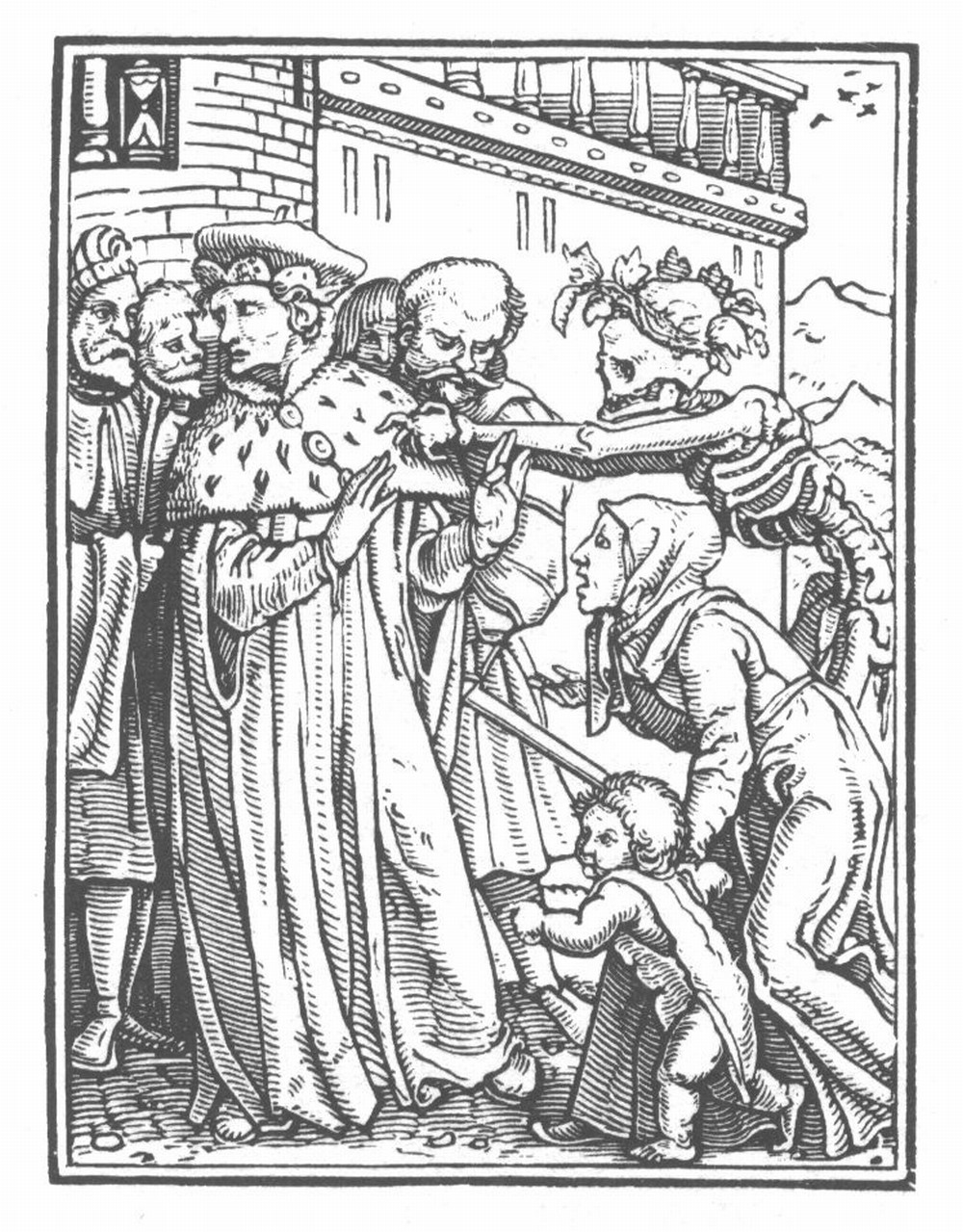
| Death takes the Duke in the very act of turning away from the pleas of a poor woman and child. |
Totentanz is German for Dance of Death, also sometimes referred to in English by the French name Danse Macabre. The Dance of Death is an allegory that arose in the early fifteenth century to remind people that Death comes for everyone. It usually shows Death, generally personified as a skeleton, summoning people of all different ages and stations of life. The idea was to admonish people (in pictures, as most were illiterate) not to set store by the glories of earthly life, for death unites us all.
If this seems a bit morbid in our modern era, keep in mind that the fourteenth and fifteenth centuries in Europe were one long parade of famine, warfare, and plague, not to mention the high mortality rates of mothers and infants and, well, everybody, even under "normal" circumstances. Death was indeed an ever-present shadow, and the Dance of Death images combined both responses to that threat: the religious fervor and the desire to make merry as long as one still could. We'll all be summoned by Death sooner or later, but we may as well go out dancing.
 |
| The Nun is in her rich apartment listening to the serenade of her lover... when Death extinguishes her candles. |
Hans Holbein the Younger
(c. 1498 - 1543) happens to be my favorite portrait painter of all time, but I hadn't been familiar with his work as a woodblock designer. He made his Totentanz woodcut designs while living in Basel in the 1520's before he had become famous for his portraiture. The Reformation reached Basel around the same time, and Holbein was doing commissions for Catholics, Lutherans, and Humanists, mostly doing murals and woodcut designs. (Remember that Holbein did not carve the wood blocks. That was done by Hans Lützelburger, the finest Form-schneider of his day. See here for a description of the woodblock printing process of the time.) Holbein designed 41 wood blocks in the series. In 1545 another twelve images were added by someone else, after Lützelburger had died and Holbein was living in England.
(c. 1498 - 1543) happens to be my favorite portrait painter of all time, but I hadn't been familiar with his work as a woodblock designer. He made his Totentanz woodcut designs while living in Basel in the 1520's before he had become famous for his portraiture. The Reformation reached Basel around the same time, and Holbein was doing commissions for Catholics, Lutherans, and Humanists, mostly doing murals and woodcut designs. (Remember that Holbein did not carve the wood blocks. That was done by Hans Lützelburger, the finest Form-schneider of his day. See here for a description of the woodblock printing process of the time.) Holbein designed 41 wood blocks in the series. In 1545 another twelve images were added by someone else, after Lützelburger had died and Holbein was living in England.
 |
| Is it a coincidence that Death seem so cheerful about assisting the doctor in his treatment of the patient? |
Holbein's Dance of Death wasn't first published until 1538, possibly because of disapproval of its content - it was pretty seditious in some ways, highlighting the corruption of pope, emperor, and magistrate, among others. Despite or because of this, it was popular enough to change the Dance of Death genre. For example, before Holbein it had been common to depict Death and all the people in one large scene dancing together (perhaps pointing more directly to the Black Death and other episodes where many people were struck down at once.) Holbein instead showed separate vignettes of each person being summoned in his or her own daily environment. Sometimes Death is actually the one killing the victim, not just notifying him that his time has come, as had been the standard before. Holbein's Death is often quite mischievous, as for example stealing the rich man's money, or trying to draw the astrologer's attention away from the heavenly spheres and toward contemplation of a skull instead.
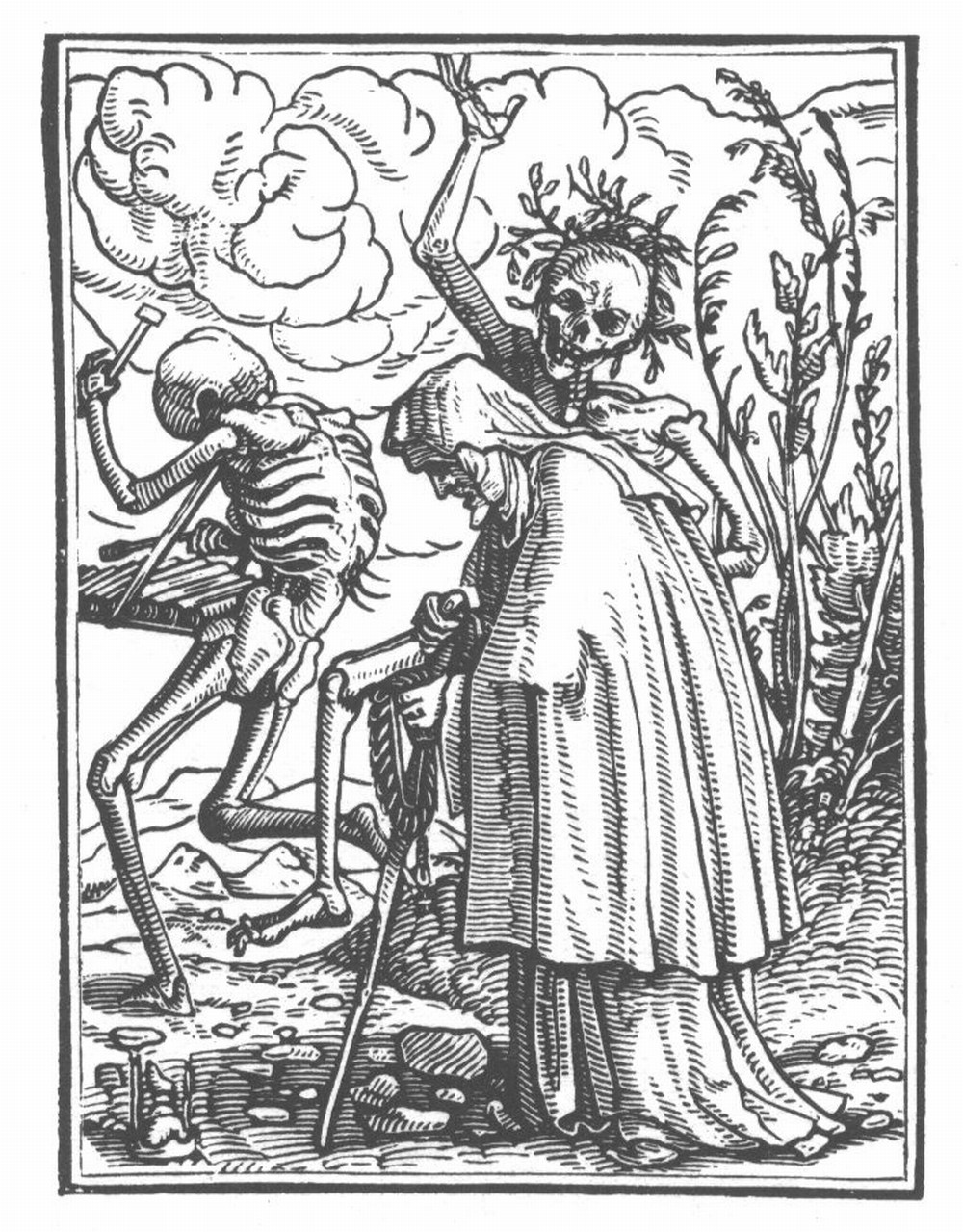 |
| As Death leads away the Old Woman, perhaps he's finally showing a more lovable side, helping her along with music and dancing. |
Speaking of skulls, I can't help thinking that Holbein might have felt a special affection for his Death figures, since Hohlbein is German for "hollow bone," which could be a riddling term for "skull."
At this time of year people in my neighborhood blithely decorate their houses with skeletons, skulls, and Grim Reapers, thinking of it as fun and festive. It occurs to me that perhaps we should reconsider our condescension toward people in what we like to call Dark Ages and ignorant times -- they apparently had a much more sophisticated and multi-faceted view of images of Death. What we glance at and dismiss as cute holiday decor they would perceive as moral lesson, social commentary, and humor, simultaneously knowing the very real fear of Death and acknowledging what it says about life.
If you want to see all of Holbein's Totentanz images you can find them at various websites. Try this one, or the images at Wikimedia Commons, (where I got the ones I've shown here. Many thanks!)
[Pictures: The Duke, The Nun, The Doctor, The Old Woman, wood block prints designed by Hans Holbein, c. 1526, and carved by Hans Lützelburger before 1538.]