Showing posts with label Arisia: Things that Don't Exist. Show all posts

October 2, 2020

Symbiote City

        I have completed a new block print inspired by the idea of life on Venus, and I wanted to share some of the thought behind the design.  If you really want the full story, you should review the earlier post on Life on Venus, which lays out the scientific background, and why I began thinking about jellyfish.  So, I was imagining creatures evolved from jellyfish-like organisms, floating around in the cloud deck of Venus’s atmosphere.  I had a lot of fun carving the thick, swirling clouds representing the atmosphere, and I picked my weird color combination because I thought it evoked muggy, poisonous gases.  The ink colors are actually black and yellow.  One of the weird quirks about mixing pigments is that while you mix black with colors to get dark blue, dark red, dark green, dark purple, you never really get “dark yellow.”  It just ends up looking green instead.  So that’s how I depicted the atmosphere of Venus.
        The creatures, however, are less straightforward, and they illustrate an interesting point about creating strange new things.  The seed of my idea was that all Venusian life would be evolved from medusae.  (That’s the scientific word for jellyfish.)  Presumably these creatures have had as long to evolve as, say, the first things to crawl out of the oceans on Earth.  They could therefore be as diverse as all vertebrates, from snakes to hummingbirds to fish to giraffes to frogs to whales to ostriches to dachshunds to turtles to humans.  If I were writing a sci fi novel about life on Venus, I could depict all manner of creatures, as wide a diversity as I could imagine.  In one little illustration, however, I can’t.  Why not?  Because the idea behind the picture was that life on Venus evolved from jellyfish, and if I depicted creatures diverse enough not to look like jellyfish, no one would any longer be able to recognize the idea.  If I were capable of greater detail and precision in my carving, I’m sure I could have stretched the bounds a little further while including more subtle clues about my creatures’ origins.  However,  in the end, with the limits of my ability, I couldn’t really get wildly creative without losing the focus.
        I was taken with the idea of creatures evolving symbiotically, and imagined that very large medusae could house smaller ones.  With no solid surface land in the cloud deck, these huge ones would be floating islands, providing both a ground to build on and a protective dome inside which other organisms could thrive.  The symbiotic smaller medusae have four tentacles more like an octopus, with which they are capable of manipulating their world with great dexterity.  Likewise, there's no reason that intelligent, dextrous jellyfish should, when building towns, come up with anything even remotely like human towns.  Yet I've made mine look fairly humanoid so that my humanoid viewers can recognize it as a town.
        Then there’s another little type of jellyfish inside the dome, and I picture these perhaps processing the chemicals in the atmosphere in a way that makes them useful so that the dome dwellers have domesticated them.  Perhaps there are also species that are kept as pets.  To the lower right a flock of them is fleeing to the safety of the island dome’s tentacles, pursued by a large predatory medusa.  To the left and in the upper right corner are a couple of other species.  The fact is, though, that they all look a lot like basic Earth jellyfish, and not nearly as wild and alien as they could actually be in real life, if real life actually evolved on Venus.  I alluded to this before in my discussion of the poem Jabberwocky, because nonsense and sci fi/fantasy both have to balance the known with the unknown, the strange with the relatable, and the wildest stretches of the imagination with the intelligibility of the story to be told.  This piece is not intended to be a great flight of world-building bravura, but is rather a just-for-fun whimsy.

[Picture: Symbiote City (Venusian Medusae), rubber block print by AEGN, 2020;
the carved block, photo by AEGN, 2020.] 

November 19, 2019

Picturing the Unseen

        There is a particular issue that comes up when illustrating fantasy, which is how to depict those things that are unseen: invisible, or never witnessed by human eyes.  It’s a contradiction that encompasses illustrators of dinosaurs, prehistoric personalities, and ancient cities, as well, but it hits fantasy and sci-fi illustrators particularly hard.  I think invisibility deserves its own post some day, so for now I’m thinking about drawing things that no one has ever seen.
        First, there are the things that, within the context of a story, are perfectly visible, such as dragons, time machines, or indeed any fictional person, place, or thing.  These cannot be drawn from life or copied from reference photos, so what’s an artist to do?  The more popular mythical things, such as dragons and fairies, have no shortage of previous depictions to be used for inspiration, but some creatures are entirely new.  The most common method for depicting fantastical things is the chimera approach: wings like a bat, tail like a snake, feet
like a raptor, and so on.  In other words, find something real that relates to it, and use that model just for the element to which it relates.  In many cases we have written descriptions to work from, as well.  Ultimately, however, there has to be a picture in the mind to be used for guidance, instead of a real object or photo.  All we have to do is imagine something, and then it can be drawn.
        What about things that even within the context of a story, no one has ever seen?  Some ghosts or spirits are supposed to be invisible, some objects are hidden away in utmost secrecy, some beings are veiled from mortal view by darkness, light, mist, or distance…  In these cases  we must make pictures that reveal nothing — Or we get caught in a contradiction.
        This is an illumination of the simurgh, a bird that this thirteenth century Persian bestiary tells us lives “in fastnesses never penetrated by man,” and hidden from view.  The marginal note is by a later reader, who wrote testily, “Thou fool, if nobody has seen the simurgh, then how dost thou portray it?”  It’s a fair point.  Here’s where an artist’s superpowers become evident: sometimes an illustrator is omniscient and can show you in lavish and loving detail what no mortal has ever seen.  I say, just go with it!
        For a satirical little poem about a never-seen microbe (with a picture, of course!) revisit this previous post.

[Pictures: 10. Landscape with Ruins and Cylinder Segments, wood block print by Lorenz Stöer, 1567 (Image from TU);
Drollery, rubber block print by AEGN, 2019;
Simurgh, painting from Persian bestiary, c 1297-1300 (Image from The Morgan Library & Museum).]

March 5, 2019

Creature Collections: Dracopedia

        As work continues apace on my own creature collection, it’s time for another review of some of the cool books already available.  Today I’m looking at three books by the same author/illustrator.  The premise of the Dracopedia books by William O’Connor is a blend between the genres of “how to draw” guides and “field guides” to mythical creatures.  In some ways these two genres are contradictory because instructions for drawing have to mention that you’re making things up, while field guides claim that you’re reporting what has really been seen in the world.  I think O’Connor does a surprisingly good job at the uneasy balance between the two ways of presenting mythical creatures.  All the Dracopedia books follow the format of presenting a creature and the “facts” about it, followed by a break-down of the process O’Connor used to create his illustration.  Most of his illustrations are done with a pencil sketch scanned into the computer and then painted digitally.
        The first Dracopedia book is subtitled A Guide to Drawing the Dragons of the World, and is organized as thirteen families of dragon, each with its biology, habitat, history, and different species, followed by the drawing lesson.  O’Connor’s illustrations are beautifully detailed and lifelike, although they tend to be a little too monochromatic for my idea of perfection.  His natural history is well thought out and includes lots of good information, and it would have pleased my mythical-field-guide-loving children very much back in the day.  My one caveat is that O’Connor does indulge in a bit of mythical revisionism, reinterpreting as dragons all sorts of creatures that, in my opinion, are their own separate families.  This includes quetzalcoatl (which has now become somewhat standard as a dragon species in field guides), sea serpent, and hydra, but also the claim that the kilin is an Arctic dragon, the salamander is a species of basilisk (which in turn is a type of dragon), and tales of fairies and will-o’-the-wisps are really based on sightings of dragons.  This irked my purist heart a bit!  On the other hand, I really enjoyed O’Connor’s inclusion of the tiny feydragons, as well as riding dragons, which he calls dragonettes.
        The second book appears to be Dracopedia: The Great Dragons, but my library system doesn’t have it, so I can’t tell you about it and we move on to…
        The third book is subtitled The Bestiary and broadens its scope to 26 mythical creatures selected, after my own heart, as one for each letter of the alphabet.  Each creature has a section on history, followed by the art demonstration.  This time the art demos include a fair amount about concept sketches, and it’s interesting to see how the artist tried out a few different ideas for the creature and the composition of the piece, before selecting one to complete.  O’Connor selects creatures from around the world, including several of the oddities from European heraldry, but he definitely gives them his own spin and interpretations.  He has a tendency to stick wings on everything, including the chimera, enfield, and manticore.  I get it - everything’s cooler with wings - and I
certainly can’t complain about his wanting to reimagine things, as I’m busily reimagining things in my own bestiary, but some of his reinterpretations go a little too far for me.  They also end up with a number of the creatures looking a little samey, with no fewer than seven winged lion-and/or-horse things.  These criticisms should not be taken as too damning, though; on the whole this is an excellent book, with loads of wonderful content to satisfy the lover of mythical creatures.  I especially love the way he’s done the questing beast and the xenobeast.  (Fun note: out of the entire alphabet, O’Connor and I share only four creatures!  Although a few of his others were on my short list.)
        The fourth book is Dracopedia: Legends, and is organized around thirteen famous dragon legends from Europe and Asia.  Each story is retold, followed by the art demonstration, which includes a nice section on “Research and Concept Design.”  O’Connor assigns each of these legendary dragons to one of the families he defined in the first Dracopedia book.  Again, don’t look to this book for faithful retellings to satisfy the scholarly purist, but take it as a rip-roaring collection of monster adventures and illustrations, and enjoy.

[Pictures: Fronstispiece from Dracopedia: Legends by William O’Connor, 2018;
Feydragon Biology, from Dracopedia by O’Connor, 2009;
Questing Beast, from Dracopedia: The Bestiary by O’Connor, 2013;
Xenobeast, from Dracopedia: The Bestiary by O’Connor, 2013.]

June 19, 2012

Chimeras

        The classical chimera, with its three random heads poking out of random places, has always seemed to me a most unconvincing beast.  It seems like a made-up monster rather than a plausible creature.  But in the word's more generalized meaning, a monster made up of elements from different creatures, fantasy is full of excellent chimeras.
        Really, almost any fantasy creature can be described in chimerical terms, from the Asian dragon with its "horns resembling those of a stag, his head that of a camel," etc., to the griffin's mix of eagle and lion, to the jackalope's conglomeration of other creatures' features.  But while they can be described by analogy, dragons and griffins seem to have their own integrated identities.  I want to focus on a few chimeras that are definitely hybrids but which, unlike their Lycian namesake, I wholly endorse.
        First of all, two chimeras of my own invention.  The walraconstrictor is a product of a game I used to play in college.  My roomates would give me two animals and my job was to combine them.  The only one I specifically remember, because it was our favorite, was the walraconstrictor.  Another chimera came to me in a dream.  I dreamt of the frowl and when I woke tried to sketch it.  I never could get it to look quite right, but I still think the concept is promising.
        A running joke in the fantasy cartoon series "Avatar: The Last Airbender" is that the animals are all hybrids, including tiger-dillos, badger-moles, buffalo-yaks, cat-owls, elephant-rats, eel-hounds, ostrich-horses, and sabertooth moose-lions.  Indeed, when our heroes encounter the Earth King's pet bear in the episode "City of Walls and Secrets," they question whether the beast must actually be a platypus-bear, skunk-bear, armadillo-bear, or gopher-bear.  A "just bear" seems rare and strange to them.  P and T really enjoyed the chimeras played for laughs throughout the series.
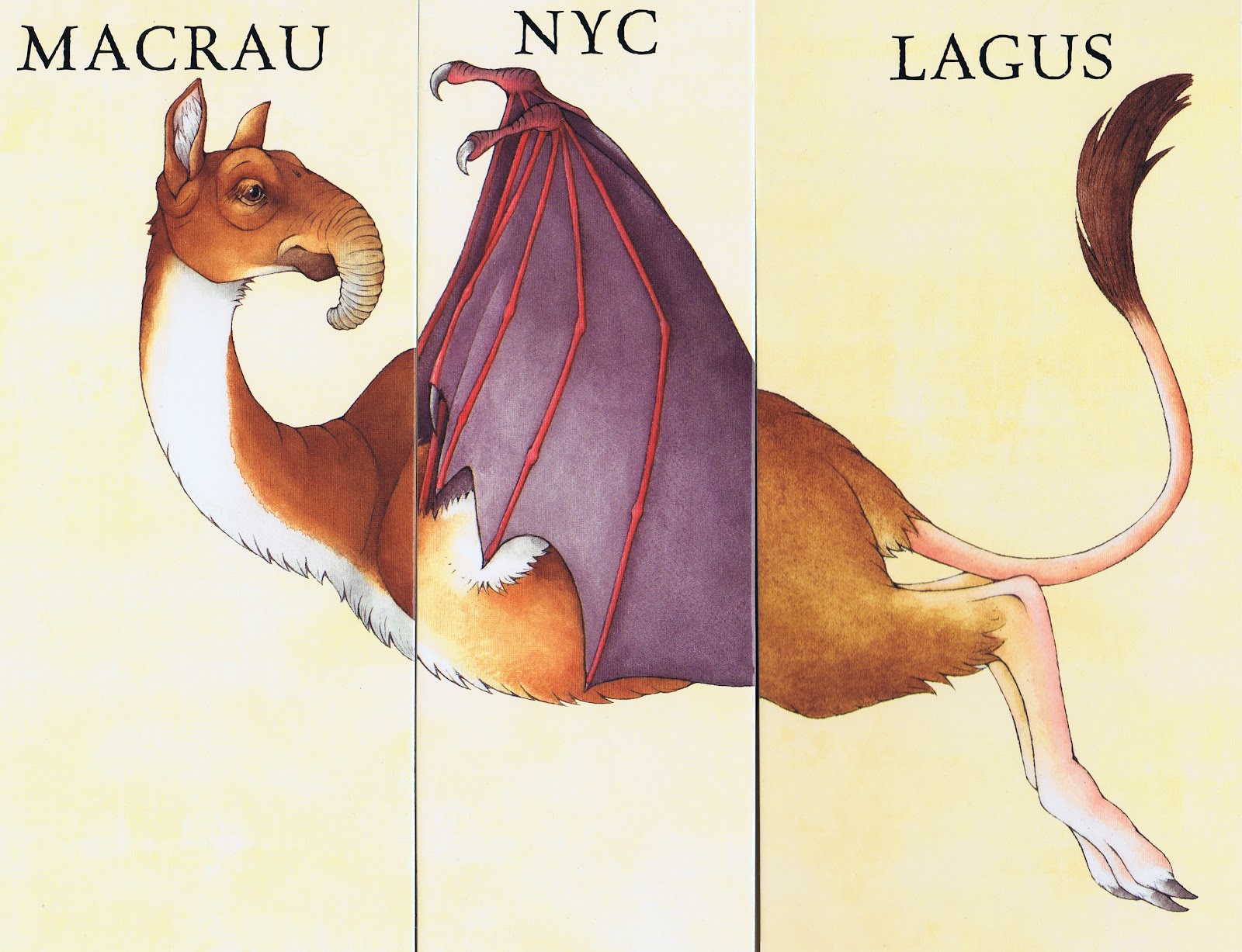
        Finally, if you and your friends want to create your own chimeras, the game "exquisite corpse" can be adapted to animals.  Each person takes a turn drawing a portion of an animal - head, fore-body, or rear - in which all the artist can see of the other contributions is the very edge, to make sure they all match up.  There are also a number of split-page books that make it easy to mix-and-match animal parts.  My favorite is definitely Flip-o-storic illustrated by Sara Ball.  The sectioned animals are all post-dinosauric prehistoric creatures such
as the saber-toothed cat and the glyptodon.  The book includes good factual information about the real extinct creatures involved, presented so that you can also see how it would describe the chimeras you create.  It's fun to see how some combinations look too "normal" to be appealing, while other combinations don't seem to meld convincingly - but some mash-ups are just right.
        As long as humans have been telling stories they seem to have been creating monsters by combining features of the real animals they encountered.  So remember, all it takes to design your own mythical creatures is a well-stocked menagerie and a pair of scissors!

[Pictures: Chimaera of Arezzo, woodcut depicting the famous Etruscan bronze sculpture, from Monstrorum historia by Ulisse Aldrovandi, 1642 (image from AMS Historica of the University of Bologna);
Walraconstrictor and Frowl, pencil and photoshop by AEGN, 2012;
Macraunyclagus and Dolothus, illustrations by Sara Ball from Flip-o-Storic by Britta Drehsen, 2011.]