Showing posts with label creature collections. Show all posts

June 5, 2026

Creature Collections: Hidden Worlds

         Most of the Creature Collections I’ve featured over the years take the form of encyclopedias or field guides, listing a range of fantastical creatures said to be found in our world.  (If you’d like to see all the Creature Collections so far, look in the sidebar or here.)  Today I’m highlighting some books that play with the conceit of discovering different worlds of creatures.  Each of these books has actually been mentioned before in this blog, but I thought they deserved to be pulled together under the Creature Collections category.


        The Land of Neverbelieve, by Norman Messenger - This lavish book is the record of a visit to a mysterious island and the strange things seen there.  The watercolor and colored pencil illustrations are dreamlike, and the pages fold out to give even more room for pictures.  There is no story or apparent order to the information gathered here and Messenger's imagination has wandered freely, so there's a lot to look at.  Back when she was much younger my daughter T especially liked all the funny trees with their surreal shapes and produce.  I featured a few of these plants in my series of posts on the Botany of the Realms of Imagination: giant curly ferns, umbrella palms, and spaghetti trees.
However there are plenty of creatures in this book, as well!


Amarant, by Una Woodruff - This one reproduces the sketches and watercolors of a seventeenth century noblewoman whose travels brought her to the mysterious island of Amarantos, which was once known as Atlantis.  As a botanist, our artist was focussing her observations on plants, but the book finds its place among my creature collections because so many of the plants of Amarantos happen to be plant-animals hybrids with insects, birds, all kinds of other creatures, and even dragons.  This makes a fun coffee table book, excellent simply for admiring the pictures, however it dates back to 1981 and is no longer readily available.  I was lucky to find a used copy.  In past posts you can see the flower of immortality and a couple of insect-plants, as well as the Dragon Vine and Dillcorn.


        Codex Seraphinianus, by Luigi Serafini - This one is a little different in that it includes no story whatsoever, and all the text is written in an imaginary alphabet of some sort.  One chapter is on plants and you can see spreads of those illustrations here and here, but there are also chapters on machines and vehicles, cultural items, architecture, and of course creatures.  It’s another one that’s best for browsing through, and it’s beautiful, surreal, very weird, and definitely an oddity.  (Also first published in 1981, so clearly there was something in the air that year.)


        Dinotopia: A Land Apart from Time, by James Gurney - The creatures in this book (followed by a series of books and other media) are not fantasy per se, since dinosaurs did of course actually exist.  But this is a fantasy version of dinosaurs, in which they have survived and evolved in intelligence but not form, and now are living in a collaborative society with humans.  As with the other books in today’s post, it’s the beauty of the illustrations that provides the appeal.  Like the others it’s in the form of an explorer’s notebook recording all the amazing things he discovers, and the magic of the book is in inviting us to immerse ourselves in the gorgeous pictures of wondrous things.  You can see mention of
Dinotopia along with some i
llustrations of these magical dinosaurs in a Steep Street, a Skybax rider, and Treetown.


        This is exactly the sort of book I was constantly devising in my childhood, with maps and short explanations, along with pictures of people, buildings, landscapes, and plenty of fantastical creatures.  Of course, my little booklets were neither as comprehensive nor as expertly illustrated as these!  If you’re in the mood for a strange and wondrous armchair journey, I recommend a look at any of these books, if you can find them.


[Pictures: Of Marsh and Stream, illustration by Norman Messenger from The Land of Neverbelieve, 2012;

Unicorn bird, illustration by Una Woodruff from Amarant, 1981;

Illustration by Luigi Serafini from Codex Seraphinianus, 1981;

Skybax Rider over Dinotopia, painting by James Gurney, c 1992 (Image from Heritage Auctions).]

July 26, 2021

Periodic Table of Aliens

         Do you like my depictions of fantastical creatures?  Do you like weird and wild space aliens?  The properties of the elements of the periodic table?  Light verse?  Cute and quirky books?  If you replied “Yes” to any of those questions, you should zip straight over to Kickstarter to check out Miguel Mitchell’s new Kickstarter campaign!
        Miguel has written a poem with a humorous verse for each of the 86 naturally-occurring chemical elements in the universe, describing a property of the element and an imaginary space alien associated with it.  With a PhD in chemistry and plenty of speculative fiction cred, he knows whereof he rhymes.  I’m involved because he commissioned me to illustrate his verses.  Exactly how many of the illustrations I will do depends on how much backing the project gets — the more people pledge, the more illustrations I’ll do!  The remaining illustrations will be done by Miguel himself.
        Today I’m sharing with you the illustration for sodium and its associated alien, the oodleplop.  (You can read the verse as the sample shown on the Kickstarter page.  I’d share it here, but I want to make you go to Kickstarter — that’s what a marketing mastermind I am.  Bwaahaha!)  This is one of the first illustrations I’ve done because it really caught at my imagination, and the whole scene of the slime-monster tending a dark old-time apothecary came to me in a glorious flash.  In fact, the idea tickled me so much that I even wrote a short story inspired by it (although in my story the creature is on Earth).
        I’ll share one more illustration with you today.  This one is a faux block print, done digitally rather than actually carved and printed.  It illustrates a long-legged iverstahl, who is associated with strontium.  The other little alien doesn’t have a name.  Maybe it’s actually a larval iverstahl before it undergoes metamorphosis…  But I tend to think that it is indeed another species, receiving assistance from the tall iverstahl.  I know what it’s like to need help reaching high things.
        Anyway, I signed on to be an illustrator on Miguel’s project because I thought it was a fun combination of science and fiction, and because I thought it would be an interesting challenge to imagine all these crazy creatures.  If you, too, think this sounds like a fun project, please consider supporting the Kickstarter campaign to make it possible.  And forward this along to all your most wonderfully nerdy friends, so that they, too, can enjoy and support this delightful undertaking.


[Pictures: Na is for sodium, aka Love Potion, rubber block print by AEGN, 2021;

Sr is for strontium, illustration by AEGN, 2021, both for Periodic Table of Alien Species by Miguel O. Mitchell.]

January 7, 2020

Upcoming Bestiary Talk

        On Thursday I will be giving a presentation on “The Fantastic Bestiary,” which is my not-particularly-subtle pun with two meanings of fantastic: “really great” and “imaginative or fanciful.”  The thing that gets me so excited about medieval bestiaries is not just the wonderful creatures or just the quirky illustrations or just the strange “facts,” but the blending of so many different fascinating facets: art, science, mythology, morality, history, literature…  It’s a veritable smorgasbord of Interesting Things.  The title slide of my talk gives a sort of table of contents, and you can see that I’ll be trying to cover a range of all the good stuff that goes into medieval bestiaries, and then, of course, how I tried to take all that good stuff and adapt it into my own bestiary.
        In putting together the talk and slides I’ve really been going a little crazy, spending weeks scouring through about 80 on-line digitized manuscripts and incunabula, comparing creatures and contents, and selecting my favorite illustrative examples.  Obviously it’s been a labor of love, since otherwise it couldn’t possibly be worth the amount of time I’ve spent, and I’ve indulged many a fascinating tangent along the way.  I’m just astonished and grateful that there are so many digitized works available to me - 20 years ago this sort of research, encompassing rare works from about two dozen different libraries and museums, would have been extremely difficult and expensive for a scholar, and utterly unthinkable for an amateur like me.
        If you do happen to be local to the greater Boston area, and available during the day, the presentation will be at North Hill in Needham, Thursday, January 9, at 2:00pm.  If not, I do hope to be sharing at least a few highlights in coming blog posts.

[Pictures: Title Slide with three dragons;
A collection of griffins from 13 bestiaries, demonstrating a wide range of artistic talent (or lack thereof).]

June 14, 2019

Creature Collections: Encyclopedias

        My interest in compendia of magical beasts is nothing new, obviously  (click on “Creature Collections” in the sidebar for lots and lots of other books) but for the past year or two I’ve been trying especially hard to get my hands on as many comprehensive creature reference books as possible, in order to research subjects for my block prints and my bestiary.  Here are a few of the works I’ve consulted:

        The Mythical Creatures Bible, by Brenda Rosen, 2009 - Lavishly illustrated, full-color encyclopedia with creatures organized in categories, of which “Sacred Creatures” is a separate category, which I appreciate.  The variety of illustrations includes some from older sources and some apparently made for this book.  It does include some errors (such as “the real-life lizard called a Salamander,” and putting the elves of The Lord of the Rings among the “many famous fairies in literature”) which don’t inspire confidence.  It is, however, an appealing book to browse through.

        Dragons, Unicorns, and Other Magical Beasts, by Robin Palmer, 1966 - A dictionary of only about 66 animals with small illustrations, plus complete stories or poems about 12 of them from a variety of cultures.  Hardly a comprehensive reference work, but it is interesting to read about some of the creatures in their own contexts.

        A Dictionary of Fabulous Beasts, by Richard Barber and Anne Riches, 1971 - A good small reference with a wide variety of creatures, including lots of local monsters of the British Isles, and some more modern beasts such as the gremlin and shmoo.  I especially appreciate that each entry includes its references in an extensive bibliography.  The bibliography is helpfully organized by time period.

        A Field Guide to Fantastical Beasts, by Olento Salaperäinen, 2016 - Despite the title this is not a field guide, but it is a nice overview of lots of creatures, relatively heavy on humanoids, and arranged in categories (including “The Sacred & the Divine”).  Each of the entries includes side boxes that mention specific instances in literature from ancient myth to modern movies.  It does a great job of putting recent pop culture instances into context.  The illustrations aren’t particularly inspiring, but do at least have the benefit of including a nice diversity of people, when people are shown.

        Giants, Monsters, and Dragons, by Carol Rose, 2000 - Pretty much the keystone reference work on mythical beasts (it tends not to include the more humanoid creatures), this one has a lot going for it.  It covers a lot of beasts, each one given with its references; it has an excellent bibliography; and it includes a number of useful indexes.  It’s always one of the first places to look.  Because it’s such a popular source, it’s a little hard to cross-check - any errors in this book tend to be repeated by everyone else on the internet and in subsequent works (including, no doubt, my own).  Obviously I’d prefer to be able to trust all its information completely, but I think it’s pretty much impossible to cover this much ground without allowing a few errors to creep in, and I consider this encyclopedia an impressive and extremely useful resource.

        The Element Encyclopedia of Magical Creatures, by John & CaitlĂ­n Matthews, 2005 - This dictionary aims to include all sorts of magical beings, including not just what I think of as mythical creatures, but also gods, and famous named individuals of certain species, such as centaurs, for example.  It also has articles on the magical attributes of real animals such as elephants and dogs.  There are inset sections retelling specific stories about many of the creatures, and others discussing certain larger categories, such as “Celestial Creatures” and “Road Predators.”  I would have appreciated if it included references for each entry, as some of the other encyclopedias do.

        As I mentioned, I think it’s pretty hard to achieve simultaneously broad range and perfect accuracy of detail, and I’m sure all these works have at least a few inaccuracies, especially in their accounts of non-European mythologies.  I wish they were perfect, of course, and if there were a perfect source I would certainly wish to own a copy — but I confess that I find myself with a bit of a soft spot for the inaccuracies that result from the Game of Telephone that is mythology.  After all, myths and legends have always morphed and changed over time and place as people hear stories, misunderstand them, “improve” them, and tell them again, on down the line.  Despite our best efforts, why should we be any different?

[Pictures: Kraken by uncredited illustrator (?) from The Mythical Creatures Bible by Rosen, 2009;
Gremlin by Rosalind Dease from The Dictionary of Fabulous Beasts by Barber & Riches, 1971.]

March 5, 2019

Creature Collections: Dracopedia

        As work continues apace on my own creature collection, it’s time for another review of some of the cool books already available.  Today I’m looking at three books by the same author/illustrator.  The premise of the Dracopedia books by William O’Connor is a blend between the genres of “how to draw” guides and “field guides” to mythical creatures.  In some ways these two genres are contradictory because instructions for drawing have to mention that you’re making things up, while field guides claim that you’re reporting what has really been seen in the world.  I think O’Connor does a surprisingly good job at the uneasy balance between the two ways of presenting mythical creatures.  All the Dracopedia books follow the format of presenting a creature and the “facts” about it, followed by a break-down of the process O’Connor used to create his illustration.  Most of his illustrations are done with a pencil sketch scanned into the computer and then painted digitally.
        The first Dracopedia book is subtitled A Guide to Drawing the Dragons of the World, and is organized as thirteen families of dragon, each with its biology, habitat, history, and different species, followed by the drawing lesson.  O’Connor’s illustrations are beautifully detailed and lifelike, although they tend to be a little too monochromatic for my idea of perfection.  His natural history is well thought out and includes lots of good information, and it would have pleased my mythical-field-guide-loving children very much back in the day.  My one caveat is that O’Connor does indulge in a bit of mythical revisionism, reinterpreting as dragons all sorts of creatures that, in my opinion, are their own separate families.  This includes quetzalcoatl (which has now become somewhat standard as a dragon species in field guides), sea serpent, and hydra, but also the claim that the kilin is an Arctic dragon, the salamander is a species of basilisk (which in turn is a type of dragon), and tales of fairies and will-o’-the-wisps are really based on sightings of dragons.  This irked my purist heart a bit!  On the other hand, I really enjoyed O’Connor’s inclusion of the tiny feydragons, as well as riding dragons, which he calls dragonettes.
        The second book appears to be Dracopedia: The Great Dragons, but my library system doesn’t have it, so I can’t tell you about it and we move on to…
        The third book is subtitled The Bestiary and broadens its scope to 26 mythical creatures selected, after my own heart, as one for each letter of the alphabet.  Each creature has a section on history, followed by the art demonstration.  This time the art demos include a fair amount about concept sketches, and it’s interesting to see how the artist tried out a few different ideas for the creature and the composition of the piece, before selecting one to complete.  O’Connor selects creatures from around the world, including several of the oddities from European heraldry, but he definitely gives them his own spin and interpretations.  He has a tendency to stick wings on everything, including the chimera, enfield, and manticore.  I get it - everything’s cooler with wings - and I
certainly can’t complain about his wanting to reimagine things, as I’m busily reimagining things in my own bestiary, but some of his reinterpretations go a little too far for me.  They also end up with a number of the creatures looking a little samey, with no fewer than seven winged lion-and/or-horse things.  These criticisms should not be taken as too damning, though; on the whole this is an excellent book, with loads of wonderful content to satisfy the lover of mythical creatures.  I especially love the way he’s done the questing beast and the xenobeast.  (Fun note: out of the entire alphabet, O’Connor and I share only four creatures!  Although a few of his others were on my short list.)
        The fourth book is Dracopedia: Legends, and is organized around thirteen famous dragon legends from Europe and Asia.  Each story is retold, followed by the art demonstration, which includes a nice section on “Research and Concept Design.”  O’Connor assigns each of these legendary dragons to one of the families he defined in the first Dracopedia book.  Again, don’t look to this book for faithful retellings to satisfy the scholarly purist, but take it as a rip-roaring collection of monster adventures and illustrations, and enjoy.

[Pictures: Fronstispiece from Dracopedia: Legends by William O’Connor, 2018;
Feydragon Biology, from Dracopedia by O’Connor, 2009;
Questing Beast, from Dracopedia: The Bestiary by O’Connor, 2013;
Xenobeast, from Dracopedia: The Bestiary by O’Connor, 2013.]

March 6, 2018

Creature Collections: The More the Merrier

        It’s been a long time since I’ve posted any creature collection reviews, mostly because it’s been a long time since my kids were particularly interested in them.  But I still like them, and as I’ve been researching possible creatures to complete my mythical alphabet, I’ve been looking at several recently.  Here are a few stragglers that P, T, and I had all looked at several years ago, as well as a few that I’ve been consulting in the past month.

        Magnificent Magical Beasts, by Simon Holland - Gorgeously illustrated by eight artists in lavish full-page spreads, this book features 17 of the most famous mythical creatures, along with notes about multiple variations of each, including variants from different parts of the world.  Included are quotations from historical sources, fun facts, and summaries of legends.  This doesn’t have enough creatures or information to count as a full-fledged reference book, but it is an especially attractive introduction to mythical creatures with enough scholarly heft to feel satisfying.
        Dragons and Serpents, by Gerrie McCall and Lisa Regan - We especially liked the format of this one.  Each two-page spread features one creature, sometimes a species, and sometimes a particular individual.  One page has a large picture highlighting certain features of the beast, while the other side includes a map, a summary of the legend concerning the creature, and additional details and notes of interest.  I really enjoyed the selection, which included monsters from ancient legend and modern literature, and from a wide array of cultures.  Unfortunately, I definitely disliked the full-page pictures of the creatures, most of which looked bizarrely distorted, apparently in an effort to use foreshortening to give an impression of 3-D action.  Better illustrations might have launched this book into the top tier.
        Mythologies: Dragons, by John Malam - The collage format combines tidbits of information, illustrations and photographs culled from various sources, maps,  and somewhat uninspiring original illustrations.  Information pages are interspersed with "Once upon a time" pages that retell dragon legends from Europe, the Middle East, the far East, and India.  T especially liked these stories.  P also gave this book a thumb up.
        Dragons (Mysterious Encounters series), by Kelli Brucken - This is possibly the most interesting of a number of superficially very similar books in similar series.  It includes some more diverse and interesting dragon tales, not just the same as all the others.  Perhaps most unusual is a chapter on modern dragon sightings.
  An A to Z of Monsters and Magical Beings, by Rob Hodgson and Aidan Onn -
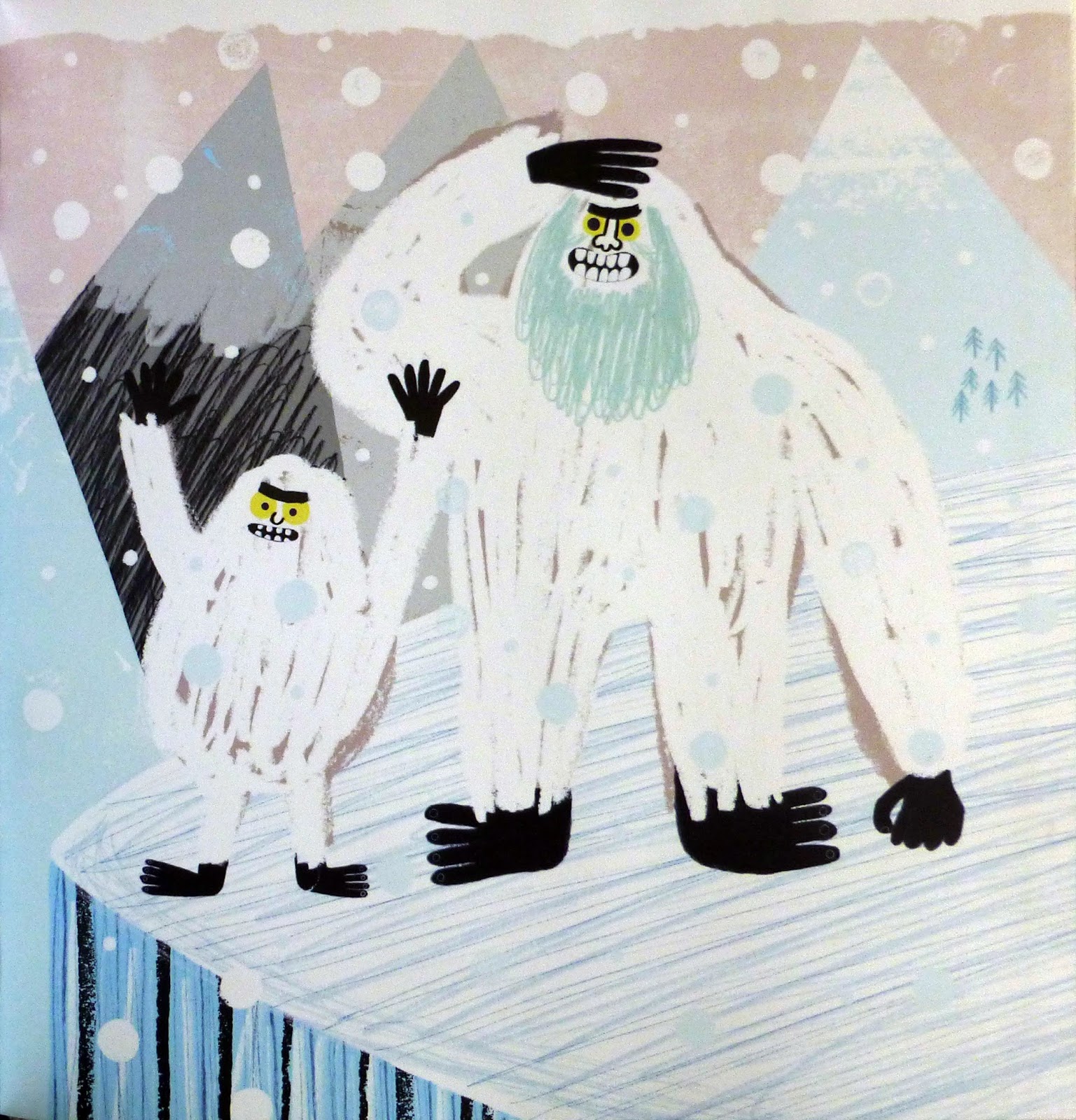
One creature for each letter, illustrated with big, bold mixed-media spreads, some of which are quite charming, but most of which would not satisfy my childhood craving for “accurate” detail.  The creatures represent a smattering from diverse parts of the world and a few interesting surprises.  Each is described in a single paragraph that adds a bit of personal twist and humor to the traditional mythology, such as suggesting that you share your packed lunch with the minotaur or ice cream with a yeti.  Not substantive, but cute.


[Pictures: Cover of Magnificent Magical Beasts, but I can’t tell you which of the eight artists did this piece because I already had to return the book to the library, 2016;
Yetis, mixed media by Rob Hodgson from An A to Z of Monsters and Magical Beings, 2017.]

February 20, 2015

Of Porcupineapples and Umbrellaphants

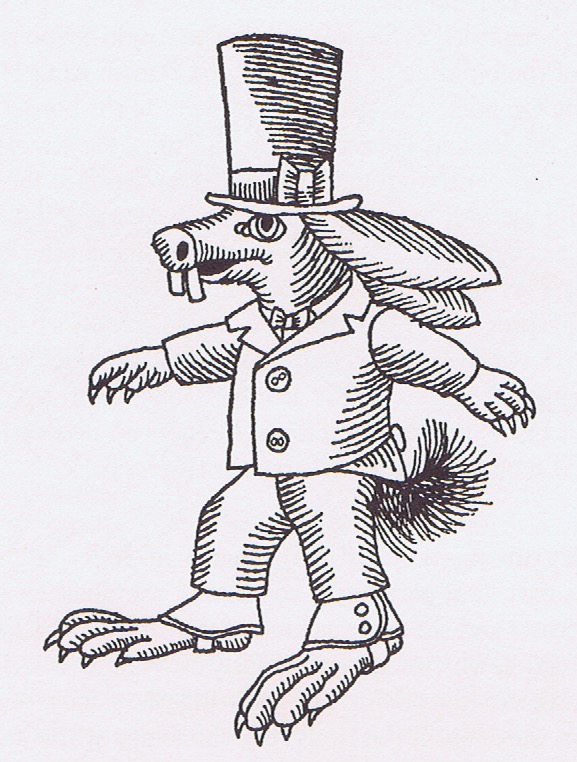
        Gustave Verbeek (b. Verbeck, 1867-1937) was a cartoonist who created a number of newspaper comic strips in the early 1900s.  Two of his strips in particular, “The Terrors of the Tiny Tads” and “The Loony Lyrics of Lulu” centered almost entirely on fantastical creatures and wordplay, two of my favorite topics.  Actually, most of his strips range from utterly random to downright disturbing, but along the way he came up with a number of amusing and clever creatures.
        Verbeek’s beasties are generally mash-ups made of words that can be blended together, for example the porcupinaeapple and the caribooklet.  I particularly like the vehicles, such as the hippopautomobile and the perambulatortoise.  Some hybrids include fantasy creatures, such as the dragonion, which is heavy on the onion and light on the dragon, and the banjogre.  But of course they’re all completely fantastical.
       However, when I came across “The Terrors of the Tiny Tads,” it was not the first time I’d encountered this sort of blended mash-up creature.  Jack Prelutsky’s  Scranimals, illustrated by Peter SĂ­s, and Behold the Bold Umbrellaphant, illustrated by Carin Berger, are collections of poems about just such hybrid critters, even including a porcupineapple.   (Verbeek had an umbrellaphant, too.)  I wonder whether Prelutsky ever encountered Verbeek’s comic strips, or whether these are simply examples of convergent evolution.  Prelutsky’s poems are definitely 
better - Verbeek’s tend toward rather random gratuitous violence (They are “terrors,” after all) - but both revel in additional puns and wordplay to go along with the fun and funny creatures.
        Perhaps one of the real values of these silly creatures is how they naturally inspire you to think up your own.  Just sitting here this morning I can’t help but start mashing words together and seeing what I get.  So far my favorites are the pelicanopener, hollyhocktopus, artichokapi, clockroach, kumquotter, helicoptermite, and capybureau.  What new and wonderful creatures can you discover?

[Pictures: Porcupineapple, drawing by Gustave Verbeek, 1907;
Fryingpanther, drawing by Verbeek, 1907;
Caribooklet, drawing by Verbeek, 1908 (Images from cartoons.osu.edu);
Hippopautomobile, drawing by Verbeek, 1905;
Banjogre, drawing by Verbeek, 1913;
Umbrellaphant, drawing by Verbeek, 1905 (Images from A Blog of Bosh).]

December 7, 2012

Creature Collections: For Young and Old

        It's high time for more reviews of books of mythical creatures.  Here's an assortment that includes introductory books for the youngest fantasy fans, through books for scholarly adults.  None of these books made it into our top tier of beloved favorites, but all have some fun or interesting traits to recommend them.  Perhaps one will be just what you were looking for!

        Magical Creatures, by Man-eating Meg and Loch Ness Lucy - With those authors, how could I resist?  The paragraphs about each creature are entertaining introductions, and the illustrations are very bright and primitive.  I wasn't crazy about the "messiness" of most of them, but a few were quite pleasing, and they had lots of details that would be fun for little kids to notice.  This is probably a great introduction for younger children.

       The Creature Catalog, Michael Berenstain - Yes, this is one of the Berenstain family of Berenstain Bears fame, and you can definitely see it in some of the illustrations, especially the werewolf, chimera, and Bigfoot.  The pictures are printed with black and white plus only one color per page, which gives the book a really dated look.  P wasn't very impressed, although oddly, one of his complaints was that it had too many "strange" creatures, which I see as a plus.  I also like the inclusion of space aliens, which most books on fantasy creatures seem to ignore.  But on the whole, I didn't find myself getting excited about either the illustrations or the written paragraphs describing the creatures.

        The Monstrous Book of Monsters, Hamilton, Bitskoff, Duddle, and Mansfield.  This is a large book in the style of the -ology books, lavish in the matter of pop-ups, fold-outs, and flaps.  Unfortunately it is also lavish in fart humor and poop jokes.  Although it was not without some clever ideas (I liked the idea of the flow chart for disposal of captured monsters), for the most part I felt that this book was counting on gross-out laughs to substitute for creativity.  My captive nine-year-old boy, presumably well in the target audience, liked it better than I did, but not as well as he's liked others.

        The Magic of Mythical Creatures, Colleayn Mastin, illustrated by Jan Sovak - On the plus side, some different creatures such as the Iceworm and Qallupilluk, and detailed traditional-style illustrations with interesting watercolor backgrounds.  On the minus side, I don't get the impression this book was very well proofread.  The punctuation and grammar make it a bit hard to read in places.  Fun fact: only female griffins have wings; males have spikes on each side instead.

        The Mythic Bestiary, by Tony Allan - Not for young kids, this volume includes the sexual aspect of many monsters and assorted nudity (the mermaid doesn't have the seashell bikini or carefully placed tresses, for example).  For young adults or adults, however, it's a really nice reference work with a pretty comprehensive selection from world myths and legends, and lots of illustrations from different sources.

        The Book of Imaginary Beings, by Jorge Luis Borges, illustrated by Peter SĂ­s - This is not a book intended for children, and it's unlikely to interest them.  There are 116 entries in which Borges allows his erudition and lit-speak free rein to the point of stream-of-consciousness.  The Cheshire Cat and the Kilkenny Cats are lumped together in a single entry without benefit of segue, and proper monsters like harpies and hippogriffs share space with a "metaphysical animal" that's a thought experiment from a philosophical treatise.  I really enjoy the breadth of the creatures' origins, and that they're culled from modern literature as well as classical mythologies, but…  when it comes right down to it, a number of these "imaginary beings" really don't qualify as proper mythical creatures at all.  The illustrations by SĂ­s are not plentiful.  (The front cover flap calls them drawings, but they look like stippled etchings to me.)  But fans of Borges's style and his wonderful free-range musings will get a kick out of his sly humor, including a few inventions of his own slipped in amongst the classical references.

[Pictures: cover of Magical Creatures, paintings by Lucy Clibbon, written by Meg Clibbon, 2006;
cover of Monstrous Book of Monsters, by Hamilton, Duddle, and Bitskoff, 2011;
Western Dragon, etching(?) by Peter SĂ­s, from The Book of Imaginary Beings by Jorge Luis Borges, 2005.]

July 13, 2012

Creature Collections: a Touch of Science

        Imaginary creatures aren't always pure fantasy.  Sometimes the imagination can be grounded in science to come up with some interesting new ways to think about the amazing possibilities of life.  Here are a few books and videos that do just that.

        Myths and Monsters: Secrets Revealed, by Katie Edwards, illustrated by Simon Mendez - Each mythical creature featured in this book is paired with a real animal that may have spawned or contributed to the myth.  The "realistic" illustrations of both imagined and actual creatures are colorful and quite beautiful.  T really liked the animal pairings, some of which were new and surprising to her. P also gave this book a thumbs-up.

        After Man, by Dougal Dixon - This book is written and illustrated in the style of an old-fashioned naturalist's notebook - picture Audubon, for example - but set on Earth 50 million years into the future when humans are gone from the scene and other animals have evolved in new and different directions.  Extensive notes explain the underpinnings of evolution with which Dixon worked, keeping all his fantastic creatures firmly founded on actual scientific principles.  (P liked the hornheads best.  I like the rabbucks - after all, they look a lot like my favorite llamas and vicunas.)

        Inspired by Dixon's book, there is a thirteen-part television documentary miniseries called The Future is Wild that imagines how life on Earth could evolve over 200 million years after the disappearance of humans.  Each 25-minute episode focuses on a particular ecosystem at a particular time period, and profiles a few species and their interrelations within that ecosystem.  It's based on science, but imagines entirely new creatures.  We enjoyed it a lot, although P tended to take it a little personally when some member of his favorite species came to an untimely end.  (And can I just say… octopuses taking the primates' place as most intelligent life on Earth is awesome!)

        Expedition, by Wayne D. Barlowe - Another naturalist's notebook, this time from an A.D.2358 expedition to a planet called Darwin IV.  Notable for making its alien species truly alien (no humanoids-with-funny-head-ridges here!), this book is a tour-de-force of imagination operating within the rules of science as we understand them.  But it's not particularly intended for children, and P and T found it much too dense to be enjoyable.  And I found that many of the creatures looked more like a Surrealist's nightmare than functioning life forms, which made it hard to get my head around.  (It just goes to show that when you want to tell a story sometimes it doesn't pay to get too creative!)

        However, inspired by Barlowe's book, there is a 94-minute television program called Alien Planet that shows a pair of robot probes exploring the life forms of Darwin IV.  Perhaps because it had to reach a more general audience, this version focusses on the more accessible of Barlowe's creations, and also has a plot of sorts, in the journey and challenges faced by the two probes.  P and T got quite attached to the probes as characters, but perhaps not so attached to the various hypothetical life forms.  Still, it's a neat way to get sci-fi with a solid grounding in the way real scientists think.

[Pictures: Reedstilt and pfrit
Wakka and strick, both illustrations by Dougal Dixon from After Man, 1981.]

February 21, 2012

Creature Collections: Artists' Edition

        I was originally thinking of this post as "Field Guides, Part III," until it occurred to me that not one of these particular selections is in faux field guide format.  I've
broadened my scope to something more accurately called "Creature Collections."  And this time around I've found three creature collections that are really built around their illustrations, featuring the work of famous artists and illustrators.

       A Book of Dragons, Hosie and Leonard Baskin - This book presents twenty dragonoids, each with a page of text and a page of picture in Leonard Baskin's intense, inky style.  The creatures are pulled from various sources, from Tiamat to Smaug, with a couple of whimsical oddities such as the Fold-up Dragon.  If you insist on traditional versions you might not appreciate Baskin's personal interpretation of some of these dragons, but I enjoyed them for variety's sake.

       Eric Carle's Dragons Dragons and other creatures that never were, compiled by Laura Whipple - This is an anthology of poems about various mythical
creatures, each illustrated with Carle's bright collages.  It includes a nice selection of beasts, and I plan to feature some of the poems in an upcoming post.  Carle's depictions are more bold than mystical, but I think they generally capture the spirit well.  But I did have one reservation: how do people feel about Ganesh included as a "creature that never was"?  Is this different from including, say, ancient Egyptian animal-headed gods?

       Here Be Dragons: A Fantastic Bestiary, Ariane Delacampagne and Christian Delacampagne - Not a children's book, this is intended as a scholarly work on the symbolism, psychology, and cultural uses of fantastic beasts through history and around the world.  I didn't even read the whole thing cover to cover.  But I did look at all the pictures, and I enjoyed them thoroughly, too.  Older children especially would probably find lots to interest them in this oversized volume with its beautiful photographs of works of art from a broad range of cultures.  There are carvings, paintings, mosaics, pottery, textiles, and more, all showing fantastic beasts, divided up into five categories: unicorns, human-headed animals, animal-headed humans, flying quadrupeds, and dragons.  It's a beautiful tribute to the strange and marvelous workings of the human imagination.

        Do you know of any other fantastic bestiaries illustrated by noted or notable artists?  If so, I'd love to hear about them.

[Pictures: cover of A Book of Dragons, painting by Leonard Baskin, published 1985;
dragon from Dragons, Dragons, mixed media and collage by Eric Carle, published 2004;
creatures from a manuscript of Marco Polo's Book of Marvels, c. 1410, reproduced in Here by Dragons.]

July 22, 2011

More Field Guides (Part II)

        Back in November I listed a selection of Field Guides to the Creatures of Fantasy, but since then I keep finding more, so it's time for a supplementary list.  Some of these focus more on the myths and legends, while some make more of a pretense of non-fiction.  Some focus on traditional "information," while some are newly imagined, but they're all great celebrations of the fauna of the human imagination.

     The Book of Dragons & Other Mythical Beasts, by Joseph Nigg.  A nice collection of critters from all around the world.  And any book that includes the Bishop Fish has got to be good.
     How to Raise and Keep a Dragon, by Edward Topsell (i.e. Joseph Nigg).  This is a cute "non-fiction" style book, right up P and T's alley as they pretend to raise pet dragons of their own.  P points out that there aren't any other books quite like this,
and T says the only thing she doesn't like about it is that she can't really buy a dragon.  Myself, I think the concept of dragons is ruined when they become mere pets, but this is still a fun book.
     Bestiary, by Jonathan Hunt.  As its subtitle says, An Illuminated Alphabet of Medieval Beasts.  P really likes this one, somewhat to my surprise, since it's got less "information" than some.  What it does have are large illustrations set in attractive medieval-style borders, and a mix of animals that includes some more unusual ones in order to fill out the letters of the alphabet.
     Arthur Spiderwick's Field Guide to the Fantastical World Around You, by Tony DiTerlizzi and Holly Black.  This is based on the Spiderwick Chronicles series, which never really caught on at our house, so some of the "information" is fairly specific to those stories.  Neverthless, this has great illustrations and lots of fun tidbits of imagination that make it enjoyable to look at independent of the tie-in.
     The Essential Worldwide Monster Guide, by Linda Ashman.  This is actually a book of humorous poems about thirteen mythological creatures from around the world.  Several of the monsters were new to me, which is always fun, but despite the title there was very little actual information about each monster.
     Dragons: A Natural History, by Karl Shuker.  This book is good for slightly older children, at least eight or nine, I'd say, since it's a bit more scholarly.  I really liked the format of information about various dragonoids intermixed with legends from around the world.  Quite a few of the legends were previously unknown to me [and gave me all kinds of interesting ideas].  I also liked that the illustrations were gathered from all sorts of historical sources, from medieval illuminated documents, to antique photographs, to artifacts from around the world.  On the other hand, P and T seemed to like this one less than I did.


        I'm sure I'll have more to add to my growing list eventually, and until then, Enjoy!

[Pictures: cover of Bestiary by Jonathan Hunt, Simon & Schuster, 1998;
cover of Dragons: a Natural History by Karl Shuker, Simon & Schuster, 1995.]

November 12, 2010

Field Guides to the Creatures of Fantasy

        Earlier this year my son P declared his intention of being a cryptozoologist when he grows up.  I'm pretty sure he views the job more as fiction than as science, but in any case I thought it was an admirable aspiration for an eight-year-old.  It also got me thinking about what a great branch of fantasy cryptozoology can be.  At P's instigation we've been combing the library for all sorts of books about mythological and fantastic creatures - but not just stories that involve these creatures.  No, P likes the trappings of science.  He wants field guides, histories, descriptions of attributes… in short, he likes "non-fiction" books about fictional creatures.  And we've found quite a number of excellent ones, too.
        First and foremost on the list have to be the Dragonology books and Monsterology "by" Dr. Ernest Drake.  There's a whole series of "Ology" books, and not only are they fabulous, but they must have been so much fun to create that I go giddy with envy at the thought of it.  (P and T's other favorite is Wizardology.)  The Ernest Drake books have proven successful enough that  Candlewick Press have spun them out into all sorts of additional volumes, including The Dragonology Handbook, Drake's Comprehensive Compendium of Dragonology, several books that come with model kits, and a series of novels, The Dragonology Chronicles.  All of these books maintain a veneer of history and science that adds to the fun.  I was particularly impressed with the Homework assignments in The Dragonology Handbook.  They're cleverly designed so that everything a child is instructed to do involves researching and working with actual facts, including lessons in geography, history, food chains, and the Mohs mineral hardness scale, all seamlessly integrated into Drake's assertions about dragons.  And of course the books are beautifully made, with gorgeous illustrations, lots of flaps and envelopes to explore, and a nice faux-singed finish on the edges of the pages.    T especially commends the "specimens" of unicorn hair, dragon skin, and so on in Monsterology.  We all highly recommend these books for any lover of fantasy cryptozoology.  (They aren't cheap books, but we've checked many of them out of the library, and been able to pick up a couple at library book sales.  But I'd say it's worth it to splurge on your favorite.)
        The Ology books are by no means the only ones in the game, however.  This is a genre that's been quite trendy recently.  Isn't it wonderful when fashion actually coincides with your own tastes?  Here are our reviews of a few others that we've checked out at our house.
        Life-Size Dragons by John Grant and Fred Gambino.  Personally, I don't agree with this book's vision of the origin and science of dragons, and wasn't crazy about the computer-style illustrations… but P loved them, and the poster printed on the inside of the book-wrapper sealed the deal for him - he bought this book with birthday money.  The poster adorns his bedroom wall.
        Mythical Beasts by Katie Torpie and David Deen.  This is a Groovy Tube Book, and while its content is a serviceable if uninspired introduction to various mythological beasts of the world (with an emphasis on Greek mythology), its real claim to niftiness is that it comes with a board game and a collection of fifteen small plastic models of beasties, from a gorgon to la chupacabra.  These models (along with all the others T and P have collected - and made for themselves from polymer clay) have recently found habitats all over the house, so that everywhere I look I'm liable to come face to face with a miniature dragon, chimera, or roc.
        The Discovery of Dragons by Graeme Base.  Again, gorgeous illustrations, and witty short tales in the form of facsimile letters describing the discovery of each species of dragon.  P found it a little short on scientific details, but the rest of us enjoyed it.  (I guess the satirical "scholarly" introductions were a bit over the eight-year-old heads.)
         Fantastic Beasts and Where to Find Them by J.K. Rowling.  We like this mainly because of the Hogwarts connection.  It lists plenty of interesting creatures and displays Rowling's usual wit, but on pure cryptozoological handbook basis, it wouldn't be able to beat some of the fancier, more lavishly illustrated competition in the field.  (But I do also have to commend it for having been written and published to raise money for the Comic Relief charity.  As far as I'm concerned, anything that combines mythical beasts and making the world a better place has got to be pretty good!)
        Gruesome Guide to World Monsters by Judy Sierra.  This book is aimed at older children or perhaps adults with its ĂĽber-hip graffiti-like mixed media illustrations and gleefully bloodthirsty descriptions of each monster's modus operandi.  While I liked that the creatures represented folklore from all around the world, for my taste the book had too much of an emphasis on ghosts and bogeymen, fantasy I don't happen to care at all about.  P and T (who were 7 at the time we checked it out from the library) found it somewhat too scary for enjoyment.
        A Field Guide to Monsters: Google-Eyed Wart Floppers, Shadow-Casters, Toe-Eaters, and Other Creatures by Johan Olander.  This is another book that must have been fun to make.  Like the Ology books it includes facsimiles of sketches, pages from journals, and other alleged evidence regarding its monsters.  In this case, however, the monsters are not classics of folklore but are all imagined by the author.  Many of them are quite silly, as for example the Balloonster that P & T thought was highly amusing.  Some were a bit creepier than the kids could enjoy.  Its general tone seems calculated to amuse adults more than children.
        A Practical Guide to Dragons by Lisa Trumbauer and A Practical Guide to Monsters by Nina Hess.  These books are from the Dungeons & Dragons game world.  They feature the standard D&D monsters and the D&D types of metallic and chromatic dragons with their various affiliations of good and evil, which seems rather constraining to me.  Be that as it may, they are fun field-guide-style collections of creatures.  T really likes the detailed illustrations of lairs, and P especially commends the boxes with facts for each creature such as habitat, diet, weapons, and your best defense.  Both of them give these books an enthusiastic thumbs-up despite not even being aware that they're spin-offs from a game.
        Aahhh, what a wonderful richness of field guides is available to the fantasy cryptozoologist now!  And what a delightful trend their publication is for one who wrote many a fantasy field guide in her youth.  I envy the authors and illustrators who have made these books, and I'm grateful that my family and I have been able to enjoy them.  Why not nip over to your local library and check out a few?


        P.S. Here's a supplement: More Field Guides (Part II).

[Picture: Fiery Dragon, rubber block print by AEGN, 2010 (sold out).]