Showing posts with label Arisia'19: Stale Writing Advice. Show all posts

September 5, 2017

Non-Violet Prose

        I’ve just been reading some advice on editing one’s own work, and as editing my own work is something I do a lot of, I’m always happy to see tips from anyone who has some wisdom to share on the topic.  This particular article, however, hit one of my buttons so hard that I simply can’t help myself from gnashing my teeth and making this post a rant.
        Editing tip number one is “trim the fat,” which is certainly good advice, because it’s pretty much a truism: you should trim that which should be trimmed.  The question, obviously, is not whether one should trim fat, but how to know the fat from the meat.  In answer, the article’s author uses an example attributed to George Saunders.  Imagine I’ve written the line “Jack came into the room in a huff and sat heavily upon the old green recliner.” What are we trying to say with this line? The only information relevant to the plot is that Jack is now in the room, and possibly that he is sitting (unless of course the recliner is somehow important). So we can’t trim the entire sentence, because Jack’s arrival might be important. But do we care how he came into the room? Or how he sat on the chair? Or the details surrounding the chair?  How much better is this sentence: “Jack entered the room.”
        That’s a question: How much better is this sentence?  And the answer the author provides is: Clean and simple. Saunders refers to his hypothetical as “Hemingwayesque” in its brevity and simplicity.  But my answer is emphatically the opposite.  “Jack entered the room” is a stupid, useless sentence.  If that’s all the author’s going to give me, the entire novel may as well read “Jack entered the room.  Jack shot Jill.  Jack felt bad.  Jack developed an alcohol dependency.  The End”  Clean and simple!  Such brevity!  Such complete lack of interest or engagement.  Of course I care if Jack was in a huff!  Of course I want to know about the old green recliner.  That old green recliner tells us an enormous amount about where Jack is and what world he lives in, and if we happen to know that the recliner is Jack’s own chair, it begins to tell us quite a bit about Jack himself, too.
        It’s true that in our hypothetical single sentence example, we don’t know what else the author has already told us.  If I can learn about Jack’s mood through his actions or what he says, then perhaps the huff is trimmable fat.  If I’ve already heard the description of the room and its furniture so that I can picture Jack there in my imagination, then perhaps the old green recliner is trimmable fat.  But in the absence of the rest of the hypothetical story, this advice, like so much other writing advice, assures us that all description is fat, that readers don’t want to picture a world or know a character, and that of all the elements of story (character, setting, conflict, plot, and theme) plot is the only one that isn’t fat.
        Again and again we’re told that to write descriptively is heinous sin.  (For more on this you can revisit my previous rant In Defense of Purple Prose.)  I presume that description is supposed to be bad because readers are supposed not to like it, but that is certainly not true in my experience as a reader of books I love, nor as someone who has spoken with many people, especially children, about the books they love.  It is, indeed, so far from being true that it makes me wonder whether this writing advice is even intended to make books for actual readers.  I begin to suspect that the idea is simply for all the Hemingwayesque writers to be able to sit around congratulating themselves on their Hemingwayesquity, while sneering down upon all the poor, stupid readers who simply wanted to be able to immerse themselves in a story with well-rounded characters in a deep, vivid world.
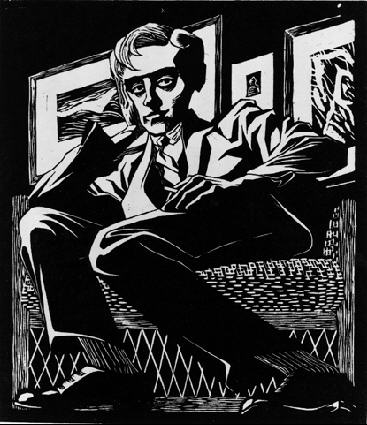
[Picture: Self Portrait in a Chair, woodcut by M.C. Escher, 1920 (Image from MCEscher.com);
Man in a Chair, woodcut by Ted Faiers, 1976 (Image from TedFaiers.com).]

May 15, 2015

The Rifle on the Wall

        Anton Chekhov (Russia, 1860-1904) famously wrote, “If you say in the first chapter that there is a rifle hanging on the wall, in the second or third chapter it absolutely must go off. If it's not going to be fired, it shouldn't be hanging there.”  He added in a variation of the same statement, “It’s wrong to make promises you don’t mean to keep.”  This principle, encouraging Occam’s razor and discouraging false foreshadowing, is generally taken as advice to writers, which it was meant to be.  But it also tells us something about ourselves as readers.  That is, we expect everything that’s mentioned to have significance.  Presumably this is because authors have trained us to expect significance.  In the mystery genre especially we’re always looking for clues and we feel wonderfully clever when we think we’ve noticed the significance of the rifle on the wall.  Of course, mystery writers want to keep us guessing.  Therefore they sprinkle the room not only with a rifle on the wall, but a couple of knives in the drawer, a brass candlestick on the mantelpiece, a pistol in the desk, and some poisoned brandy on the sideboard.  That way the rifle may never be fired after all.
        In a related effect, as readers we expect that any character given a name will be significant - or at least more significant than any nameless characters.  Again, this is simply a convention employed by writers and learned by readers.  In real life everyone has a name, of course, but a significant role in my life could easily be played by a person whose name I don’t know - and conversely, there are plenty of people to whom I’m introduced by name who then never enter my life’s story a second time.  However, while readers may have been trained by our books to expect significance from anything specifically mentioned, there may also be some innate human characteristics that are reinforcing the habit.  For one thing, we’re hardwired to look for patterns, so we want to make connections between everything that’s drawn to our attention.  Researchers discovered that if a character in a story is introduced only by name, without any further information given at the point of introduction, readers keep that name in a specially accessible part of their memory until they learn sufficient background information to slot the character properly into the framework of the story.  In other words, our brains are designed to use certain criteria to determine that some things are significant (such as proper names), and to treat significant things differently from all the other details in life that fly by (such as the people to whom we’re never introduced).
        Now back to the rifle that was never fired because in fact the crime was committed with the fireplace poker.  (Ha ha - fooled you, didn’t I?  But I told you there was a mantelpiece, so you should have deduced the poker!)  Chekhov is urging us to cut out all superfluities, and he’s quite right; everything in writing should be there for a reason.  Just remember that the reason doesn’t necessarily have to be so obvious as Chekhov implies.  I shouldn’t hang a rifle on the wall of my story for no reason at all, but that doesn’t mean it absolutely must go off.  Perhaps the rifle is there to indicate that Major Grumbacher is a man who admires and celebrates the manly arts of hunting and war.  Perhaps the rifle represents the memory of violent Grandfather Silas, whose oppressive influence hangs over the house like a shadow.  Perhaps the rifle is simply a red herring.  Perhaps the rifle is a rare and valuable piece that once belonged to Annie Oakley and will be stolen by idealistic young Charlotte as an icon to represent the achievements of women.  Perhaps taking the rifle off its display hooks reveals the lever that opens Lady Davenport’s secret wall safe behind it.  Perhaps the rifle is a stage prop from Tony Terrence’s one great success 45 years ago…  You get the idea.  By all means cover your stories’ walls with rifles, but don’t be so boring as to make them all go off!

[Pictures: Soper’s Rifle Mechanism, wood block print from The English Mechanic & Mirror of Science, 1870 (Image from Andy Brill);
German Falconer, wood block print by J. Amman, 16th century (Image from Wikimedia Commons).]

August 16, 2011

A Small Rant on Writing Advice

        A while back I read Elmore Leonard’s rules on writing, and I'm afraid it brought out all the contrarian curmudgeon in me!  It’s pretty clear Elmore Leonard wouldn’t approve my writing.  On the other hand, while I’ve never read anything of his, I don’t particularly like the writing that he holds up as a model, either.  The more the professionals tell me that if I don’t write like Steinbeck I’m no good, the more stubbornly I dismiss the whole snotty, self-satisfied lot of ‘em.  Who needs their smug “advice” anyway?  Sure, Steinbecks’s an acclaimed writer, but I don’t want to write like Steinbeck.  I wouldn’t take Steinbeckitude as a gift.  In fact, I write precisely in the hope that there will be more non-Steinbeckian books in the world.
        Please pardon my stridency and allow me to hazard here an analogy between the publishing industry and the modeling industry.  Models are undoubtedly beautiful -- they are the ones whose beauty has been officially proclaimed by the professionals, leaving the rest of us wondering whether we need to do whatever it is they do so that we, too, can be beautiful.  There are thousands of books and magazines offering us advice on how to be beautiful – use the right products, have the right hairstyle, wear the right clothes, do the right exercises... get the right plastic surgery...  But what if I don’t want to look like Gisele Bündchen (or whoever’s hot right now)?  I want to look like me, beautiful.  So where is that line between helping me be me beautiful, and trying to hector me into longing to be just like a fashion model?  Where is the line between helping me make my writing excellent and trying to hector me into thinking I have to write like Steinbeck to be publishable?
        As for Leonard’s advice, of course all his points are absolutely useful ideas to keep in mind as a sort of checklist to consider.  But I can think of exceptions to all of them.  Leonard’s over-all point, that the author should get out of the way of the story, is also very interesting and worth considering.  Certainly writing should not be self-advertising, like the way Jim Carrey acts, or jarring... but many of my favorite books are characterized by the “voice” of the narration, even when there is no narrator.  J. K. Rowling and Jane Austen are both examples of this – there is no character telling the story; the narrator is an invisible omniscient... and yet both authors provide humor and commentary in their choices of how they tell the story.  It's clear that someone is telling the story, and the personality of that invisible someone is one of the most enjoyable things about their books.
        What does all this have to do with my writing?  (Or yours?)  I admit that it may be dreadful arrogance on my part to resist so stubbornly the idea that I should mold myself to others’ advice, and my only defense is that I understand I will never be a best-seller any more than I will ever be a supermodel.  I want to be the best writer I can be – I want it badly! – but if the way to be a good writer is to write more like Steinbeck, I’m going to have to say, “No, thanks.”  I write because I have stories I want to share, and if failing to follow others’ writing advice means not so many people will ever read my stories, that makes me sad.  But I think it would be even sadder to spend my time forcing myself to tell other people’s stories in other people’s styles.

[Picture: Writing, rubber block print by AEGN, 2009.  (This piece was commissioned as the logo for a romance writers group, the Quirky Ladies.)]

July 16, 2010

In Defense of Purple Prose

        The term “Purple Prose” apparently derives from a poem by Horace in which the Roman author refers to writing that contains excessive and irrelevant description.  Horace compares such literary passages to the practice in Rome at the time of sewing patches of expensive purple cloth onto cheaper garments in the hope of being thought richer and more elegant than you really are.  Nowadays the term “purple prose” generally disparages any rather lush, descriptive writing style, and every time I see a list of Advice for Good Writing, it always seems to include the rule that one must avoid adjectives and adverbs.  But while Horace criticizes inappropriate “purple patches,” I’d bet he never said there was anything wrong with an entire toga of pure, beautiful, luxurious purple.
        All around I see “spare” writing praised and poetic writing spurned, and students told to slash all adjectives and adverbs from their work – whether excessive and irrelevant or not.  Then I, unrepentant logophile that I am, become irate and pledge once more my undying devotion to descriptive words of all persuasions.  I love every vivid, penetrating, perfect adjective.  I love adverbs passionately.  Yes, yes, I know that an overabundance of careless adverbs can make for lousy writing, but even chocolate is nauseating in excess.  The antidote to bad writing is not to eschew adverbs and adjectives, but to learn to use them well.  In short, abstinence-only writing education is both misguided and ineffectual.  That’s why I want to share the joyous news that descriptive, poetic, exuberant writing can be excellent writing - and a lot of fun, too.
        Find a passage of lush description and/or exciting action from your favorite work.  Now try rewriting it leaving out all adjectives or adverbs.  While you’re at it, leave out all those similes and descriptive dependent clauses, too.  What’s left should still include some excellent nouns and verbs, of course, and goodness knows I love nouns and verbs every bit as much as adverbs and adjectives.  (And I even love conjunctions.)  Nevertheless, I’m guessing that your beautifully written passage isn’t quite the same any more.  And if you go further and replace those verbs that seem a bit, well, purple, and strike out any nouns that aren’t really straight to the point… By now all that remains will be the white bones of a story in the cold, dry ashes of a world.
        Purple patches – the inappropriate kind, those sewn onto cheap prose in the hope that it will seem richer and more elegant than it really is – do not come from too much love of words.  Rather they are a symptom of laziness and careless profligacy.  By contrast, a true love of language, and a true love of all the evocative power and searing precision words wield, will lead to a prose of truly imperial purple.

        [Picture: Romance, rubber block print by AEGN, 2009 (sold out).  Commissioned for Penelope’s Romance Reviews.]