July 31, 2019

Portrait of the Artist with Muses

        I had just declared myself finished with all the prints for my bestiary, when I decided that the image I was using for the author just wouldn’t cut it.  The thing is, it was originally intended as a portrait of another author, and a romance author at that, and I decided I wanted something more appropriate to this work.  I wanted something that reflected the artist/author observing and recording the marvelous creatures of the Realms of Imagination.  So, hmmm… A person surrounded by all manner of wild and wacky mythical creatures… What does that remind me of?  Why, the Temptation of St Anthony, of course!  Obviously I wouldn’t show demonic creatures attacking my human, but rather human and creatures regarding each other equally with curiosity and delight.
        If you go back to the previous post and look again at Schongauer’s famous “Temptation” you will see at once that I stole one of his monsters wholesale.  The fishy thing on the left is lifted with only minor modifications and placed in the same position in my block.  I did replace its arms with wings, and I gave it scales under the influence of Michelangelo’s copy of Schongauer’s work, but I just love its trumpet schnozz, its lugubrious eye and jowls, and its wild spikes.  Another of Schongauer’s monsters also contributed: the beast on the far right provided its head and wings, and the inspiration of its tail.  Again, I switched out its arms and instead gave it legs and a pot belly.  I also made its expression much more cheerful.
        Schongauer’s is not the only “Temptation” that tempted me, however.  The malacomorph on the tree branch has its snail shell as part of my running joke of sprinkling malacomorphs throughout the entire bestiary, but I was inspired by Cranach’s frill-faced beast in embellishing its head.  (The frill in my first sketches looked more like Cranach’s, but eventually got modified with a little touch of the weird frills on Schongauer’s bottom 
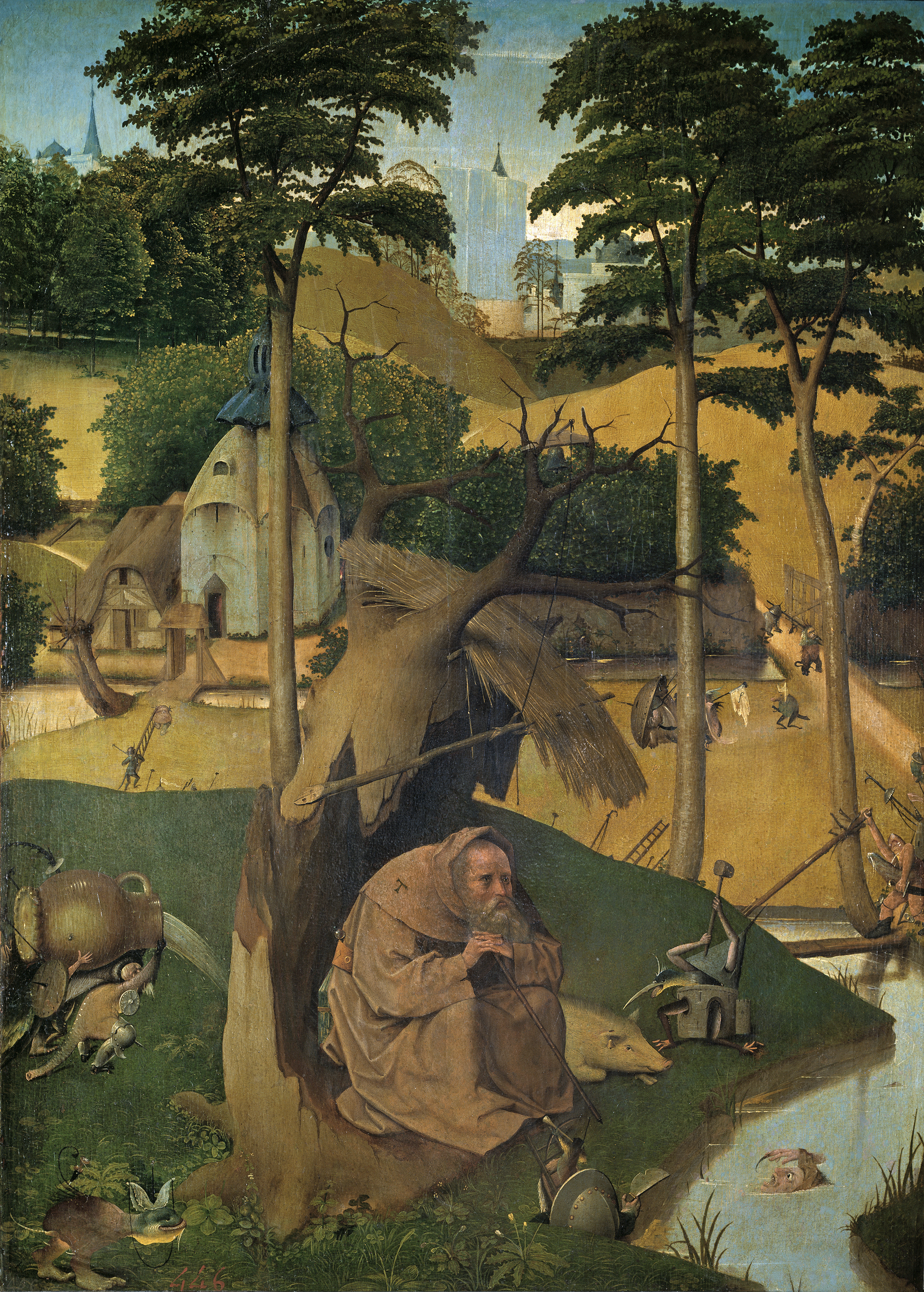
right beast.)  And finally, my bottom right monster is copied from one at the lower left of a painting by Hieronymus Bosch.  I thought it was, frankly, adorable.
        As for the “artist,” that’s a portrait of me, of course, wearing something that I hope is vaguely suggestive of a nineteenth century explorer’s khaki.
        I like to think that all these beasties are really not demons, but just misunderstood!

[Pictures: Portrait of the Artist, rubber block print by AEGN, 2019;
The Temptation of St Anthony (detail), painting by Hieronymus Bosch or a follower, c 1500-1516 (Image from Wikimedia Commons).]

July 24, 2019

Temptation of St Anthony

        Any exploration of European art history ends up providing a crash course in Catholic saints and their iconography.  Today we’re looking at the Temptation of St Anthony, and we’re looking at it because of the marvelous monsters featured therein.  According to the Golden Legend and other hagiographies, St Anthony had a number of run-ins with demons while he was hanging out in the desert.  He was tempted by demons in the form of beautiful women, tormented by demon attacks on the ground, and ambushed by demons in mid-air.  These various episodes, both separately and combined, all tend to be titled “The Temptation of St Anthony,” although I think the alternate titles “Trial” or “Tribulation” make more sense.  In any case, it was a popular subject in medieval and renaissance art.
        First up, the famous engraving by Martin Schongauer, which is probably both Schongauer’s most influential piece, and the most influential version of St  Anthony’s Temptation.  You can see why this theme would be popular: it’s just so much fun!  The demons are wacky, grotesque, dementedly creative, 
with wings and horns and tails, spikes here, fur there, scales on the other… It’s not often an artist of serious religious themes gets to let his imagination run so wild.  And there’s Anthony, just looking resigned: “Oh bother.  Demons again.”
        With Schongauer’s image as our baseline, let’s get back to the wood block prints.  Lucas Cranach the Elder’s is not as appealing a composition with its frenetic cluttering, but a close look at the individual elements provides plenty of delight.  How about the bottom monster with the head of a boar, the wings of a beetle, and the hindquarters of a lizard?  What about the frill-faced beast in the center top that looks more like a smug cat than a terrifying demon?  That does, of course, lead me to wonder to what extent the artists did intend their monsters to be frightening.  Did original viewers enjoy these prints for the frisson of fear as people today enjoy horror movies?  Or did they, like me, find the creatures as wonderful and amusing as scary?
        This epic scene by Jan Wellens de Cock is one that includes many episodes from the saint’s life in a single image.  In the middle of the bottom Anthony is being visited by a lovely noblewoman whose true identity is betrayed by her clawed foot peeking out from the hem of her gown.  The mid-air demon attack is also portrayed, in the upper left quadrant, and throughout the picture strange little imps can be seen converging on poor Anthony.  (Don’t worry; he withstands them all!)  The level of detail is quite impressive and I love the wonderful scenery as well as the monsters.  My favorite creature is the strange flying thing in the far upper left.
        And finally a smaller wood block print by Hans Weiditz which was an illustration in a book rather than the larger ones above, which were printed as individual sheets.  Again, it’s pretty busy, but the various demons have a marvelous array of features, especially the one in the lower right with a clawed duckfoot, insect wings, an arrow-pointed tongue, and a furry face.  I can’t help being most taken by the creature in the upper left, however, who pauses in his temptation of Anthony to look thoughtfully out at the viewer.  Does the artist want it to be a little more sympathetic, or are we being reminded that not all devils appear so evil?
        You may be wondering what’s the significance of all these crazy monsters.   Frankly, cool wood block prints is significance enough, but as it happens, there’s more.  As someone who, unlike the medieval and renaissance audiences of these pieces, has no fear of actual monstrous demons, but who instead enjoys fantastical creatures, these are a treasure trove of strange and marvelous beasties.  I will share in a future post something I did under their hopefully-not-too-demonic inspiration.

[Pictures: The Temptation of Saint Anthony, engraving by Martin Schongauer, 1470-5 (Image from Art Institute of Chicago);
The Temptation of Saint Anthony, woodcut by Lucas Cranach the Elder, 1506 (Image from Art Institute of Chicago);
The Temptation of Saint Anthony, woodcut by Jan Wellens de Cock, 1522 (Image from National  Gallery of Art);
The temptation of St Antony, woodcut by Hans Weiditz, c 1520-5 (Image from The British Museum).]

July 17, 2019

Herrick's Hag

The Hag is astride,
This night for to ride;
The Devill and shee together:
Through thick, and through thin,
Now out, and then in,
Though ne’r so foule be the weather.

A Thorn or a Burr
She takes for a Spurre:
With a lash of a Bramble she rides now,
Through Brakes and through Bryars,
O’re Ditches, and Mires,
She followes the Spirit that guides now.

No Beast, for his food,
Dares now range the wood;
But husht in his laire he lies lurking:
While mischiefs, by these,
On Land and on Seas,
At noone of Night are working,

The storme will arise,
And trouble the skies;
This night, and more for the wonder,
The ghost from the Tomb
Affrighted shall come,
Cal’d out by the clap of the Thunder.

        Here’s a poem by Robert Herrick (UK, 1591-1674).  I’m no expert on Herrick, but I think this seems a little unusual for him, as he’s famous for poems celebrating the joy and beauty of both the English countryside and the English young women.  He is one of the foremost poets of the carpe diem genre, author of that most famous line “Gather ye rosebuds while ye may.”  So how does a poem about a witch consorting with the devil at midnight fit into that?
        To me the tone of the poem evokes a rollicking song - I can imagine this set to foot-stomping music - that plays the fright for entertainment.  Such a galloping rhythm and rhyming couplets are now usually associated with comic poetry, and the images focus more on the wild ride than any specific evil the witch is committing.  But how was it intended and received in a world that still knew a very real and serious fear of witchcraft?  Witchcraft trials were at their peak in Europe during Herrick’s young adulthood.  When Herrick published this poem in 1648, self-proclaimed “Witchfinder General” Matthew Hopkins had just been responsible for the executions of an estimated 300 accused witches in England between 1644-1647.
        So, was this poem intended as fantasy, or as warning of true perils?  I don’t know, but of course I’ve shared it today as a fantasy poem.  Read it aloud to enjoy the rhythm, and the phrases such as “a lash of a bramble” and “husht in his lair he lies lurking.”  I particularly like the idea of the demonic thunder frightening the ghost right out of its tomb.

[Pictures: Witch and Devil riding, wood block print from the workshop of Michael Wolgemut, from the Nuremberg Chronicle, c 1493 (Image from Cornell University (Shared Shelf Commons));
Matthew Hopkins Witch Finder Generall, wood block print from The Discovery of Witches by Hopkins, 1647 (Image from The British Museum).]

July 10, 2019

Nature at Work

        Here’s a cool illustration from a medieval French manuscript.  Don’t worry, this is not an image of animal abuse; it portrays Nature, personified as a woman, sculpting a bird on her anvil.  She has already created several other animals and birds and even a man, who will be brought to life by the divine breath when she’s finished making them.  I love that Nature is dressed so elegantly (if perhaps not very practically).  I love the beautiful blue sky and the details of the smith’s tools and forge.  I love the very plain, dull earth, as if Nature’s work is only just beginning.  I also appreciate that this personification of Nature is a woman, giving some recognition and scope for female power and creativity in a culture that didn’t usually allow much.  It’s a beautiful little painting, finely detailed, luxuriantly colored, and edged with shining gold illumination.
        The illustration appears in a French manuscript from about 1405, of Le Roman de la Rose, a poem about the art of courtly love.  The Romance of the Rose was one of the most widely read books of the middle ages, especially for a secular work.  I haven’t read it, so I can’t tell you anything about how our image of Nature fits into it, but it seems to come from the second section of the poem, wherein various allegorical personages hold forth on Love.  Just for fun, here’s also a wood block print of the same scene from an edition printed in 1503.  This Nature looks less aristocratic and more like a hard-working craftswoman as she hammers her little doll-like human.  However, it makes a good demonstration of why manuscript books were considered higher quality and higher prestige than early printed books: the hand-painted illustration is clearly a much more beautiful work of art than the rather crude wood block print.

[Pictures: Personification of Nature making a bird, painting by anonymous artist from Le Roman de la Rose, 1405 (Image from The J. Paul Getty Museum);
Personification of Nature making a man, wood block print by anonymous artist from Le Roman de la Rose, 1503 (Image from Digital Library of Medieval Manuscripts).]

July 3, 2019

Apple Pie and Chow Mein

        In honor of July Fourth, let’s have a look at Margaret Chodos-Irvine’s illustrations for Apple Pie 4th of July by Janet S. Wong (2002).  Chodos-Irvine uses a variety of printmaking techniques, most of which fall into the collagraph category.  What she does differently from the collagraphs I’ve featured before, however, is to print in multiple layers with multiple “blocks” for multiple colors.  You can see how the various cut-out shapes build up the picture, not minding that they don’t fit together precisely, and how the textured patterns are printed on top of solids.  Chodos-Irvine is known for the bright, bold colors and textures of her illustrations, which come from using all manner of textured materials which she collects.  She particularly went to town with the textures and patterns in her Caldecott Honor-Winning Ella Sarah Gets Dressed (mentioned in my previous post on print-illustrated Caldecott books.)
        Chodos-Irvine has a web site with some pictures and explanations of her process and her inspirations.  (Step-by-step creation of a piece here.)  Check it out if you want to see more.  You can see that she works very messily!  This is not so surprising when she’s using so many sorts of different materials and inks at once.  She lists some forty materials that she has used in printmaking, including posterboard, textured vinyl, paper doilies, corrugated cardboard, ribbon, styrofoam…  In other words, anything you can ink up and press is fair game.  She clearly has fun with it.  Indeed, she says, “If you are going to be illustrating children’s books, you might as well be smiling, right?”
        Of course I picked today to feature Chodos-Irvine because of the July Fourth connection with the book.  It’s about a girl who doesn’t think people will want to eat Chinese food on the 4th of July - only apple pie.  But of course they do want Chinese food.  The book doesn’t preach, but I’m going to: July 4th is when we celebrate the United States of America, and you cannot, simply cannot, celebrate all that the USA has been, has stood for, and can be, without also celebrating all the immigrants of which we are composed.  (Besides, Chinese food is yummy every day of the year!)
        To those who will be celebrating tomorrow, Happy Independence Day, and remember as you cheer the fireworks and parades, that what makes America great is not hatred, oppression, and exclusion, but the possibility of an American Dream of life, liberty, and the pursuit of happiness for everyone.  The prouder we are of that ideal, the harder we have to work to make it true.

[Pictures: Chow mein in our kitchen, collagraph by Margaret Chodos-Irvine from Apple Pie 4th of July by Janet S. Wong, 2002;
printmaking materials, photos by Chodos-Irving, 2013;
Soda and potato chips, collagraph by Chodos-Irvine from Apple Pie 4th of July, 2002;
Fireworks show, collagraph by Chodos-Irvine from Apple Pie 4th of July, 2002 (Images from Margaret Chodos-Irvine.com).]

June 28, 2019

Words of the Month - Pluralia Tantum

        A plurale tantum is a word that, grammatically, appears only in the plural form and never (or, if you’re being less precise in the definition, very seldom) in the singular.  (Plurale tantum is Latin for “plural only” and its plural is pluralia tantum.)  In English, pluralia tantum are often things that occur only in sets, such as eyeglasses, or things that are always a collective, such as suds.  Still, there really isn’t any logical reason why the grammar should have to work this way.  For example, you could certainly say to the person washing dishes, “Oh, you got a sud on your nose!”  Logically this makes perfect sense, but in English it is perceived as being a humorous “error” for effect.  (See a previous post on similar linguistic humor a lá P.G. Wodehouse.)
        You can give thanks, or say “You have my thanks,” but you cannot give a single thank, even though clearly it is possible to thank someone a single time.  Or take riches.  You cannot have a single rich.  On the other hand, you can have wealth in singular only, and not many wealths.  (A word that can be grammatically single only, usually a mass noun, is a singulare tantum.)  There’s clearly no logic there.  Besides, different languages choose different words to treat this way, proving that there’s nothing intrinsic or inevitable about English’s selection.
        Other examples of pluralia tantum include alms, blues, clothes, electronics, fecesgraffiti, heebie-jeebies, heroics, hysterics, knickers, kudos, news, odds, outskirts, remains, spaghettisurroundings, and tenterhooks.  To test them out, try “Mary has lots of electronics, but Joe has only one electronic,” or “Can you believe he came to the door wearing only a clothe?” or “They lived on the northern outskirt of town,” or “Billie sang the blues, but Ethel sang only a blue or two before she quit.”
        Words that are pluralia tantum in normal conversation but which can have exceptions include trousers, pants, jeans, pajamas, and scissors.  I have seen stores advertising
“The perfect trouser for spring,” which always looks stupid and pretentious to me, but clearly works in the fashion industry.  And I would never refer to a single scissor, but I have seen it done, alas.  Amazon, for example, will sell you an 8-inch Scotch Precision Scissor.
        There are also plenty of words that are pluralia tantum in one definition, but normal in another.  Glasses is a case in point.  You can have one glass, but never for your eyesight.  Likewise, you can witness a single spectacle, but again, never for your eyesight.  You can have brains, but if you have a single brain, well… duh.
        Reggie says, “Igor sure has a lot of brains!”
        “Smart, is he?” asks Gladys.
        “No, I mean in jars.  Shelves and shelves of them.”  And this is why it’s important to know your pluralia tantum.
        
[Pictures: Rub-a-dub-dub, rubber block print by AEGN, 2002;
Princess Zita, linocut by Julia Forsyth, 2017 (Image from JuliaForsythArt on Flickr).]

June 25, 2019

Sound from the East

        Here’s a wild and amazing wood block print by Dai Zhengsheng (China, b. 1954).  Given its title, A Distant Sound from the East, I feel sure it must have deep significance, or at least a background story for its imagery, but I don’t have any information about what that might be.  Dai says, “When I am creating artwork, the starting point and the goal of expression in my work is to elucidate and clarify traditional Chinese culture and the progression of original creative power in life, by means of using direct, condensed, pure and profound woodcut language.”  Which isn’t really very helpful.  You can see if you peer closely (don’t forget that you can click the image to see it at least a bit bigger) that there are figures in the facets of the various shapes: something like a cat at the lower left, somebody reading a book in the bottom middle, figures with staves on the sides of the large central block…  The whole thing evokes the view from an airplane, and the rays of light from glowing clouds, and some sort of superhuge robot like a prism with arms and legs.  The whole thing is quite large, about three feet square (90cm) and full of densely detailed carving over the entire surface.  It’s technically very impressive, as well as being visually fascinating.  I’d love to get a look at it in person.

[Picture: A Distant Sound from the East, woodcut by Dai Zhengsheng, 1998 (Image from Ashmolean Library).]

June 21, 2019

How to Be an Artist

Gratitude first, then curiosity spurred by wonder,
Gathering beauty until it overflows.
Precision spurs precision,
Detail detail, light light.
Polishing each facet of wonder,
Place the world in a small silver setting
And present it to itself.

Pause often to let the beauty flow clear.
Hush often to hear the silence fill up with silence.
Yet never stop, for the pausing is work,
The hushing is work,
The waiting is work –
As long as it fills and overflows again.

[Picture: Small Glass Bottles, rubber reduction print by AEGN, 2017.]
Poem by AEGN, 2017.

June 18, 2019

Baumann's Block Prints

        Gustave Baumann (German-born, USA 1881-1971) is a prolific, famous printmaker with a long and successful career.  He primarily worked in color linoleum and wood block prints with multiple blocks, and I did a previous post here on his process with a six-block six-color piece.  That piece gave us a great tour of his working method, but wasn’t a piece I really loved, so today I’ve got a few of his pieces that I do love.
        First, a wonderfully detailed view of a wonderfully detailed building.  The piece is entitled “Old Munich” and my first thought is that the color palette was chosen under the inspiration of sepia-toned photographs.  However, I’m probably being anachronistic with that, since in 1905 photography and sepia-toning would presumably have seemed fairly new.  At any rate, it’s a beautiful image, with a sort of wistful, autumnal look.
        This next one also captures light wonderfully, with a masterful dappling of shadow and the hot sunlit lawn beyond the cool shade of the tree.  The little birds are not very detailed, but the very imprecision of this scene somehow contributes to that sense of looking into strong sunlight, slightly dazzled.  I can’t even figure out how many different blocks and colors Baumann has used for this piece, because the layering of colors adds so much further subtlety.  (This piece is undated, but it has the same border of little yellow dots as the piece in my previous linked post, and is signed with a similar sort of chop, so I’m guessing this one is also from around 1924.)
        And finally, a piece that at first glance looks closer to my beloved single-color block prints… But when you start to look more closely you realize that it has at least three different colors of brown ink, and possibly four or five, depending on how some of the colors were achieved.  Once again, I love the way Baumann has depicted light and shadow.  Perhaps most notable, I find the cream-colored texture on the main arch to be a delightful surprise, and an interesting contrast from the solid areas and other textures in the piece.  Everything about this is gorgeous!


[Pictures: Old Munich, color linocut by Gustave Baumann, 1905;
Live Oak, Sando Park, color woodcut by Baumann, between 1901-1934, c 1924?;
Interior of a Stable, color linocut by Baumann, 1905 (Images from Art Institute of Chicago).]